Question 21 RVR02 - Master of LT 500-1600 GRT
INLAND ONLY Two power-driven vessels are crossing within a half a mile of each other as shown in illustration D042RR below. Vessel "A" sounds one short blast on the whistle. What should Vessel "B" sound if in agreement?
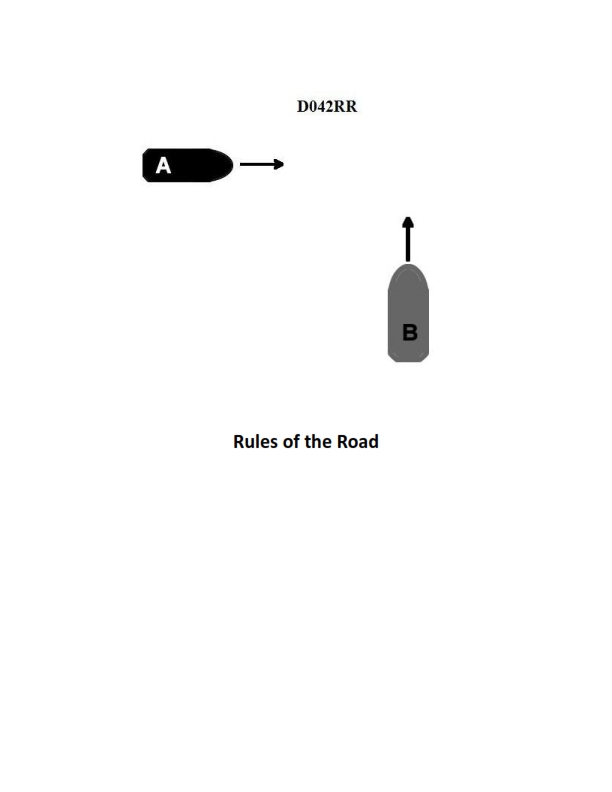
The Correct Answer is B **Explanation for Option B (Correct Answer):** This scenario is governed by the Inland Rules of Navigation (specifically Rule 34 - Maneuvering and Warning Signals). The illustration D042RR (which depicts a crossing situation where Vessel A is the stand-on vessel and Vessel B is the burdened vessel, or simply a crossing situation where vessels are exchanging signals for passing arrangement) involves power-driven vessels exchanging whistle signals when maneuvering near each other. Vessel "A" initiates the passing/crossing signal by sounding **one short blast**. Under the Inland Rules, a power-driven vessel sounds: * **One short blast** to signify: "I intend to leave you on my port side" (port-to-port passing) OR "I intend to hold my course and speed" (in a crossing situation where A is the stand-on vessel and proposing to maintain course). Vessel "B," if in agreement with Vessel A's proposal, must sound the **exact same signal** to confirm the maneuver. * Therefore, if Vessel A sounds **one short blast**, and Vessel B agrees, Vessel B must sound **one short blast** in response. This confirms the agreed-upon maneuver (e.g., A passing port-to-port, or A maintaining course and B taking action). **Why the Other Options are Incorrect:** * **A) three short blasts:** Three short blasts signal "astern propulsion." This is used when a vessel is operating its engines astern, usually to back down, slow down rapidly, or stop. It is not the correct response for agreeing to a passing signal. * **C) two short blasts:** Two short blasts signify "I intend to leave you on my starboard side" (starboard-to-starboard passing). If Vessel B sounded two short blasts in response to A's one short blast, it would be indicating disagreement (a "danger" signal is then required if B believes the proposal is unsafe, or B must signal agreement if the proposal is safe and proper). B must sound one short blast to show agreement with A's one short blast. * **D) two prolonged blasts followed by two short blasts:** This signal is the mandatory signal used by a towing vessel when towing another vessel or vessels (Rule 34(e)). It is not used as a response signal for agreeing to a maneuvering signal between two non-towing power-driven vessels.
Pass Your Coast Guard Licensing Exams!
Study offline, track your progress, and simulate real exams with the Coast Guard Exams app