Question 13 RVR02 - Master of LT 500-1600 GRT
INLAND ONLY Two power-driven vessels are meeting in a narrow channel on the Great Lakes as shown in illustration D037RR below. Vessel "A" is downbound with a following current. Vessel "A" shall do which of the following?
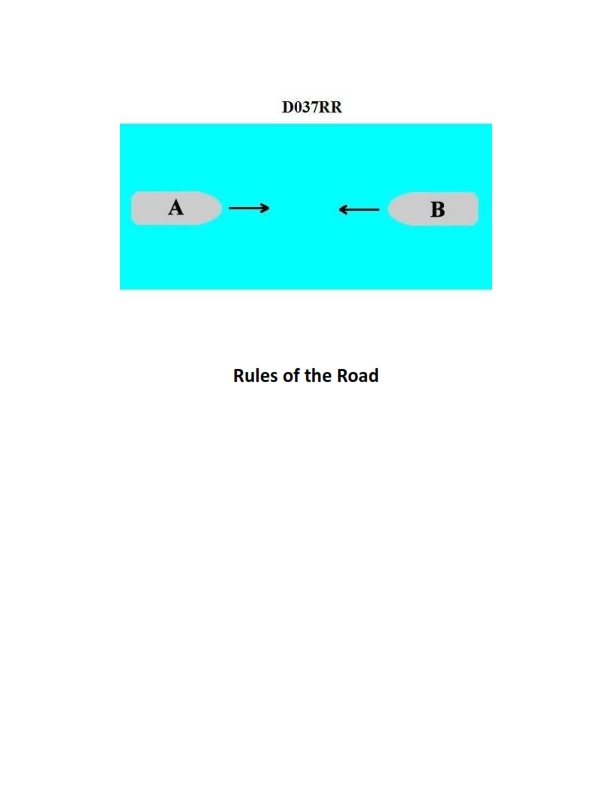
The Correct Answer is D **Explanation for Option D ("All of the above"):** The scenario described—two power-driven vessels meeting in a narrow channel on the Great Lakes, where Vessel "A" is downbound with a following current—is governed by the Inland Rules of the Road (specifically the Great Lakes Pilotage Rules, which fall under the Inland Rules). 1. **Propose the manner of passage (Option A):** Inland Rule 9(a)(ii) states that in a narrow channel, a vessel descending a river or taking advantage of a favorable current shall **propose the manner of passage** and initiate the maneuvering signals. Therefore, Vessel A must propose the passage. 2. **Initiate the maneuvering signals (Option B):** As noted above, Rule 9(a)(ii) mandates that the vessel proposing the manner of passage (Vessel A) also **initiate the maneuvering signals**. 3. **Have the right of way (Option C):** While the term "right of way" is generally avoided in favor of "stand-on vessel" or "privilege," Inland Rule 9(a)(ii) grants the vessel navigating with the current (Vessel A) the *privilege* over the vessel navigating against the current (the upbound vessel). This privilege effectively means Vessel A has the priority in determining the meeting arrangement and passage. This is the common understanding and application of Rule 9(a)(ii)—the downbound vessel with a following current is the burdened vessel (the one that proposes the maneuver) but is granted the prerogative of passage. Since Vessel A must propose the passage, initiate the signals, and is granted the privilege/priority of passage under Rule 9(a)(ii), all three components are correct. **Explanation of Incorrect Options:** * **A) Propose the manner of passage:** While correct, this option is incomplete because Vessel A must also initiate the signals and has the governing priority of passage. * **B) Initiate the maneuvering signals:** While correct, this option is incomplete as it ignores the requirement to propose the manner of passage and the resulting priority of the vessel navigating with the current. * **C) Have the right of way:** While Vessel A is granted the priority/privilege of passage under the narrow channel rule (Rule 9(a)(ii)), this option is incomplete as it misses the mandatory actions of proposing the passage and initiating signals.
Pass Your Coast Guard Licensing Exams!
Study offline, track your progress, and simulate real exams with the Coast Guard Exams app