Question 13 RVR01 - Master of Unlimited Tonnage
INLAND ONLY Two power-driven vessels are meeting in a narrow channel on the Great Lakes as shown in illustration D037RR below. Vessel "A" is downbound with a following current. Vessel "A" shall do which of the following?
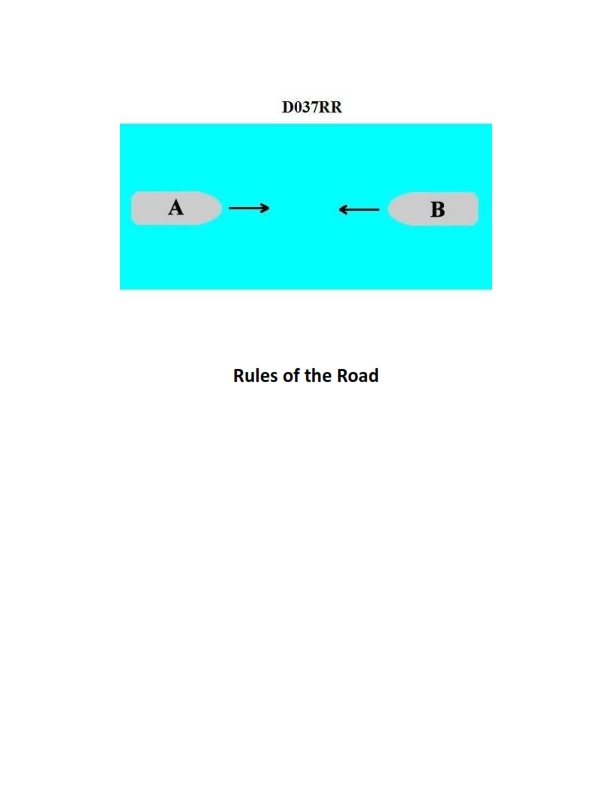
The Correct Answer is D **Explanation for Option D ("All of the above"):** The scenario describes two power-driven vessels meeting in a narrow channel on the Great Lakes, with Vessel "A" being **downbound with a following current**. This specific situation is governed by the Inland Rules of the Road, particularly Rule 9 (Narrow Channels) and the specific Annex V provisions for the Great Lakes. 1. **Propose the manner of passage (Option A):** Rule 9(a)(ii) for the Great Lakes states that a vessel **downbound with a following current** (Vessel A) "shall have the right-of-way over an upbound vessel" and "shall propose the manner of passage." Therefore, A must propose the manner of passage. 2. **Initiate the maneuvering signals (Option B):** The proposal of passage is communicated via maneuvering signals (whistle blasts) as defined by Rule 34 (Maneuvering and Warning Signals). Since Vessel A must propose the manner of passage, it must initiate the signals to communicate that proposal (e.g., one blast for port-to-port passage, two blasts for starboard-to-starboard passage). 3. **Have the right of way (Option C):** As explicitly stated in Rule 9(a)(ii) for the Great Lakes, a vessel downbound with a following current (Vessel A) "shall have the right-of-way over an upbound vessel." Since Vessel A must propose the manner of passage, initiate the signals, and has the right of way, **All of the above (D)** is the correct answer. **Explanation of Why Other Options are Incorrect (as standalone answers):** * **A) Propose the manner of passage:** While correct, this option is incomplete because Vessel A also has the right of way and must initiate the signals. * **B) Initiate the maneuvering signals:** While correct, this option is incomplete because Vessel A also has the right of way and must propose the manner of passage (the signals are just the means of proposing). * **C) Have the right of way:** While correct, this option is incomplete because Vessel A also has specific duties to propose passage and initiate signals.
Pass Your Coast Guard Licensing Exams!
Study offline, track your progress, and simulate real exams with the Coast Guard Exams app