Question 55 QMED02 - Electrician-Refrigerating Engineer
In actual applications, electrical connections associated with "R1, R2 and R3" of the transmitter to "R1, R2, and R3" of the indicators shown in figure "C" of the illustration are made by what means? Illustration EL-0092
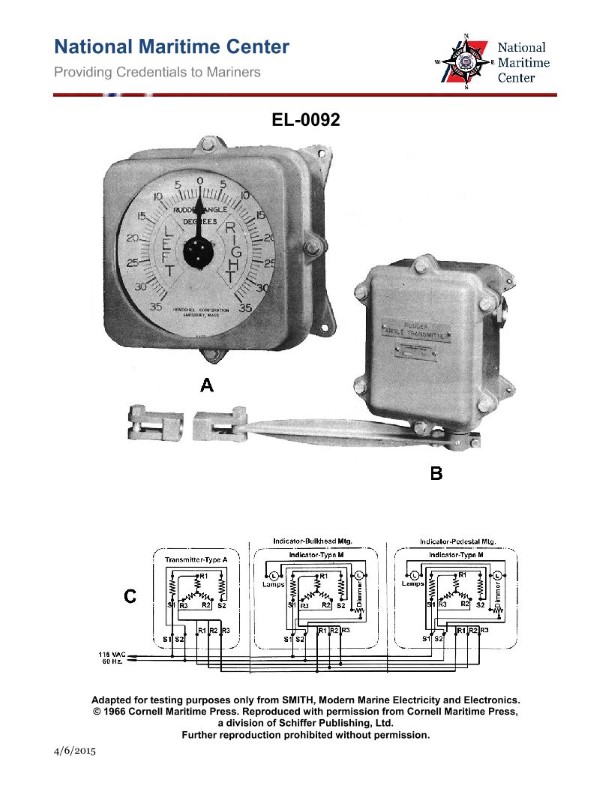
The Correct Answer is B. **Explanation of Option B (Slip Rings and Brushes):** The illustration described (figure "C" of illustration EL-0092, which typically depicts a synchro or Autosyn remote indicating system used in aircraft) shows a system where the "transmitter" (often mounted on an engine or flight control surface) needs to send positional data to the "indicator" (in the cockpit). For the system to function, the rotor of the transmitter must be free to rotate continuously or semi-continuously (e.g., following the movement of a throttle, flap, or rudder). The connections designated R1, R2, and R3 are typically the connections to the rotating element (the rotor) of the synchro transmitter, which is excited by AC power (e.g., 26 VAC or 115 VAC). To supply electrical power (R1/R2) or signal reference (R3) to a component that is continuously rotating, **slip rings and brushes** are the required mechanical means. The slip rings are concentric conductive rings mounted on the rotating shaft, and the brushes (usually spring-loaded carbon or metallic contacts) ride on these rings to maintain continuous electrical contact while allowing full rotation. **Why the other options are incorrect:** * **A) Spliced and taped connections:** Splicing and taping are fixed wiring methods. If applied to a rotating component, the wires would twist, break, or short out after very little movement. They are suitable only for static connections. * **C) Soldered contacts:** Soldered contacts create a permanent, rigid electrical connection. Like splicing, they cannot accommodate the continuous rotary motion required between the fixed frame (stator leads) and the moving element (rotor leads) of the transmitter. * **D) Solderless crimp-on connectors:** While modern aviation heavily uses crimp connectors for reliable wiring terminations, these connectors are used to attach wires to fixed terminals. They are a static connection method and cannot facilitate continuous rotational movement between two parts.
Pass Your Coast Guard Licensing Exams!
Study offline, track your progress, and simulate real exams with the Coast Guard Exams app