Question 49 QMED02 - Electrician-Refrigerating Engineer
The discharge capacity of the axial piston hydraulic pump, shown in the illustration, is _______. Illustration GS-0058
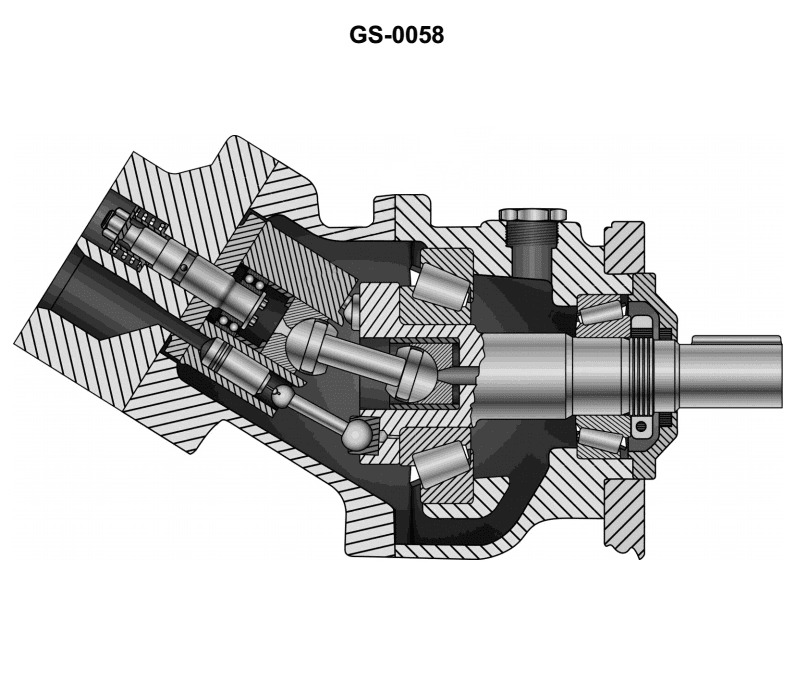
The Correct Answer is B **Explanation for Option B (Correct Answer):** The illustration (GS-0058, depicting a common type of axial piston pump) shows a **bent-axis type** axial piston pump. In this design, the cylinder block and the drive shaft are connected via a universal joint, and the angle ($\alpha$) between the cylinder block axis and the drive shaft axis is the key determinant of the pump's displacement (discharge capacity per revolution). If this angle ($\alpha$) is mechanically fixed (i.e., the pump is designed with a specific, non-adjustable housing/yoke angle), the volume of fluid displaced per stroke of the piston, and therefore the total discharge capacity per revolution, is **fixed** by this predetermined pump housing angle. **Why other options are incorrect:** * **A) variable set by angle determined by operator:** This would describe a **variable displacement** pump. While bent-axis pumps *can* be designed to be variable (by allowing the angle $\alpha$ to change, often controlled by an actuator or operator input), the question asks about the illustrated pump's capacity in general terms, and standard or basic versions of this design often have a *fixed* housing angle. Assuming a standard, fixed-displacement configuration where the angle is structural, the capacity is fixed, not operator-variable. * **C) fixed by length of the shaft:** The length of the shaft itself does not determine the volumetric displacement. Displacement is determined by the piston area, the number of pistons, and the stroke length, which is a function of the angle ($\alpha$). * **D) variable set by adding shorter or longer cylinder block:** The discharge capacity is based on the internal volume displacement, which relies on the piston stroke (determined by the angle) and the piston bore/area. Swapping cylinder blocks (which would change the overall size and potentially the number of pistons) would change the *design* capacity, but it does not make the capacity *variable* in operation. Furthermore, the length of the cylinder block itself is not the primary factor determining displacement; the bore and stroke are.
Pass Your Coast Guard Licensing Exams!
Study offline, track your progress, and simulate real exams with the Coast Guard Exams app