Question 65 QMED01 - Junior Engineer
According to the illustrated main and auxiliary diesel engine cooling water systems diagram, which of the following heat exchangers uses high temperature fresh water (jacket water) as a source of heat? Illustration MO-0129
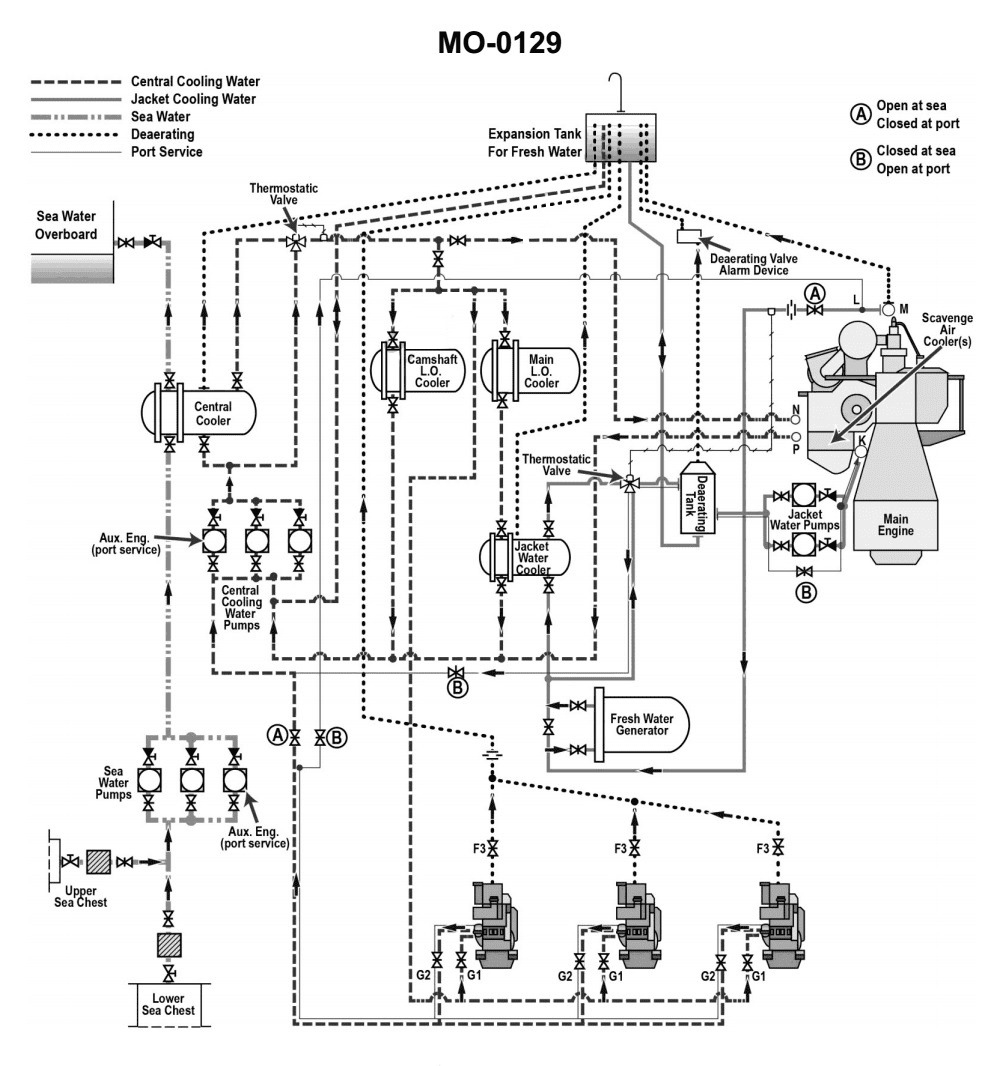
The Correct Answer is C ### **Explanation for Option C (Correct)** **Fresh water generator (evaporator):** A fresh water generator (FWG) is designed to produce potable or technical water by evaporating seawater under vacuum. To make the seawater boil (evaporate) at low temperatures (typically around 40°C to 70°C, depending on the design and vacuum level), a heat source is required. On most marine diesel engines, the most convenient, reliable, and available source of waste heat is the **High Temperature (HT) fresh water** loop (also known as jacket water or main engine cooling water). This jacket water exits the engine cylinder jackets at a temperature usually between $80^{\circ}\text{C}$ and $95^{\circ}\text{C}$, making it ideal for heating the seawater inside the FWG's evaporator section. ### **Explanation for Incorrect Options** **A) Camshaft lube oil cooler:** This heat exchanger removes heat from the camshaft lubricating oil. The cooling medium used is typically **Low Temperature (LT) fresh water** (auxiliary cooling water), not the high-temperature jacket water, because the purpose is to *cool* the oil, not heat it. **B) Scavenge air cooler(s):** These heat exchangers are located after the turbocharger and their primary function is to drastically reduce the temperature of the combustion air (scavenge air) before it enters the cylinders. This cooling is crucial for increasing the air density and engine efficiency. The cooling medium is almost universally **Low Temperature (LT) fresh water** or, in some cases, direct seawater, as the jacket water temperature is far too high to effectively cool the scavenge air. **D) Jacket water cooler:** This is the main heat exchanger responsible for cooling the High Temperature (HT) jacket water circuit itself. It transfers the heat absorbed by the jacket water (from the engine) into the **Low Temperature (LT) fresh water** circuit, which is then usually cooled by seawater. Therefore, the jacket water cooler *gives off* heat, it does not use the HT jacket water as a source of heat for another process.
Pass Your Coast Guard Licensing Exams!
Study offline, track your progress, and simulate real exams with the Coast Guard Exams app