Question 16 QMED01 - Junior Engineer
Which of the following statements correctly describes the construction of the close coupled sanitary pump shown in the illustration? Illustration GS-0070
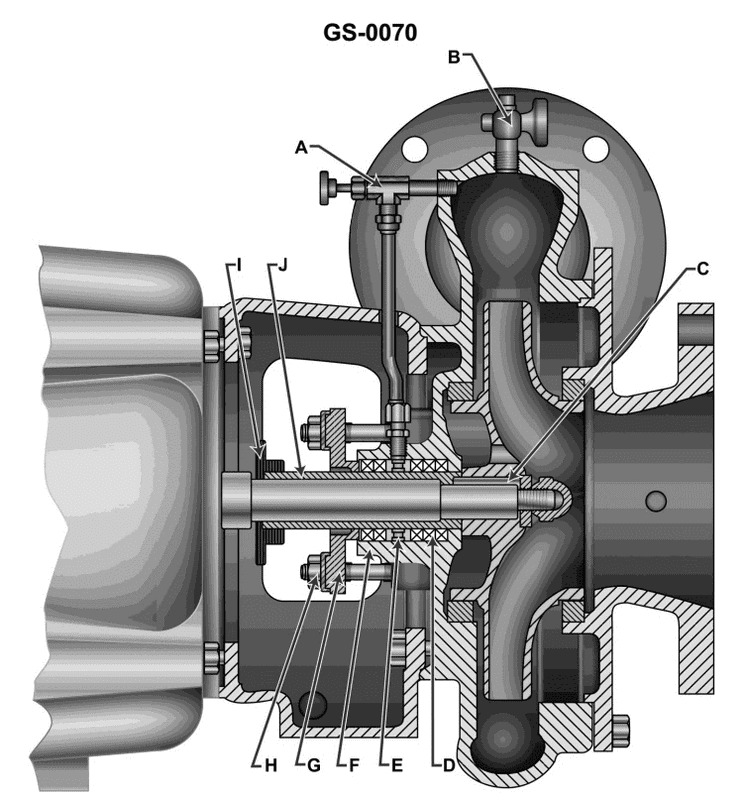
The Correct Answer is A **Explanation for Option A (Correct Answer):** Option A states, "The pump and motor have a common shaft." This is the defining characteristic of a close-coupled sanitary pump (also known as a motor-mounted or frame-mounted pump). In this design, the motor shaft is extended, and the impeller is mounted directly onto this shaft. This eliminates the need for a separate coupling, pump bearing frame, and alignment procedures, making the unit compact, economical, and easier to maintain, which is ideal for sanitary applications. **Explanation for Incorrect Options:** **B) The pump housing and motor frame provide for radial adjustment of the shaft coupling.** This is incorrect because a close-coupled pump does not use a separate shaft coupling. The impeller is mounted directly onto the motor shaft, making alignment features like radial adjustment unnecessary. Radial adjustment is typically associated with flexible couplings used in separately mounted (pedestal or frame-mounted) pump designs. **C) The pump impeller is classified as double suction.** While some large centrifugal pumps use double-suction impellers for balancing thrust and handling high flow rates, close-coupled sanitary pumps (like those typically shown in illustrations for this purpose) usually employ **single-suction** open or semi-open impellers. The double-suction feature is not a defining or universal characteristic of this specific pump construction type. **D) The pump suction and discharge connections are made with screwed pipe fittings.** This is incorrect, especially for sanitary applications. Sanitary pumps (used in food, beverage, or pharmaceutical industries) require quick-disconnect, easy-to-clean fittings that eliminate crevices where bacteria can accumulate. Therefore, they universally use sanitary clamp connections (e.g., Tri-Clamp) or occasionally flanged connections, rather than standard screwed pipe fittings (which are difficult to clean and sanitize).
Pass Your Coast Guard Licensing Exams!
Study offline, track your progress, and simulate real exams with the Coast Guard Exams app