Question 10 OSV02 - Mate - Offshore Supply Vessels
BOTH INTERNATIONAL & INLAND Vessel "A" is overtaking vessel "B" as shown in illustration D017RR below. Vessel "B" should do which of the following?
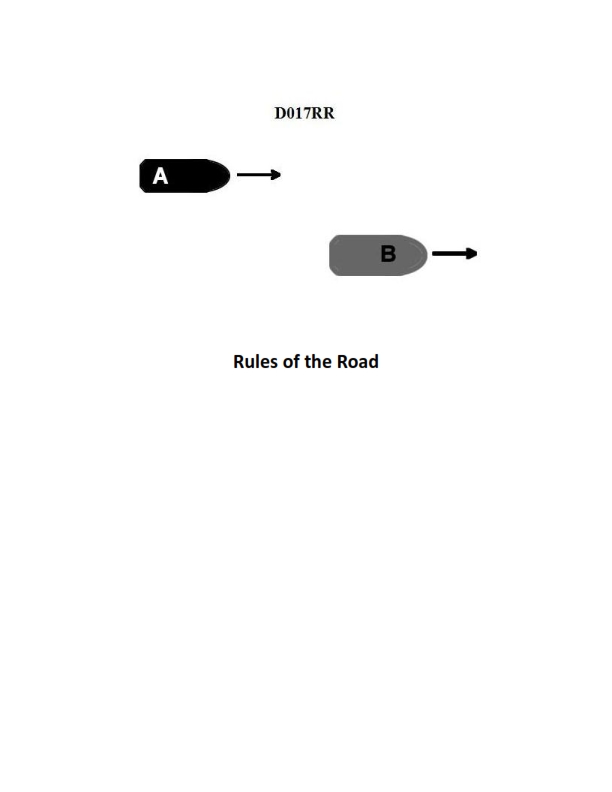
The Correct Answer is B **Explanation for Option B (Correct Answer):** This scenario is governed by the International Regulations for Preventing Collisions at Sea (COLREGs), specifically Rule 13 (Overtaking) and Rule 17 (Action by Stand-on Vessel). 1. **Rule 13 (Overtaking):** Establishes that the vessel being overtaken (Vessel B in this case) is the **Stand-on Vessel** and the vessel overtaking (Vessel A) is the **Give-way Vessel**. The overtaking vessel must keep clear of the vessel being overtaken. 2. **Rule 17 (Action by Stand-on Vessel):** Stipulates that the Stand-on Vessel (Vessel B) "shall keep her course and speed." This provides the Give-way Vessel (Vessel A) with the necessary stable parameters to safely execute the passing maneuver and keep clear. Therefore, Vessel B must maintain her current course and speed. **Explanation for Incorrect Options:** * **A) should slow down until vessel "A" has passed:** This is incorrect. Changing speed (slowing down) would violate Rule 17. By changing speed, Vessel B creates uncertainty for Vessel A, making it harder for Vessel A to determine the relative motion and safely pass. * **C) may steer various courses and vessel "A" must keep clear:** This is incorrect. Changing course would violate Rule 17. The Stand-on vessel must maintain a predictable course and speed. Allowing Vessel B to steer "various courses" would directly contradict the fundamental principle of collision avoidance, which requires the stand-on vessel to maintain predictability. * **D) should change course to the right:** This is incorrect. While changing course to the right might seem helpful, it is a change in course and therefore violates the requirement for the stand-on vessel to maintain course and speed (Rule 17). Only in the immediate approach of a collision (when collision cannot be avoided by the action of the give-way vessel alone) is the stand-on vessel allowed, and then required, to take action (which typically involves turning to starboard/right for maximum effect, Rule 17(b)). However, in a normal overtaking situation, Vessel B's primary duty is to hold course and speed.
Pass Your Coast Guard Licensing Exams!
Study offline, track your progress, and simulate real exams with the Coast Guard Exams app