Question 44 OSV01 - Master/Chief Mate - Offshore Supply Vessels
BOTH INTERNATIONAL & INLAND Two power-driven vessels are crossing as shown in illustration D042RR below. Vessel "A" sounds three short blasts on the whistle. What is the meaning of this signal?
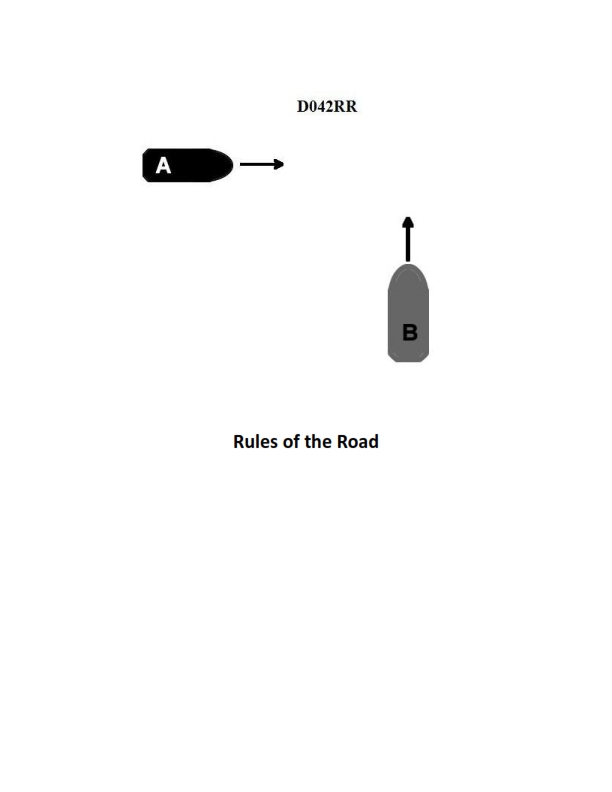
The Correct Answer is D 1. **Explanation for Option D (Vessel "A" is backing engines):** According to both the International Regulations for Preventing Collisions at Sea (COLREGs) and the Inland Rules (Rule 34), a power-driven vessel operating in sight of another vessel uses specific whistle signals to indicate maneuvers. Three short blasts means: "My engines are going astern (backing engines)." This is a clear signal that Vessel "A" is slowing down, stopping, or reversing its direction of movement. 2. **Explanation of Incorrect Options:** * **A) Vessel "A" intends to hold course and speed:** A vessel does not typically use a whistle signal specifically to state intent to hold course and speed unless it is responding to another vessel's action or is indicating that it is the Stand-on vessel in a restricted visibility situation (which requires different signals). Maneuver signals (like one, two, or three blasts) always indicate an *action* being taken, not passive intent to hold status quo. * **B) Vessel "A" is sounding a signal of doubt:** A signal of doubt or confusion (called the "danger signal") consists of five or more short and rapid blasts, not three short blasts. * **C) Vessel "A" proposes to cross ahead of the other vessel:** A proposal to cross ahead (which would involve altering course to starboard to pass port-to-port) would be indicated by one short blast ("I am altering my course to starboard"). A proposal to pass to port (starboard-to-starboard) would be two short blasts.
Pass Your Coast Guard Licensing Exams!
Study offline, track your progress, and simulate real exams with the Coast Guard Exams app