Question 28 OSV01 - Master/Chief Mate - Offshore Supply Vessels
INLAND ONLY Vessels "A" and "B" are meeting on a river as shown in illustration D041RR below and will pass 1/4 mile apart. Which is one of the lights on vessel "B" that you will see if you are on vessel "A"?
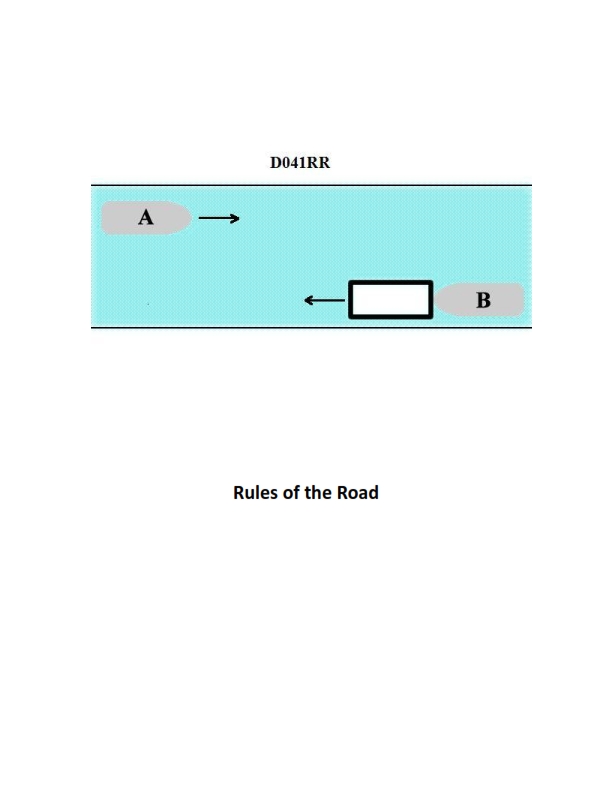
The Correct Answer is C ### Why Option C ("special flashing light") is correct: Vessel "B" is shown in the illustration (D041RR, which typically depicts two vessels meeting and passing on the Western Rivers or an area where the Inland Rules apply) as a descending power-driven vessel maneuvering to pass under the Western Rivers Rules (or equivalent Inland Rules). The Inland Navigation Rules (Rule 24(a)(i) concerning towing lights and lights for certain vessels, and Rule 24(d) concerning the special flashing light) specify that a vessel pushing ahead or towing alongside (which Vessel B appears to be doing, potentially pushing a tow) on the Western Rivers or where the application is specified, must exhibit a **special flashing light** in addition to the masthead lights, sidelights, and sternlight. This light is visible from ahead and astern over an arc of the horizon of 225 degrees, mounted on the forward part of the tow, and flashes at a rate of 50 to 70 flashes per minute. Since Vessel A is meeting Vessel B ahead, the special flashing light (located on the front of the tow being pushed) would be clearly visible to Vessel A. ### Why the other options are incorrect: **A) yellow towing light:** The yellow towing light (a second masthead light exhibited astern of the white masthead lights) is only required for vessels **towing astern**. Vessel B appears to be either pushing ahead or towing alongside, in which case the yellow towing light is **not** displayed. Furthermore, Vessel A is meeting Vessel B head-on (passing 1/4 mile apart), and towing lights are generally visible primarily from the stern quadrant, though this is debated in some contexts; however, the primary reason is that Vessel B is likely pushing ahead, not towing astern. **B) red sidelight:** The red sidelight covers the port (left) side of the vessel (112.5 degrees). If Vessels A and B are passing 1/4 mile apart in a head-on or nearly head-on meeting situation, they would likely be passing port-to-port. In a typical port-to-port passing situation, Vessel A would see the **green** sidelight (starboard side) of Vessel B, not the red sidelight. If they were passing starboard-to-starboard, Vessel A would see the red sidelight, but based on typical passing conventions, and seeing only the bow lights/masthead lights, the red sidelight is not guaranteed to be visible; the special flashing light on the forward tow is a certainty for Inland pushing operations. **D) All of the above:** Since options A and B are incorrect, option D cannot be correct.
Pass Your Coast Guard Licensing Exams!
Study offline, track your progress, and simulate real exams with the Coast Guard Exams app