Question 10 ONC06 - Master LT 100 GRT
BOTH INTERNATIONAL & INLAND Vessel "A" is overtaking vessel "B" as shown in illustration D017RR below. Vessel "B" should do which of the following?
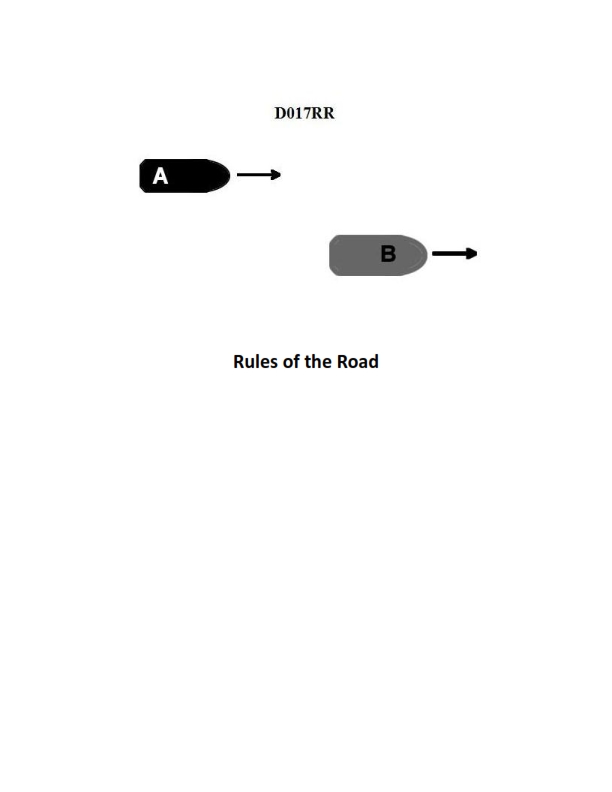
The Correct Answer is B **Explanation for B (Correct Answer):** The scenario described—Vessel "A" (the overtaking vessel) overtaking Vessel "B" (the vessel being overtaken)—is governed by Rule 13 (Overtaking) of the International Regulations for Preventing Collisions at Sea (COLREGs), which applies equally to both International and Inland waters (as Inland Rules generally mirror or incorporate COLREGs Rule 13). Rule 13(d) explicitly states: "No subsequent alteration of the bearing between the two vessels shall make the overtaking vessel a power-driven vessel crossing ahead within the meaning of these Rules or relieve her of the duty of keeping clear until she is finally past and clear." More importantly, Rule 17 (Action by Vessel B in a Crossing, Meeting, or Overtaking situation) dictates the duties of the stand-on vessel (which Vessel B is in an overtaking situation, as she is the vessel being overtaken). Rule 17(a)(ii) states: "The latter vessel [the stand-on vessel] shall keep her course and speed." Therefore, Vessel "B" (the vessel being overtaken) is the stand-on vessel and **should hold her course and speed**. **Explanation of Incorrect Options:** * **A) should slow down until vessel "A" has passed:** This is incorrect. The stand-on vessel (Vessel B) must maintain course and speed to allow the give-way vessel (Vessel A) to execute its maneuver successfully, unless a collision cannot be avoided by the sole action of the give-way vessel (Rule 17(b)). Slowing down or stopping introduces uncertainty and violates the duty to maintain course and speed. * **C) may steer various courses and vessel "A" must keep clear:** This is incorrect. Rule 17(a)(ii) mandates that the stand-on vessel (Vessel B) must **keep her course and speed**. Varying the course would confuse the overtaking vessel (Vessel A) and violate the rule. Vessel A must certainly keep clear, but Vessel B still has the duty to maintain predictability. * **D) should change course to the right:** This is incorrect. Changing course voluntarily violates the rule that Vessel B must hold her course and speed. The only situation in which Vessel B should take evasive action is if it becomes apparent that Vessel A is not taking appropriate action and a collision cannot be avoided by Vessel A's actions alone (Rule 17(b)). Until that point, Vessel B must maintain course and speed.
Pass Your Coast Guard Licensing Exams!
Study offline, track your progress, and simulate real exams with the Coast Guard Exams app