Question 28 ONC04 - Mate of LT 500-1600 GRT
INLAND ONLY Vessels "A" and "B" are meeting on a river as shown in illustration D041RR below and will pass 1/4 mile apart. Which is one of the lights on vessel "B" that you will see if you are on vessel "A"?
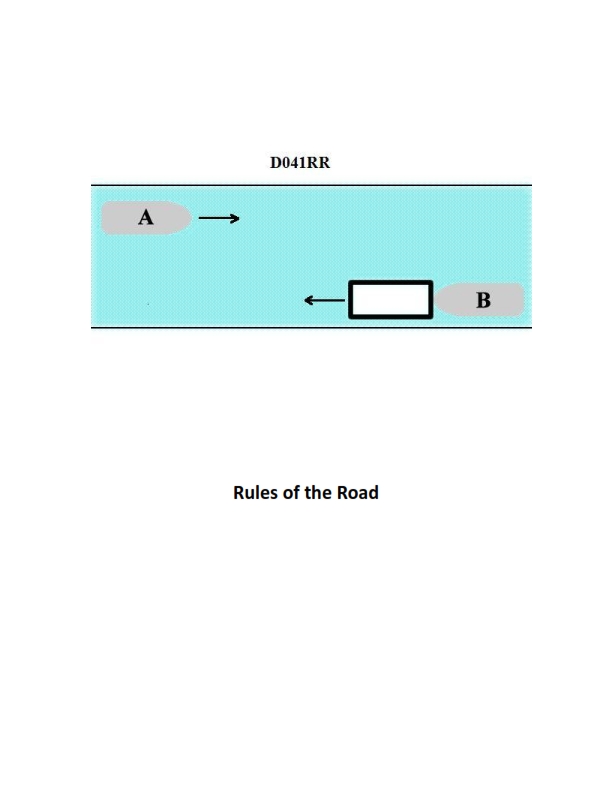
The Correct Answer is C ### Explanation for Option C (special flashing light) Vessels meeting on an inland river are frequently towboats pushing barges (a pushboat and tow). Under the Inland Navigation Rules (specifically Rule 24, relating to towing and pushing), vessels engaged in pushing ahead or towing alongside must display a **special flashing light** (a yellow light flashing between 50 and 70 times per minute) when operating on certain designated inland waters, including the Western Rivers and other specified areas. If Vessel B is a towboat pushing a tow (a very common scenario on a river), it is required to display this light. Since this light is mounted forward, near the masthead lights, it is one of the distinct lights Vessel A will clearly see when meeting Vessel B. ### Explanation for Why Other Options Are Incorrect **A) yellow towing light:** The yellow towing light (an extra stern light placed above the white stern light) is required for vessels engaged in towing (other than pushing ahead) or when the length of the tow exceeds 200 meters. This light is displayed on the stern (aft) and is meant to be seen by vessels being overtaken or approaching from the stern. Since Vessel A is **meeting** Vessel B (approaching from ahead), Vessel A will not typically see Vessel B's yellow towing light. **B) red sidelight:** When two vessels are "meeting" on a river, they are generally approaching nearly head-on. The standard procedure for meeting on inland waters is to pass port-to-port. If Vessel B is following the standard port-to-port passing arrangement, Vessel A will see Vessel B's **green sidelight** (starboard side) and *not* the red sidelight (port side). If Vessel A were to see the red sidelight, it would indicate that Vessel B is executing a dangerous maneuver, turning hard to port, or that they are involved in a crossing situation rather than a meeting situation. In a standard meeting situation, the green light is the expected sidelight. **D) All of the above:** Incorrect, as options A and B are unlikely or impossible to see in a standard meeting scenario.
Pass Your Coast Guard Licensing Exams!
Study offline, track your progress, and simulate real exams with the Coast Guard Exams app