Question 20 ONC04 - Mate of LT 500-1600 GRT
BOTH INTERNATIONAL & INLAND You are on Vessel "A" engaged in fishing in a narrow channel as shown in illustration D037RR below. Vessel "B" is a tanker proceeding in the channel. Vessel "B" sounds five short and rapid blasts. What action should you take?
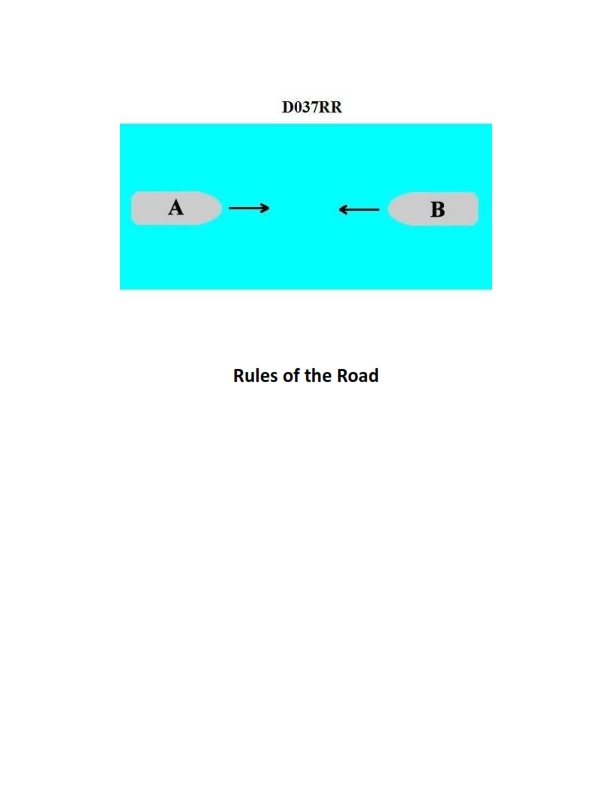
The Correct Answer is D **Explanation for D (not impede the passage of vessel "B"):** Vessel "A" is engaged in fishing, which makes it a vessel "restricted in its ability to maneuver" (or simply a fishing vessel, which has restricted maneuvering status relative to certain other vessels). The scenario takes place in a narrow channel. According to Rule 9 (Narrow Channels), a fishing vessel shall not impede the passage of any other vessel navigating within a narrow channel. Furthermore, Rule 18 (Responsibilities between Vessels) also mandates that a vessel engaged in fishing shall not impede the passage of a vessel constrained by its draft (which a large tanker, Vessel "B", often is, although Rule 9 applies most directly here). Vessel "B" sounding five short and rapid blasts is the danger signal (Rule 34(d)), indicating that Vessel "B" doubts Vessel "A's" intentions or believes there is an immediate danger of collision because Vessel "A" may be impeding its safe passage. Therefore, Vessel "A's" required action is to comply with Rule 9 and/or Rule 18 and take action to ensure it does not impede the passage of Vessel "B" (e.g., pulling nets, moving aside, or halting fishing operations temporarily). **Explanation of why other options are incorrect:** * **A) maintain course and speed:** This is incorrect. Vessel "A" is required not to impede Vessel "B". Maintaining course and speed while fishing is likely the reason Vessel "B" sounded the danger signal. Rule 9 obligates Vessel "A" to maneuver to ensure it does not impede the passage of the other vessel. * **B) not answer the whistle signals from vessel "B":** This is incorrect. While the five-blast signal is a danger signal, not a maneuvering signal requiring a direct response with maneuvering signals (like one, two, or three blasts), it is a call to action. Vessel "A" must acknowledge the implied danger by taking immediate, effective action (not impeding passage) and potentially using corresponding sound signals (e.g., if reversing, three short blasts) if maneuvering significantly. Simply ignoring the danger signal and the underlying situation is unsafe and violates the requirement not to impede passage. * **C) sound one prolonged followed by two short blasts:** This signal indicates a vessel is "not under command" (or engaged in towing), which is incorrect for a vessel engaged in fishing. Furthermore, it is not the appropriate response to the danger signal or the requirement to maneuver to avoid impeding passage.
Pass Your Coast Guard Licensing Exams!
Study offline, track your progress, and simulate real exams with the Coast Guard Exams app