Question 44 ONC03 - Master LT 500-1600 GRT
BOTH INTERNATIONAL & INLAND Two power-driven vessels are crossing as shown in illustration D042RR below. Vessel "A" sounds three short blasts on the whistle. What is the meaning of this signal?
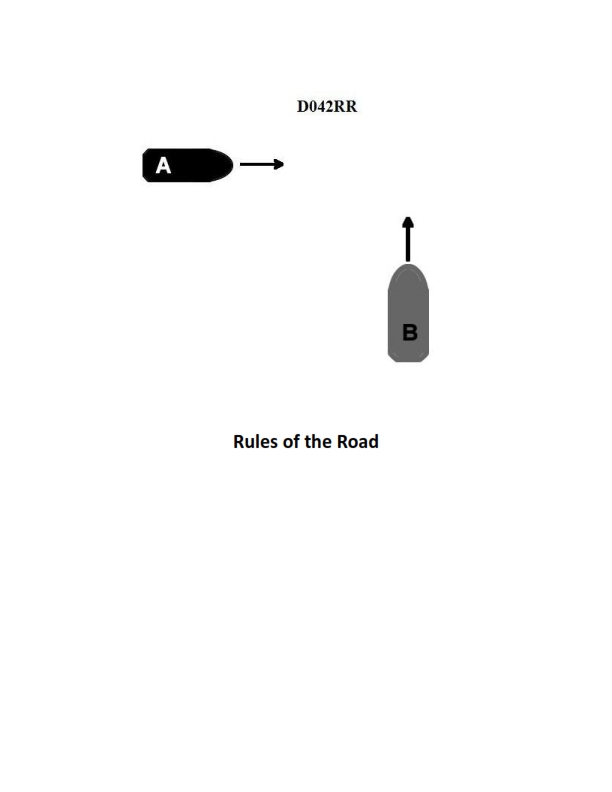
The Correct Answer is D **Explanation for Option D (Correct Answer):** According to both the International Regulations for Preventing Collisions at Sea (COLREGS, Rule 34) and the Inland Rules, a power-driven vessel using her whistle to indicate maneuvers must follow specific signals. The signal consisting of **three short blasts** (short blast defined as about one second duration) signifies that the vessel is **operating astern propulsion** (backing engines). This means Vessel "A" is either slowing down by reversing its engine or actively moving backward. **Explanation of Incorrect Options:** * **A) Vessel "A" intends to hold course and speed:** This action does not require a whistle signal in a crossing situation under the general maneuvering rules, but if a signal were given to indicate intention, a single prolonged blast (or no signal, depending on context) might be relevant, not three short blasts. Furthermore, three short blasts indicate a change in propulsion/speed. * **B) Vessel "A" is sounding a signal of doubt:** A signal of doubt, or the danger signal, consists of **at least five short blasts** given rapidly. Three short blasts have a specific maneuvering meaning. * **C) Vessel "A" proposes to cross ahead of the other vessel:** A vessel proposing to cross ahead in an internationally regulated narrow channel or fairway (or generally indicating a starboard-to-starboard passing in Inland Waters) would use **two prolonged blasts followed by one short blast** (or standard passing signals of one or two short blasts depending on the situation/rules). Three short blasts specifically indicate reversing engines.
Pass Your Coast Guard Licensing Exams!
Study offline, track your progress, and simulate real exams with the Coast Guard Exams app