Question 28 ONC02 - Second Mate/Third Mate Unlimited Tonnage
INLAND ONLY Vessels "A" and "B" are meeting on a river as shown in illustration D041RR below and will pass 1/4 mile apart. Which is one of the lights on vessel "B" that you will see if you are on vessel "A"?
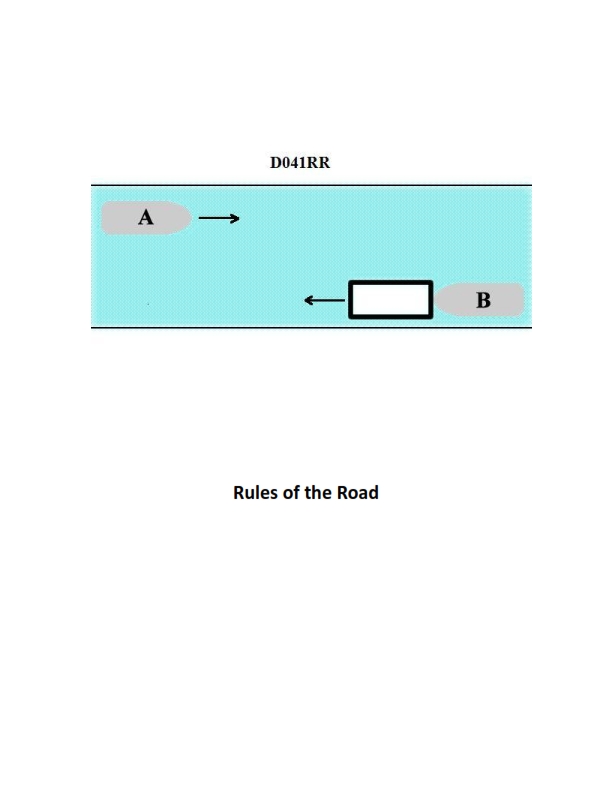
The Correct Answer is C **Explanation for Option C (special flashing light):** Vessel "B" is shown in illustration D041RR operating on a river and is described as meeting Vessel "A" and passing $1/4$ mile apart. Vessel "B" is positioned to the starboard (right) side of Vessel "A" relative to the direction of travel, and Vessel "B" is clearly displaying a series of diamond shapes, indicating a tow alongside or pushed ahead that exceeds a certain length (e.g., $200$ meters or $656$ feet). Furthermore, in Inland Rules, vessels engaged in a tow pushing ahead or alongside often utilize specific signals. However, the defining characteristic of this scenario, based on typical maritime rules and illustrations involving inland waterways (especially in the US), is that when vessels are meeting on a narrow channel or river (Inland Rules, Rule 14), they typically agree to a passing arrangement. Since they are passing $1/4$ mile apart, and given the context of river navigation illustrations where one vessel is significantly off-channel, Vessel "B" is highly likely to be a **Western Rivers vessel** (operating on rivers like the Mississippi, Ohio, etc., which have specific rules exceptions) or a vessel pushing a tow that is crossing or taking specific action. Crucially, the "special flashing light" is mandated by **Inland Rule 23(a)(ii)** for power-driven vessels when pushing ahead or towing alongside, specifically **when operating on the Western Rivers, or on waters designated by the Secretary of the Department of Homeland Security.** This light is a yellow light, located as far forward as possible, exhibiting short and rapid flashes (50-70 flashes per minute), and showing an arc of $225$ degrees, visible from right ahead to $22.5$ degrees abaft the beam on either side. Since Vessel "B" is engaged in pushing a tow on an inland river, and this light is a required forward-facing light in this context, it is a light that Vessel "A" (which is approaching from ahead) would see. **Why the other options are incorrect:** * **A) yellow towing light:** The yellow towing light (required by Rule 24 for vessels towing astern) is a fixed yellow light visible $135$ degrees astern (the stern light arc). Since Vessel "A" is approaching Vessel "B" from ahead, Vessel "A" would be in the vessel's forward arc and would not see the yellow towing light. * **B) red sidelight:** The red sidelight indicates the port (left) side of the vessel. Since Vessel "B" is passing $1/4$ mile to the starboard (right) side of Vessel "A", Vessel "A" is viewing Vessel "B$'s starboard side (and potentially the forward lights). Vessel "A" would be viewing the green sidelight, not the red sidelight, unless Vessel "B" had turned significantly to port, which is not indicated by the meeting arrangement. * **D) All of the above:** Since options A and B are incorrect, this option must also be incorrect.
Pass Your Coast Guard Licensing Exams!
Study offline, track your progress, and simulate real exams with the Coast Guard Exams app