Question 20 ONC02 - Second Mate/Third Mate Unlimited Tonnage
BOTH INTERNATIONAL & INLAND You are on Vessel "A" engaged in fishing in a narrow channel as shown in illustration D037RR below. Vessel "B" is a tanker proceeding in the channel. Vessel "B" sounds five short and rapid blasts. What action should you take?
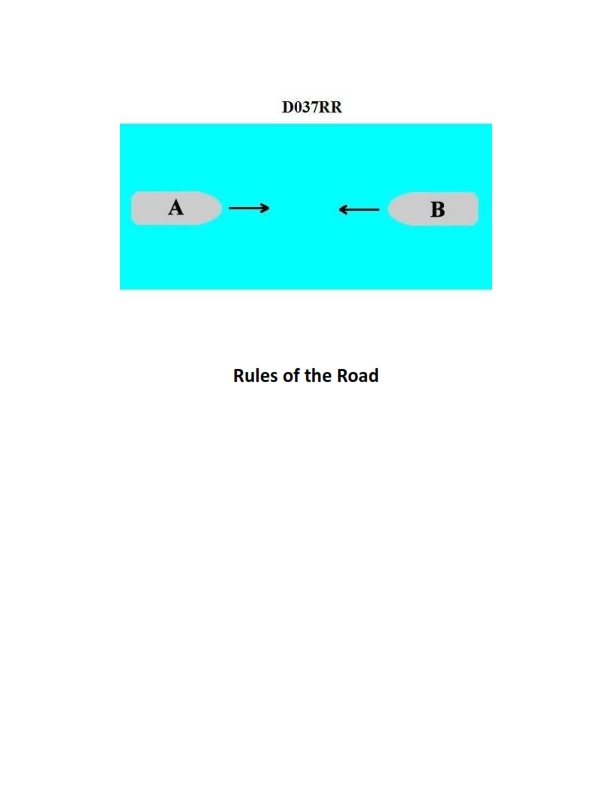
The Correct Answer is D. **Why option D ("not impede the passage of vessel "B"") is correct:** This scenario involves a vessel engaged in fishing ("A") operating in a narrow channel, and a power-driven vessel ("B," a tanker) proceeding in that channel. The COLREGs (International Regulations for Preventing Collisions at Sea) address specific situations involving narrow channels and the responsibilities of various types of vessels. 1. **Rule 9 (Narrow Channels):** Rule 9(b) states that a vessel of less than 20 meters in length or a sailing vessel shall not impede the passage of a vessel that can safely navigate only within a narrow channel or fairway. While Vessel "A" is engaged in fishing (Rule 3 defines her as a vessel restricted in her ability to maneuver), Rule 18 still generally places the responsibility on vessels that are not constrained by the channel to allow larger, channel-dependent traffic to proceed. 2. **Vessel B's Signal (Five Short Blasts):** Vessel "B" sounds five short and rapid blasts, which is the danger or doubt signal (Rule 34(d)). This signal indicates that Vessel "B" doubts Vessel "A"'s intentions, or believes Vessel "A" is taking insufficient action to maintain safety, specifically regarding Vessel "B"'s ability to safely navigate the narrow channel. 3. **Vessel A's Responsibility:** Since Vessel "A" is engaged in fishing, she is usually considered a vessel restricted in her ability to maneuver (by virtue of the gear), but in a narrow channel situation, she has a primary obligation not to impede the passage of large vessels that are confined to the channel (like a tanker). Hearing the danger signal strongly reinforces the immediate requirement for Vessel "A" to take clear and timely action to ensure Vessel "B" can pass safely. Therefore, the required action is to ensure they **do not impede the passage of vessel "B"**. **Why the other options are incorrect:** * **A) maintain course and speed:** This is incorrect. Vessel "B" has sounded the danger signal (five blasts), indicating a developing dangerous situation or doubt about Vessel "A"'s current action/inaction. Maintaining course and speed suggests complacency and ignoring the warning, which violates the fundamental principles of safe navigation (Rule 2) and the specific requirement to not impede (Rule 9). * **B) not answer the whistle signals from vessel "B":** This is incorrect. While the five-blast signal is a warning and does not typically require a specific prescribed answer signal (like a one- or two-blast maneuvering signal), it does require an action or response to resolve the danger or doubt. Ignoring the signal and taking no action would be dangerous and contrary to the spirit of the Rules. * **C) sound one prolonged followed by two short blasts:** This signal (Rule 35(e)) is the required signal for a vessel engaged in fishing or a vessel restricted in her ability to maneuver when **underway and making way** in conditions of restricted visibility. This scenario is about collision avoidance in a clear situation (whistle signals used), not restricted visibility, making this signal inappropriate for the circumstances.
Pass Your Coast Guard Licensing Exams!
Study offline, track your progress, and simulate real exams with the Coast Guard Exams app