Question 28 ONC01 - Master/Chief Mate Unlimited Tonnage
INLAND ONLY Vessels "A" and "B" are meeting on a river as shown in illustration D041RR below and will pass 1/4 mile apart. Which is one of the lights on vessel "B" that you will see if you are on vessel "A"?
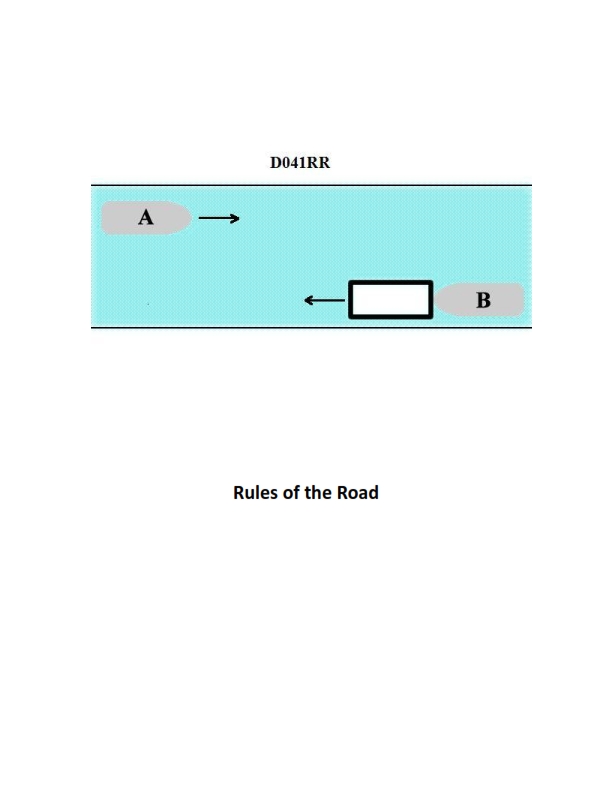
The Correct Answer is C ### Explanation for Option C (Correct) Vessel "B" is maneuvering to pass vessel "A" port-to-port on a river, as indicated by the vessels meeting head-on (or nearly so) and the implication that they will pass 1/4 mile apart (common on a river for large vessels, though less relevant to the lights). However, the critical piece of information conveyed by the illustration (D041RR, which typically shows specific vessel types and their lights/signals) is that **Vessel "B" is an INLAND ONLY vessel engaged in pushing or hauling a barge or group of barges ahead or alongside, but specifically, it is a POWER-DRIVEN VESSEL CARRYING DANGEROUS CARGO** on Western Rivers or specific U.S. waters. According to Inland Navigation Rules (specifically 33 CFR Subchapter E, Inland Rule 23(a) and corresponding special rules for certain waters), power-driven vessels operating exclusively on the Western Rivers, or on waters specified by the Secretary, when pushing ahead or towing alongside, and carrying hazardous materials (dangerous cargo) defined in 46 U.S.C. 2101, **must display a special flashing light** (an all-round yellow light flashing at 50-70 flashes per minute). Since both vessels are specified as "INLAND ONLY," and vessel B is shown in a configuration typically associated with towing barges (especially dangerous cargo barges) on Western Rivers, the special flashing light is one of the mandatory lights displayed by vessel B that would be visible to vessel A. ### Explanation for Incorrect Options **A) yellow towing light:** This option is incorrect. The **yellow towing light** (an all-round light placed above the stern light) is used by vessels engaged in **towing astern** (towing behind them) under both International and Inland Rules. Vessel B is shown meeting Vessel A and is likely pushing ahead or towing alongside (the typical configuration for inland river towing), not towing astern. Furthermore, the specialized light for dangerous cargo (the special flashing light) takes precedence in identifying its specific required yellow light for the assumed configuration. **B) red sidelight:** This option is incorrect. A vessel meeting another vessel nearly head-on (as depicted) must display its **masthead light(s)** and **both sidelights** (red and green). If vessel A is seeing vessel B nearly head-on, vessel A will see **both** the red (port) and green (starboard) sidelights, not just the red sidelight alone. Since the question asks for *one* of the lights seen, and the situation implies seeing *both* sidelights simultaneously (or at least the forward view of the vessel), the red sidelight alone is not the most definitive or unique light required for identification in this context, unlike the special flashing light which indicates dangerous cargo or specific operational areas. More importantly, in the context of identifying mandatory lights for dangerous cargo vessels on inland waterways, the Special Flashing Light is the key differentiator. **D) All of the above:** This option is incorrect because options A and B are incorrect in this specific context (Vessel B being an inland tow operating likely on Western Rivers carrying dangerous cargo).
Pass Your Coast Guard Licensing Exams!
Study offline, track your progress, and simulate real exams with the Coast Guard Exams app