Question 23 MODE02 - Assistant MODU Engineer
Under what condition would valves "4" and "5", as shown in the illustration, be closed? Illustration MO-0077
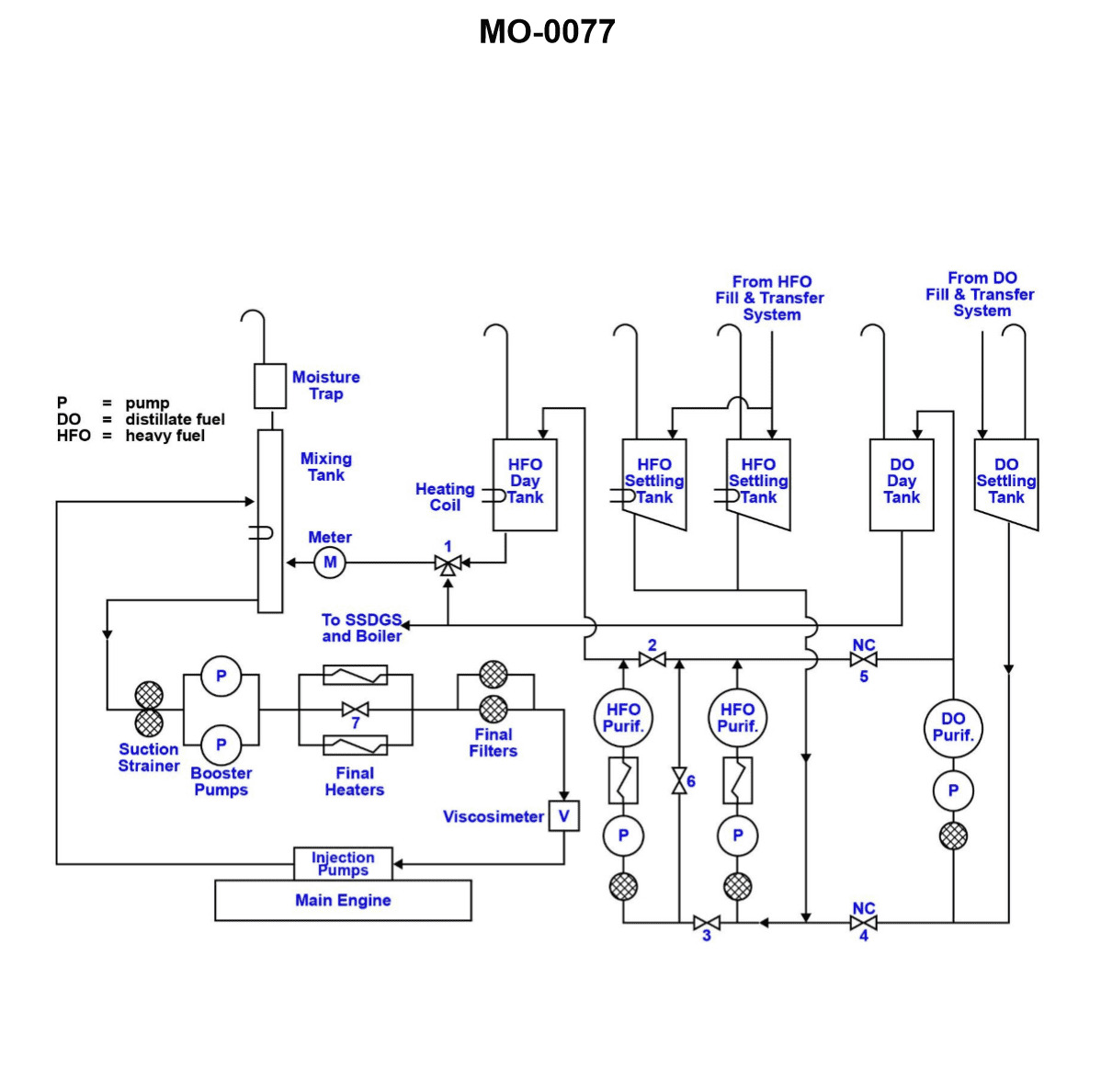
The Correct Answer is C ### Explanation for Option C (Correct) **Operating in normal mode** (C) refers to the standard, routine operation of the vessel when the main engine is running on its designated fuel (typically HFO after purification) and the auxiliary systems are supplied as intended. In a marine fuel system diagram (such as MO-0077), valves 4 and 5 almost always represent specific transfer, recirculation, or non-routine cross-connection paths. These types of valves must be kept closed during normal operation for critical reasons: 1. **Preventing Fuel Contamination:** If valves 4 and 5 allow HFO to cross into DO lines, or vice versa, they must be closed to maintain strict separation and avoid contaminating the lighter fuel. 2. **Maintaining System Integrity:** They prevent improper flow direction, accidental draining, or unauthorized system bypasses. 3. **Safety:** Non-essential bypass or cross-connection valves are routinely closed and often sealed during normal operations to ensure the correct fuel paths are maintained and system stability is guaranteed. Since "normal mode" implies that all routine supplies are functional and the non-standard paths (represented by 4 and 5) are not needed, these valves are kept closed. ### Explanation of Incorrect Options **A) Operating the main engine on DO:** If the main engine is running on Diesel Oil (DO), the fuel path supplying the DO must be open. This operation usually involves opening specific DO supply valves, and depending on where 4 and 5 are located, at least one would likely need to be open to facilitate the flow or switchover. **B) Loading the HFO bunkers:** During the loading process, the bunker filling valves and transfer lines leading into the settling tanks must be open. While valves 4 and 5 might not be the primary filling valves, they are almost certainly not both isolation valves for the entire process, meaning other valves are definitively open. **D) Operating DO purifier on HFO:** This operation requires a non-standard cross-connection to feed HFO (usually from the settling tank) into a purifier designed for DO. To achieve this flow path, the cross-connection valves (likely 4 and 5, or valves directly adjacent to them creating this bypass) would need to be *open*. This is a non-normal operation requiring valves to be open to connect the two systems.
Pass Your Coast Guard Licensing Exams!
Study offline, track your progress, and simulate real exams with the Coast Guard Exams app