Question 1 MODE02 - Assistant MODU Engineer
Which segment of the two-stroke cycle engine diagram shown in the illustration represents the exhaust event? Illustration MO-0037
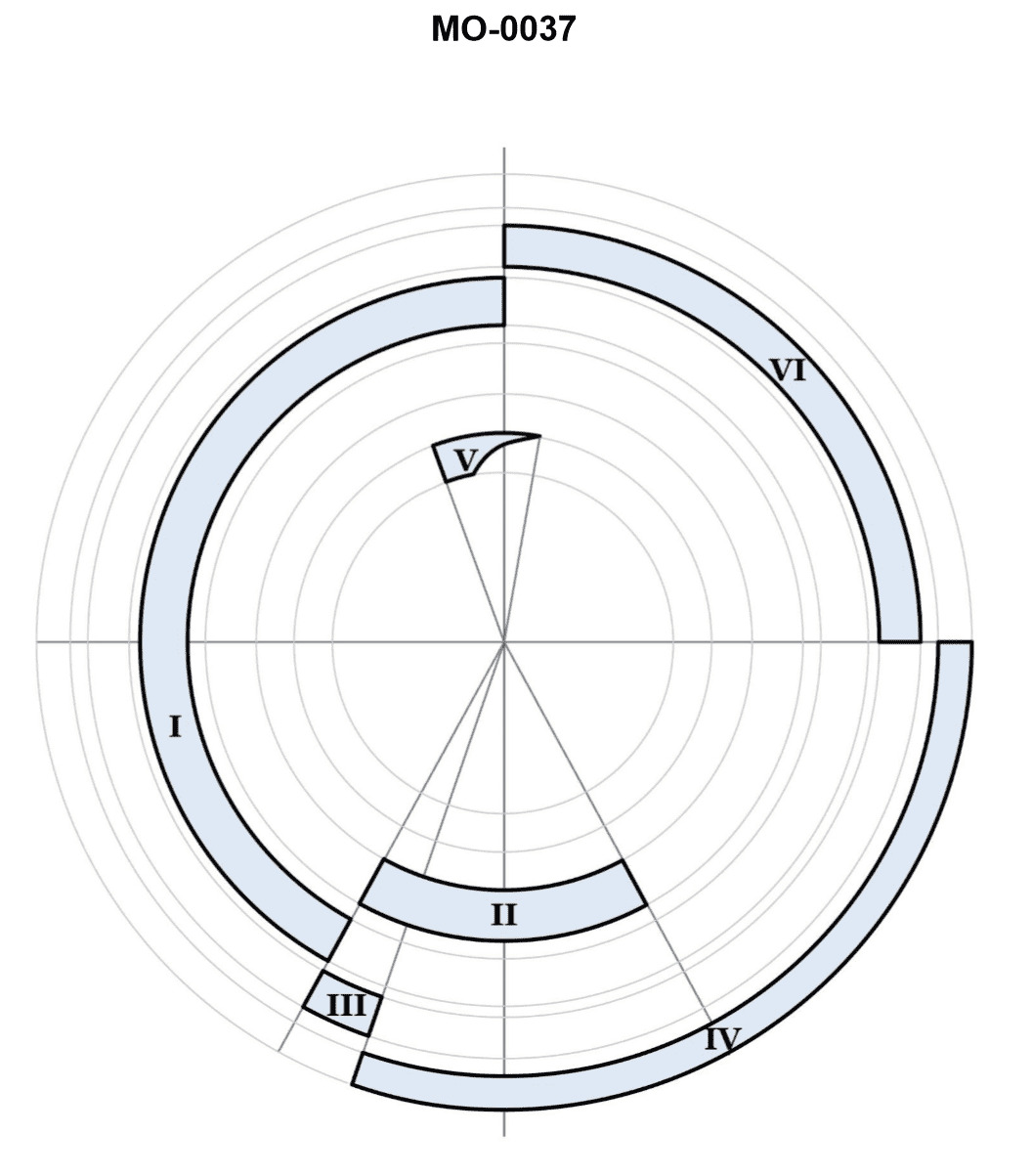
The Correct Answer is D. **Why Option D ("IV") is correct:** In a two-stroke engine, the exhaust event occurs when the piston is near the bottom dead center (BDC) and the rising exhaust port is uncovered. Segment **IV** of the cycle diagram illustrates the piston moving downward toward BDC. As the piston approaches the bottom, it uncovers the exhaust port (usually located slightly above the transfer port). This allows the burned gases (exhaust) to rapidly leave the cylinder, driven initially by cylinder pressure and then assisted by the incoming fresh charge (scavenging). Therefore, IV represents the combined blowdown and exhaust phase of the cycle. **Why the other options are incorrect:** * **A) I:** Segment **I** typically represents the compression stroke. The piston moves upward, compressing the mixture trapped above it, and simultaneously creating a vacuum/low pressure in the crankcase below. * **B) II:** Segment **II** represents the power/expansion stroke, which follows ignition (spark). The expanding, hot gases push the piston forcefully downward toward BDC. * **C) III:** Segment **III** represents the transfer/scavenging process. While the exhaust port (IV) is open, the transfer port opens, allowing the fresh fuel/air mixture (which was pre-compressed in the crankcase during the power stroke) to enter the cylinder and push out the remaining exhaust gases. This scavenging/transfer event occurs while the piston is at BDC and slightly after the exhaust event (IV) begins.
Pass Your Coast Guard Licensing Exams!
Study offline, track your progress, and simulate real exams with the Coast Guard Exams app