Question 30 MODE01 - Chief MODU Engineer
In a direct cylinder admission air starting system, once the engine begins to fire, the air starting check valve illustrated, is closed by __________. Illustration MO-0107
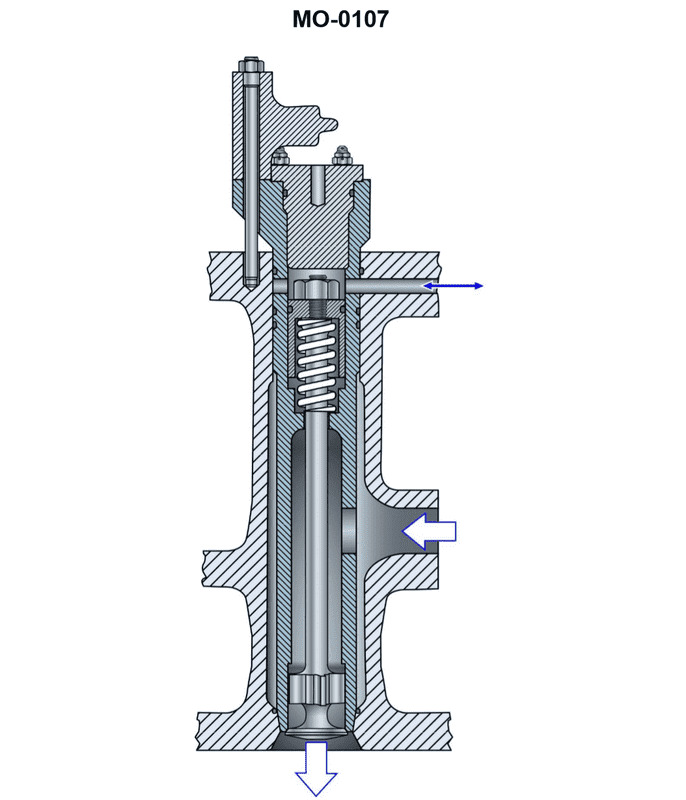
The Correct Answer is A. ### Explanation for Option A (Correct Answer) Option A, "the spring force and cylinder pressure," is correct because the air starting check valve (or automatic starting valve) in a direct cylinder admission system is designed to be pressure-activated in both directions. 1. **Spring Force:** The check valve is held closed primarily by a robust spring (often called the retaining or closing spring) when no starting air pressure is applied. This spring ensures the valve remains seated during normal engine operation (compression, power, and exhaust strokes). 2. **Cylinder Pressure:** Once the engine begins to fire, the internal combustion process generates very high pressures (combustion pressure, up to 150-200 bar) inside the cylinder during the compression and power strokes. This high pressure acts on the face of the check valve, forcing it tightly shut against the valve seat. This action is crucial for sealing the cylinder pressure and preventing blowback into the starting air manifold, thus protecting the starting air system and ensuring the engine can generate power. Both the mechanical spring force and the thermodynamic force of the cylinder pressure work together to keep the valve reliably closed after starting air is cut off and combustion begins. ### Explanation for Incorrect Options **B) a pneumatic bellows assembly:** A pneumatic bellows assembly is typically used for pressure sensing or actuation in control systems, often controlling auxiliary devices or signaling components. It is not the standard mechanism used to physically seat a robust, high-pressure check valve like the cylinder starting valve against thousands of PSI of combustion pressure. **C) a valve actuating cam:** A valve actuating cam is used on engine starting **distributors** (pilot air timing valves) to time the admission of air, or on main engine exhaust and inlet valves. The *cylinder check valve* itself (the valve mounted directly on the cylinder head) is an automatic, non-return valve. It is passive and operates based on pressure differentials, not driven mechanically by a camshaft. **D) the starting air pressure:** Starting air pressure (typically 30-40 bar) is what *opens* the valve against the spring force to admit air for starting. Once the starting air is cut off (after the engine begins firing) and combustion starts, the starting air pressure drops to zero at the valve inlet. Therefore, starting air pressure cannot be the force that closes the valve; instead, the high combustion pressure (up to 200 bar) and the spring force must overcome any residual or potential backflow pressure.
Pass Your Coast Guard Licensing Exams!
Study offline, track your progress, and simulate real exams with the Coast Guard Exams app