Question 12 LB01 - Lifeboat Operator
In illustration D012SA below, what is the mechanism that will release the tricing pendant?
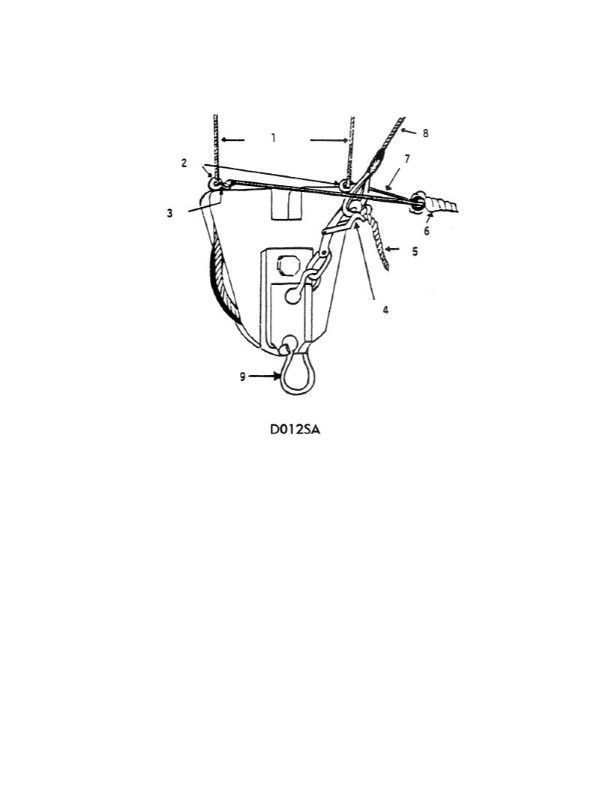
The Correct Answer is B **Explanation for Option B (The McCluny hook):** The mechanism designed to quickly and reliably release the tricing pendant in illustrations or procedures involving military/naval cargo or rescue operations (often when securing loads like lifeboats or rigid inflatable boats – RIBs) is the **McCluny hook** (also spelled McCluney or McLuney hook). The McCluny hook is a specialized, quick-release pelican hook or snap link designed to hold tension and release under load instantly when a lever or pin is pulled, ensuring the tricing pendant (which holds the object close to the ship's side) can be freed rapidly just before the object hits the water or is deployed. **Explanation for Incorrect Options:** * **A) The fore and aft gripes:** Gripes (or fore and aft gripes) are the main securing lines or chains that hold the entire boat or object in the stored position. They are not the specific, quick-release mechanism used to release the *tricing pendant* immediately prior to deployment. * **C) A 3/4" screw pin shackle:** A screw pin shackle is a standard piece of rigging used for semi-permanent connections. It requires tools and time to unscrew the pin, making it unsuitable for a quick-release mechanism required for a tricing pendant during deployment. * **D) A quick release lever:** While the McCluny hook *utilizes* a quick-release mechanism (often operated by a lever), "A quick release lever" is too generic. The specific, standardized piece of equipment used for this function in military and maritime rigging, as implied by the reference D012SA (likely a specific training or manual designation), is the **McCluny hook**.
Pass Your Coast Guard Licensing Exams!
Study offline, track your progress, and simulate real exams with the Coast Guard Exams app