Question 45 GLI08 - Limited OUPV
INLAND ONLY Vessels "A" and "B" are meeting on a river as shown in illustration D029RR below and will pass about 1/4 mile apart. Which statement is TRUE?
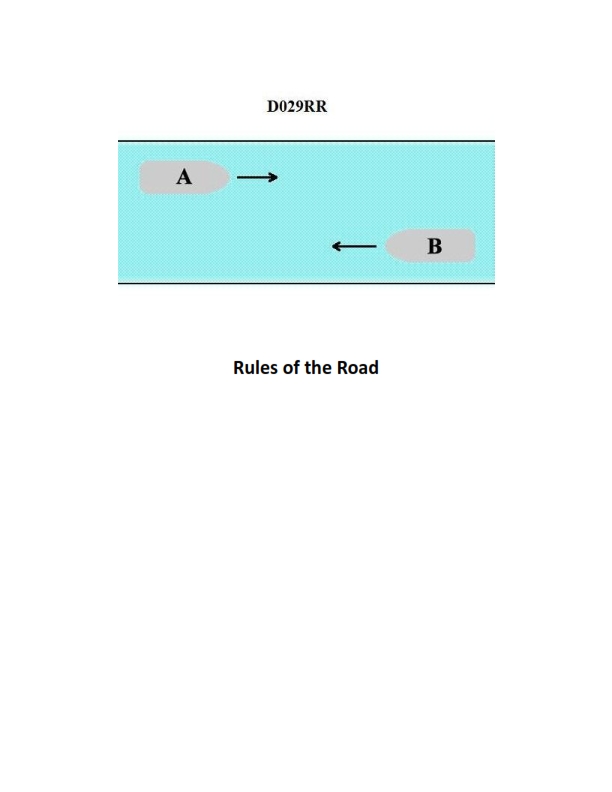
The Correct Answer is C ### Explanation for Option C (Correct) Option C states: "The vessels should exchange two blast whistle signals and pass starboard to starboard." This is correct under the Inland Navigation Rules, which govern vessel movements on U.S. rivers. 1. **Whistle Signals of Intent (Inland Rule 34):** Inland Rules require meeting vessels to signal their intent to pass. Unlike International Rules (COLREGs), which use signals to indicate action taken, Inland Rules use signals to indicate the **intended side of passing**. 2. **Two Blasts Mean Starboard-to-Starboard:** A signal of two short blasts indicates, "I intend to leave you on my starboard side." This is the signal for a starboard-to-starboard passing arrangement. 3. **Agreement is Required:** Since the vessels are meeting and require a defined method of passing (even though they are 1/4 mile apart), they must agree upon the maneuver by exchanging the appropriate signals (two blasts each, in this case), confirming the starboard-to-starboard pass. The scenario described by illustration D029RR must depict a situation where a starboard-to-starboard passing is the safest or most practical option (e.g., due to channel position, current, or a bend in the river). ### Explanation of Incorrect Options **A) Both vessels should continue on course and pass without sounding any whistle signals.** This is incorrect under Inland Rules. In a meeting situation where risk of collision exists (or where agreement is required for defining the passing arrangement), vessels must signal their intent to pass (Rule 34(a)(i)). Even with 1/4 mile separation, they must confirm the manner of passing. **B) The vessels should exchange two blast whistle signals and pass port-to-port.** This is incorrect because the signal does not match the maneuver. Two short blasts signal the intent to pass starboard-to-starboard (I intend to leave you on my starboard side). A port-to-port pass requires an exchange of **one** short blast. **D) The vessels should pass port-to-port and must sound whistle signals only if either vessel changes course.** This is incorrect. While port-to-port is the default preferred arrangement (Rule 14), Inland Rules require the signal of intent *before* the maneuver is fully established or agreed upon. If they were to pass port-to-port, they would be required to exchange one blast. Furthermore, the correct answer (C) confirms that in this specific scenario, the agreement reached is for a starboard-to-starboard pass, not the default port-to-port.
Pass Your Coast Guard Licensing Exams!
Study offline, track your progress, and simulate real exams with the Coast Guard Exams app