Question 28 GLI07 - OUPV
INLAND ONLY Vessels "A" and "B" are meeting on a river as shown in illustration D041RR below and will pass 1/4 mile apart. Which is one of the lights on vessel "B" that you will see if you are on vessel "A"?
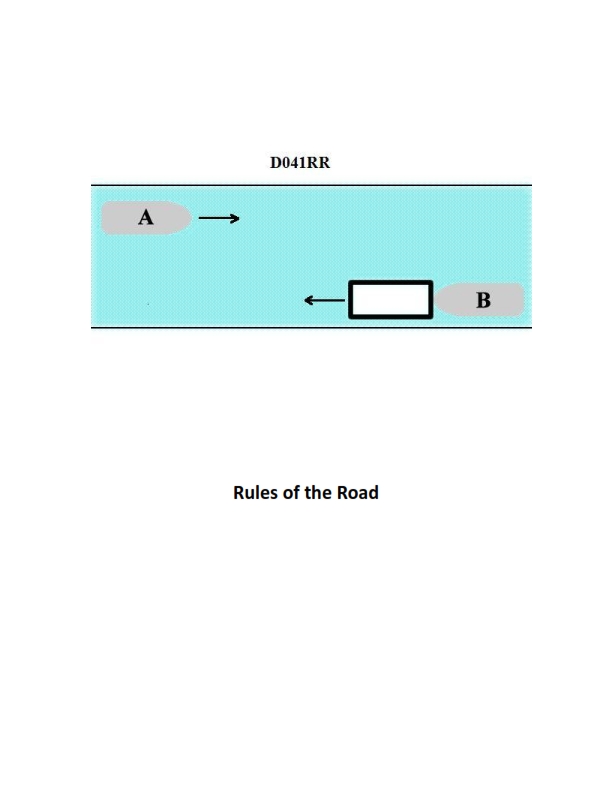
The Correct Answer is C ### Why Option C ("special flashing light") is correct: Vessels "A" and "B" are meeting on a river, and they are described as "INLAND ONLY Vessels". Inland Navigation Rules (specifically 34(b) - Passing signals) govern vessel encounters in these waters. Illustration D041RR typically depicts a meeting situation where one vessel is operating in a narrow channel or river and intends to hold the navigable channel while the other vessel is navigating outside of it. Vessel B is shown to be a pushing vessel or a tow operating in U.S. Inland waters. When a pushing vessel/tow is constrained by the narrow channel and must hold its course (often near the bank), it may display the **special flashing light** (a yellow light flashing at 50-70 flashes per minute) to indicate that it is a vessel *constrained by its draft* or *restricted in its ability to maneuver* due to the tow configuration, requiring the other vessel to take appropriate action (usually a port-to-port passing arrangement, or if needed, allowing Vessel A to pass safely). This light is specifically used in the context of passing arrangements on the Western Rivers and certain specified waters (like the Great Lakes), indicating the status of a tow. Since Vessel A is meeting Vessel B and the vessels are passing 1/4 mile apart (a close passing), the special flashing light (Rule 24(g) and Rule 34(b)(i)) is a crucial signal that Vessel A would see, indicating Vessel B's status as a vessel pushing ahead or towing alongside. ### Why the other options are incorrect: * **A) yellow towing light:** The yellow towing light (displayed above the stern light) is displayed by a vessel engaged in towing, but it is displayed on the **stern** (aft arc) of the vessel. Since Vessel A and Vessel B are meeting head-on (or nearly head-on), Vessel A will be viewing the forward lights of Vessel B, not the stern lights. Therefore, Vessel A would not see the yellow towing light. * **B) red sidelight:** The red sidelight covers the port (left) side of the vessel. Since the vessels are meeting, they would typically execute a port-to-port passing (passing each other on their respective left sides). If they pass port-to-port, Vessel A would see Vessel B's **green** (starboard) sidelight, not the red sidelight. If they were performing a starboard-to-starboard pass, Vessel A might see the red light, but generally, when vessels meet nearly head-on, the lights seen are the masthead lights and the appropriate sidelight (usually green in a standard port-to-port pass). Given the context of inland rules and the specific lights associated with inland tows, the special flashing light is the most distinctive and relevant light for this situation, making it the intended answer. * **D) All of the above:** Since options A and B are incorrect in this meeting scenario, this option is incorrect.
Pass Your Coast Guard Licensing Exams!
Study offline, track your progress, and simulate real exams with the Coast Guard Exams app