Question 28 GLI06 - Master or Mate of LT 100 GRT
INLAND ONLY Vessels "A" and "B" are meeting on a river as shown in illustration D041RR below and will pass 1/4 mile apart. Which is one of the lights on vessel "B" that you will see if you are on vessel "A"?
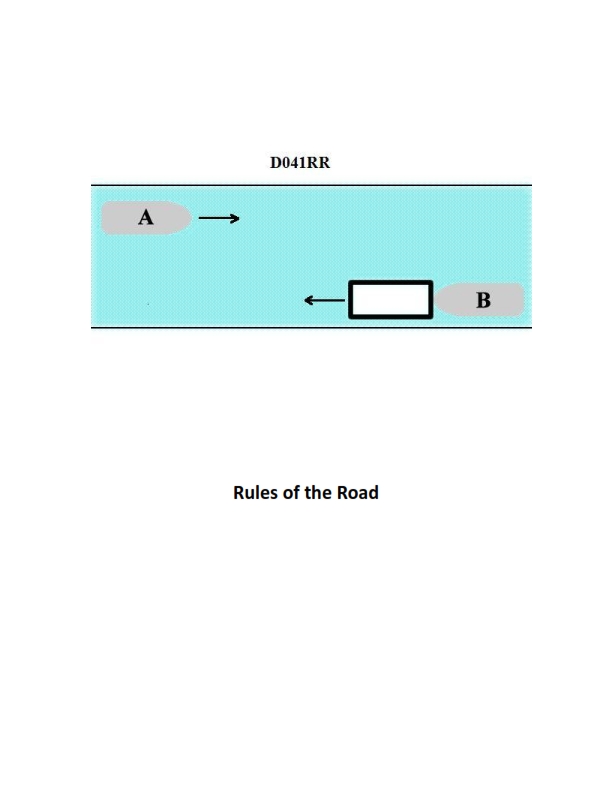
The Correct Answer is C ### Why option C ("special flashing light") is correct: Vessel "B" is shown pushing barges (a tow) ahead, and the illustration indicates that Vessel "B" is operating on a Western Rivers waterway (implied by the context often associated with these types of maneuvering scenarios, though the key indicator is the required lights for specific operations on rivers). Crucially, the situation states that the vessels are meeting and will pass **1/4 mile apart**. Under the Inland Navigation Rules (specifically Rule 24, applying to towing operations, and Rule 23, defining basic power-driven vessel lights), a power-driven vessel pushing ahead or towing alongside, when the tow exceeds 200 meters in length OR the tow is operating on the Western Rivers, must display specific lights. However, the most direct reason the special flashing light is visible here relates to specific Inland Rules concerning **pushing ahead** when the length of the tow (from the stern of the pushing vessel to the foremost end of the tow) is **200 meters or less**. When a pushing vessel is operating on the **Western Rivers** or on waters specified by the Secretary (e.g., specific narrow channels), and pushing a tow ahead where the tow length is **less than 200 meters**, the foremost end of the tow must display a **special flashing light** (a yellow light flashing at 50 to 70 flashes per minute) in addition to the mandatory sidelights (Rule 24(h)). Since Vessel "A" is approaching Vessel "B" (the towing vessel) head-on, Vessel "A" will see the lights displayed by the barges being pushed. The special flashing light is displayed at the forward end of the tow for situations similar to the one described (meeting on a river), making it one of the lights visible from Vessel "A". ### Why the other options are incorrect: **A) yellow towing light:** The yellow towing light (also known as the stern light) is a single, masthead-height light displayed above the white stern light. It is mandatory for vessels *towing astern* (where the tow is pulled behind the vessel). When a vessel is *pushing ahead* (like Vessel "B"), it displays two or three white masthead lights vertically (depending on the tow length) but **does not** display the single yellow towing light used for towing astern. **B) red sidelight:** Vessel "B" is displaying a red sidelight and a green sidelight (standard for a power-driven vessel). Since Vessel "A" and Vessel "B" are meeting head-on (or nearly head-on), Vessel "A" would see **both** the red sidelight and the green sidelight, meaning the red sidelight is indeed visible. However, the question asks which is **one of the lights** visible, and while the red sidelight is visible, the intent of this specific question, given the context of Western Rivers or narrow channels, often focuses on the unique identification lights of a tow. More importantly, the multiple choice structure, including "All of the above" and the other options, suggests that the special flashing light (C) is the most specific and intended correct answer related to the operation shown, particularly when dealing with Inland Rule distinctions. Furthermore, if Vessel B were slightly to starboard of A, the red light might be obscured, whereas the special flashing light (on the bow of the tow) is generally intended to be seen from ahead. **D) All of the above:** Since options A (yellow towing light) is incorrect, "All of the above" cannot be correct.
Pass Your Coast Guard Licensing Exams!
Study offline, track your progress, and simulate real exams with the Coast Guard Exams app