Question 28 GLI03 - Master-LT 500-1600 GRT
INLAND ONLY Vessels "A" and "B" are meeting on a river as shown in illustration D041RR below and will pass 1/4 mile apart. Which is one of the lights on vessel "B" that you will see if you are on vessel "A"?
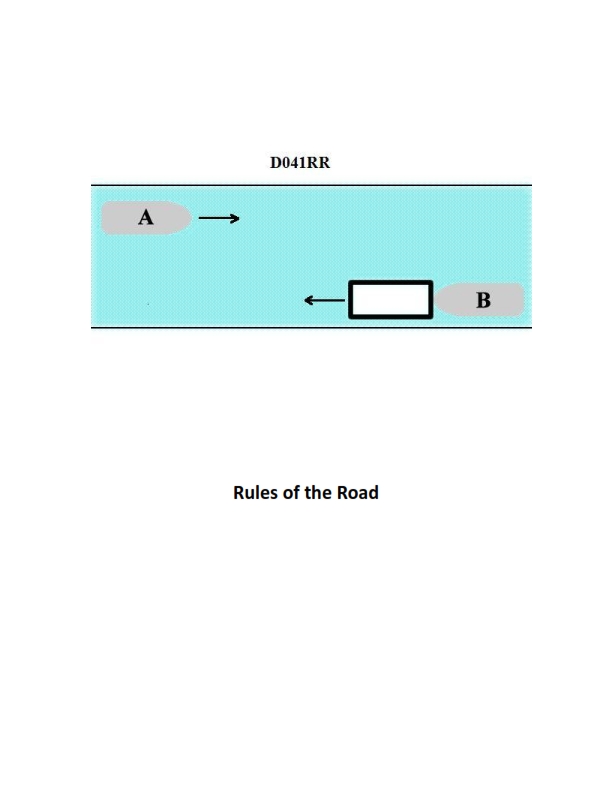
The Correct Answer is C ### Explanation for Option C (special flashing light) Option C is correct because this light is specific to a common operation on inland waterways. Under the Inland Rules (Rule 23(d)), a power-driven vessel that is **pushing ahead or towing alongside** must display a **special flashing light**. This light is: 1. Yellow in color. 2. Displayed over the forward masthead light. 3. Flashing at a rate of 50 to 70 flashes per minute. 4. Visible across the entire arc of the horizon from dead ahead to $22.5$ degrees abaft the beam on either side (a $225^{\circ}$ arc). Since Vessel A and Vessel B are meeting (head-on or nearly head-on), Vessel A is positioned within the arc of visibility for the Special Flashing Light (SFL) if Vessel B is engaged in pushing ahead (the operation most commonly associated with this light on inland rivers). Thus, if Vessel B is pushing a tow, Vessel A will see the SFL. ### Explanation for Why Other Options are Incorrect **A) yellow towing light:** A yellow towing light is typically displayed as a second masthead light (vertically above or below the forward masthead light) and is used for vessels towing astern. While Vessel B *could* be towing, the Special Flashing Light (C) is the required, defining light specifically for the pushing-ahead configuration on the inland waters. Since the question is looking for *one* of the lights, and the SFL is a unique inland requirement for meeting traffic, C is the definitive answer derived from Inland Rules scenarios. **B) red sidelight:** The red sidelight indicates the port side of Vessel B. If Vessels A and B are meeting, they will typically execute a port-to-port passing, meaning Vessel A will see Vessel B's **green** (starboard) sidelight. Although the red sidelight might be visible depending on the exact angle, it is not guaranteed, unlike the Special Flashing Light which is specifically visible across the entire forward arc during a meeting scenario. **D) All of the above:** This is incorrect because the visibility of the red sidelight (B) is not guaranteed in a meeting situation. Vessel B may not be displaying the yellow towing light (A), or if it is, the SFL (C) is the most critical light for identifying the nature of the tow/vessel configuration in this context.
Pass Your Coast Guard Licensing Exams!
Study offline, track your progress, and simulate real exams with the Coast Guard Exams app