Question 28 GLI02 - Mate of Unlimited Tonnage
INLAND ONLY Vessels "A" and "B" are meeting on a river as shown in illustration D041RR below and will pass 1/4 mile apart. Which is one of the lights on vessel "B" that you will see if you are on vessel "A"?
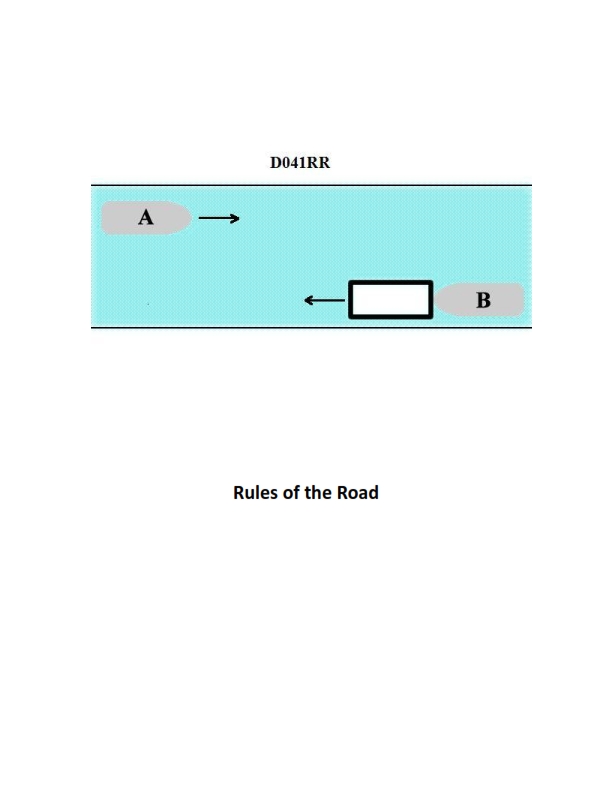
The Correct Answer is C ### Explanation for C (special flashing light) Vessel "B" is shown pushing ahead or towing alongside an arrangement of vessels in a **towing operation**, specifically on **inland waters** (as the question specifies "INLAND ONLY Vessels" and mentions a river meeting). Crucially, Vessel "B" is shown operating on the **western rivers** (or waters specified by the Supervising Authority) where special rules for towing apply. The configuration of Vessel B shows a tow that extends more than 200 meters. According to Inland Rules regarding towing lights (Rule 24, Inland Annex V), a vessel engaged in towing an alongside or push-ahead tow on the Western Rivers, or on waters designated by the Supervising Authority, must display two special flashing lights, one on the forward mast and one near the stern (or where they can best be seen). This light is yellow, has an arc of visibility of $225^{\circ}$, and flashes at a rate of 50 to 70 flashes per minute. Since Vessel A is meeting Vessel B and passing $1/4$ mile apart, Vessel A will be able to see this **special flashing light** displayed by Vessel B. ### Explanation for Incorrect Options * **A) yellow towing light:** The term "yellow towing light" typically refers to the all-around white or yellow light shown by vessels engaged in pushing ahead or towing alongside (which replaces the second masthead light under certain conditions). However, in the context of the Western Rivers configuration shown, the *primary distinguishing feature* for the tow is the **special flashing light**. While the vessel will also show other towing lights (like the mandatory yellow stern light), the special flashing light (C) is a specific and unique light required for this specific inland towing operation shown. A simple "yellow towing light" (stern light) is always present but doesn't distinguish the configuration as clearly as the special flashing light. Since the special flashing light is the most accurate and unique required light among the choices for this specific configuration, and it is a type of light displayed by the vessel, C is the best answer. (Note: Vessel B does display a yellow towing light [stern light], but the special flashing light is also correct and is the feature unique to this inland Western Rivers type of tow.) * **B) red sidelight:** Vessel B is heading almost directly toward Vessel A (a meeting situation, though they are passing 1/4 mile apart). If Vessel A is viewing Vessel B from head-on, Vessel B's **red sidelight** (port side) would be obscured, as it is only visible from dead ahead to $22.5^{\circ}$ abaft the beam on the port side. Vessel A would primarily see the masthead lights, range lights, and towing lights, including the special flashing light. Vessel A might see the red sidelight *if* Vessel B were significantly off Vessel A's starboard bow, but since they are meeting and passing 1/4 mile apart, Vessel A would likely be positioned to primarily see the **green sidelight** (starboard side) as B passes A's starboard side, or neither sidelight if they are close to head-on. Therefore, seeing the red sidelight is not guaranteed, making it an incorrect certainty compared to the special flashing light. * **D) All of the above:** Since option B (red sidelight) is unlikely to be visible in a near head-on meeting situation, "All of the above" is incorrect.
Pass Your Coast Guard Licensing Exams!
Study offline, track your progress, and simulate real exams with the Coast Guard Exams app