Question 28 GLI01 - Master-Unlimited Tonnage
INLAND ONLY Vessels "A" and "B" are meeting on a river as shown in illustration D041RR below and will pass 1/4 mile apart. Which is one of the lights on vessel "B" that you will see if you are on vessel "A"?
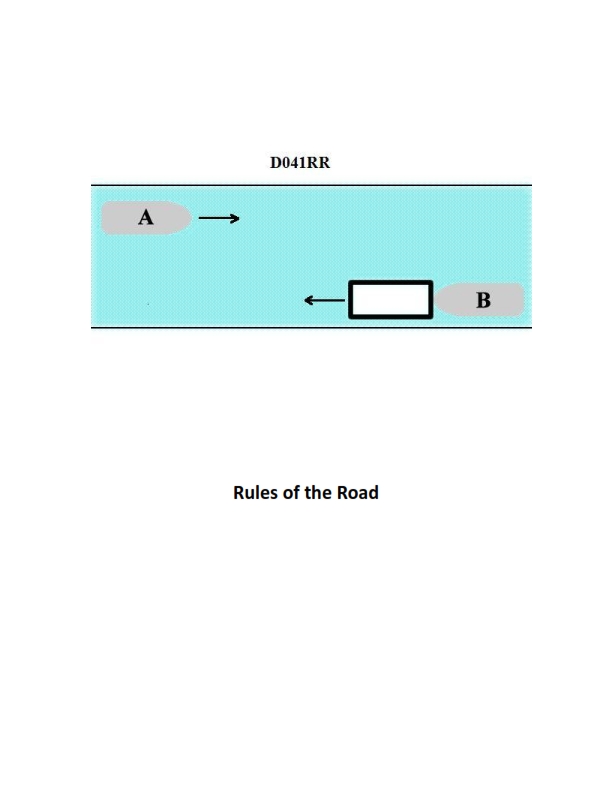
The Correct Answer is C ### Explanation for Option C (special flashing light) Vessel B is highly likely depicted as an inland push tow (a tug pushing one or more barges ahead), which is the standard configuration for commercial navigation on rivers. Under Inland Navigation Rules, a vessel or vessels being pushed ahead (the lead barge of the tow) must display a **special flashing light** (Rule 24(h)). This light is: 1. Yellow, mounted forward on the lead barge, and visible all around the horizon (360 degrees). 2. It replaces the masthead light for the vessel/barge being pushed. 3. Its primary purpose is to clearly mark the forward extent of the tow, especially to approaching vessels like Vessel A. Since Vessel A is meeting Vessel B on a river, Vessel A is approaching the forward end of the tow and will clearly see this mandatory, distinctive special flashing light. *** ### Explanation of Incorrect Options **A) yellow towing light:** The yellow towing light is an arc light (visible 135 degrees) displayed on the stern (aft end) of the actual pushing vessel (the tug). Since Vessel A is meeting Vessel B (approaching head-on or nearly head-on), the stern lights of the pushing vessel are not visible. This light is only seen by vessels approaching from astern (overtaking). **B) red sidelight:** The red sidelight (port side) is visible from dead ahead to $112.5$ degrees on the port side. While sidelights are necessary for visibility, the question asks for *one* of the lights you will see. If the vessels are meeting head-on, both the red and green sidelights would be visible, or possibly just one if the maneuver has already begun. However, the Special Flashing Light (C) is the unique and mandatory light displayed by the lead vessel of an inland push tow, making it the most definitive answer for identifying the vessel configuration and location. **D) All of the above:** Since the yellow towing light (A) is not visible from a meeting vessel, this option is incorrect.
Pass Your Coast Guard Licensing Exams!
Study offline, track your progress, and simulate real exams with the Coast Guard Exams app