Question 36 AEL01 - Assistant Engineer - Limited
In the illustration shown, under what conditions would valves "2" and "3" be closed and valve "6" be opened? Illustration MO-0077
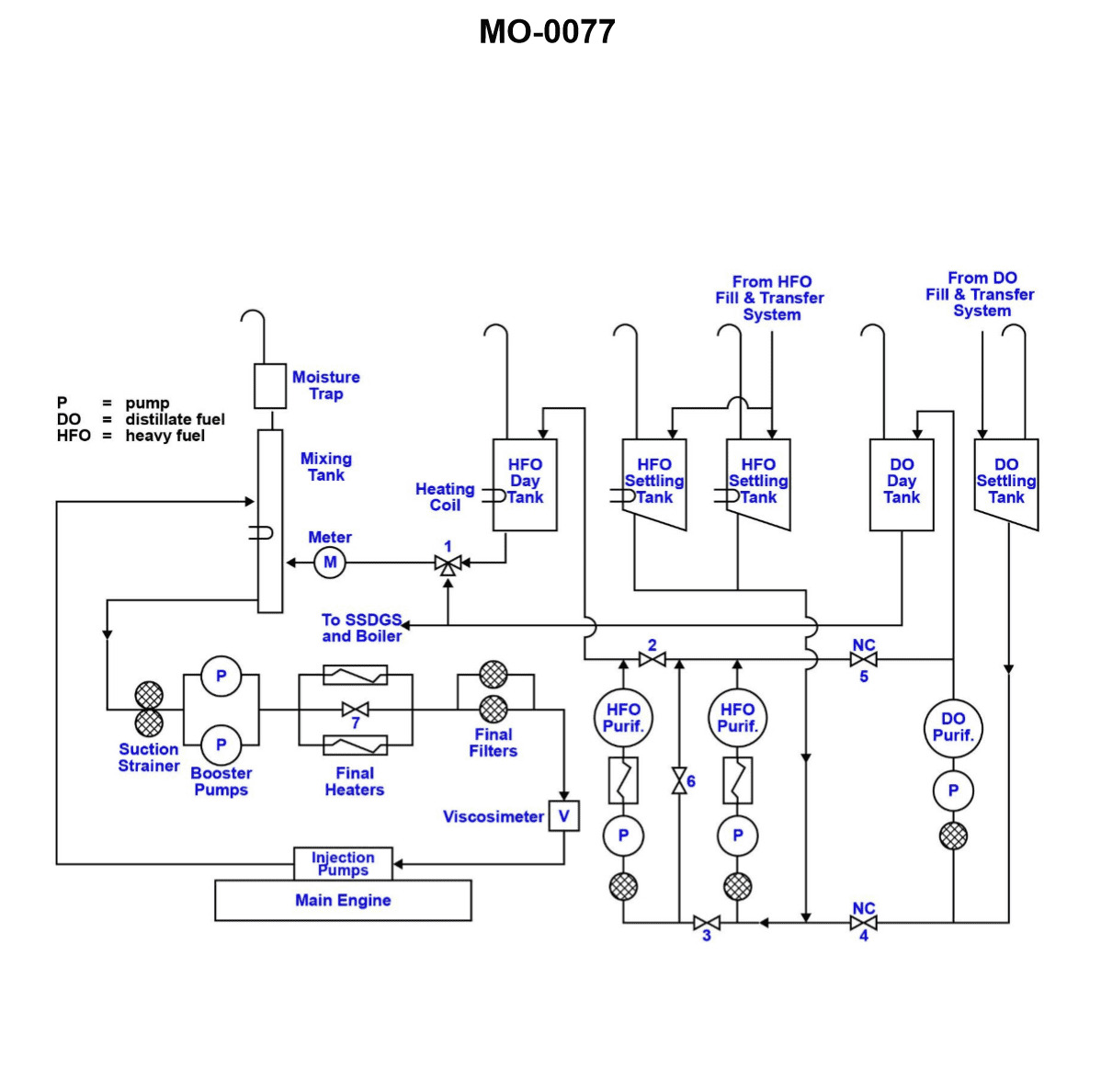
The Correct Answer is A *** ### 1. Why Option A is Correct Option A states: **"When the HFO centrifuges are being run as separators and clarifiers respectively."** This scenario requires the two centrifuges to be run in **series** (tandem operation). In a series setup, the first machine (the Separator, used for bulk water removal) discharges its processed oil directly into the second machine (the Clarifier, used for fine solid particle removal). Based on the standard layout of Illustration MO-0077 (a common representation of a dual HFO separator system): * **Valve 6** is the key valve that establishes the series connection, routing the clean oil discharge from the first centrifuge (Separator) directly to the inlet of the second centrifuge (Clarifier). Therefore, for series operation, Valve 6 must be **OPEN**. * **Valves 2 and 3** are typically bypass or isolation valves associated with the outlet of the first machine or the inlet of the second machine, which, if open, would divert the flow either straight to the tank or establish parallel operation. * To force the flow from the Separator into the Clarifier (Series operation), any bypass routes (Valves 2 and 3) must be **CLOSED**. Therefore, the condition (V2 Closed, V3 Closed, V6 Opened) locks the system into the Separator-Clarifier configuration (series operation). *** ### 2. Why Other Options are Incorrect **B) When the HFO purifier is being run as the DO purifier.** This refers to changing the type of fuel being processed (Heavy Fuel Oil to Diesel Oil). This requires adjusting the gravity disc and temperature, but it does not change the fundamental flow *path* (series or parallel) established by the piping and routing valves (2, 3, and 6). **C) When the DO purifier is being run as the HFO purifier.** Similar to B, changing the oil type (from Diesel Oil to Heavy Fuel Oil) changes operating settings (temperature, flow rate, disc size) but does not dictate the use of a series flow path (Valves 2 and 3 closed, Valve 6 open). **D) When the HFO purifiers are being run in parallel.** In parallel operation, both centrifuges draw feed oil simultaneously and discharge their cleaned oil directly to the clean oil tank. To achieve this, the series transfer valve (Valve 6) would have to be **CLOSED**, and the independent discharge valves (which often include the lines controlled by V2 and V3) would need to be **OPEN**. This directly contradicts the requirement that Valve 6 must be opened.
Pass Your Coast Guard Licensing Exams!
Study offline, track your progress, and simulate real exams with the Coast Guard Exams app