Question 43 AB01 - Able Seafarer
INLAND ONLY At night, you see the lights shown in illustration D075RR below. These lights are shown by what type of vessel?
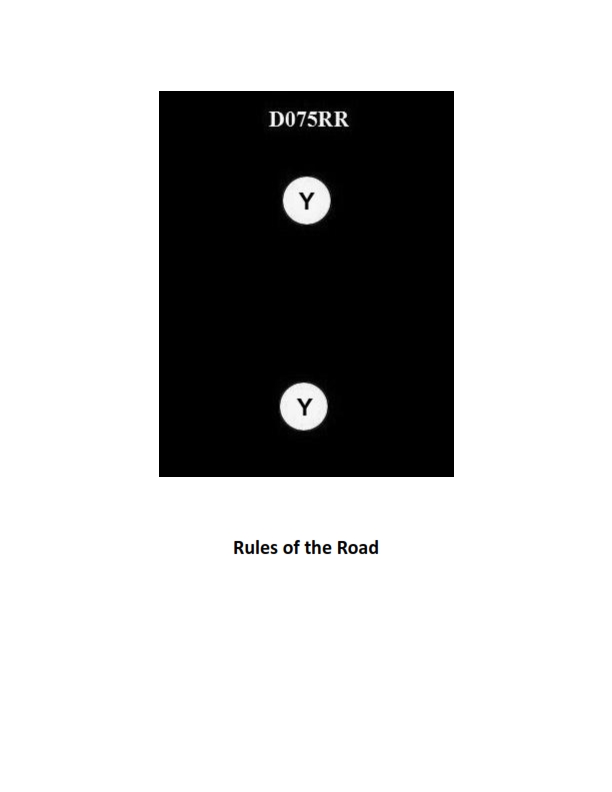
The Correct Answer is C 1. **Why option C ("tug pushing a barge ahead") is correct:** The illustration D075RR shows three specific white lights arranged in a vertical line on the vessel on the right (the pushing vessel, or tug), and two vertical red lights on the vessel on the left (the pushed vessel, or barge). * **Tug pushing ahead:** According to Inland Rules (Rule 24(c)), a power-driven vessel pushing ahead or towing alongside displays masthead lights appropriate to its length and, in addition, **two white lights in a vertical line** at the stern. However, Rule 24(e) specifies that when a pushing vessel and a vessel being pushed ahead are rigidly connected (forming a composite unit), they are regarded as a single power-driven vessel and must display lights appropriate for that length. The illustrated scenario, showing the three vertical white lights, is the key indicator for a pushing operation. * **Identifying the three white lights:** On the Western Rivers or waterways outside the demarcation line specified in Annex V, a power-driven vessel pushing ahead or towing alongside must display **three white lights in a vertical line** at the forward part of the vessel (Rule 24(g)). These three white lights identify the vessel as a towboat involved in pushing ahead (or towing alongside). * **Identifying the two vertical red lights:** The vessel being pushed ahead (the barge) must show sidelights and **two red lights in a vertical line** at its forward end (Rule 24(f)). * Since the illustration shows the combination of three vertical white lights (on the pushing vessel) and two vertical red lights (on the pushed vessel), this combination specifically identifies a **tug pushing a barge ahead** in Inland Waters. 2. **Why the other options are incorrect:** * **A) barge being towed astern:** A vessel being towed astern (barge) would only display sidelights and a sternlight, and potentially special white or yellow lights if obscured by the towing vessel. It would not display two vertical red lights. The towing vessel (tug) would display two or three vertical white masthead lights (depending on the length of the tow) and a towing light (yellow) above the sternlight (white), but it would not show three vertical white lights forward and the two red lights on the towed vessel. * **B) barge being pushed ahead:** This option describes the vessel on the left (the barge), but the question asks what **type of vessel** is showing *these lights* (implying the entire configuration shown, which includes the tug). The lights shown are characteristic of the entire **operation** (tug and barge), not just the barge alone. More importantly, the most distinct identifying feature in the illustration is the presence of the tug's three vertical white lights, defining the operation as a push tow. * **D) tug towing a barge astern:** Similar to Option A, a tug towing astern displays two or three vertical white masthead lights and a towing light (yellow) above the sternlight (white). It does not display the three vertical white lights shown in the forward part of the tug, nor would the towed barge display two vertical red lights.
Pass Your Coast Guard Licensing Exams!
Study offline, track your progress, and simulate real exams with the Coast Guard Exams app