Question 39 AB01 - Able Seafarer
BOTH INTERNATIONAL & INLAND Vessels "A" and "B" are power-driven vessels and crossing as shown in illustration D026RR below. Which statement is TRUE?
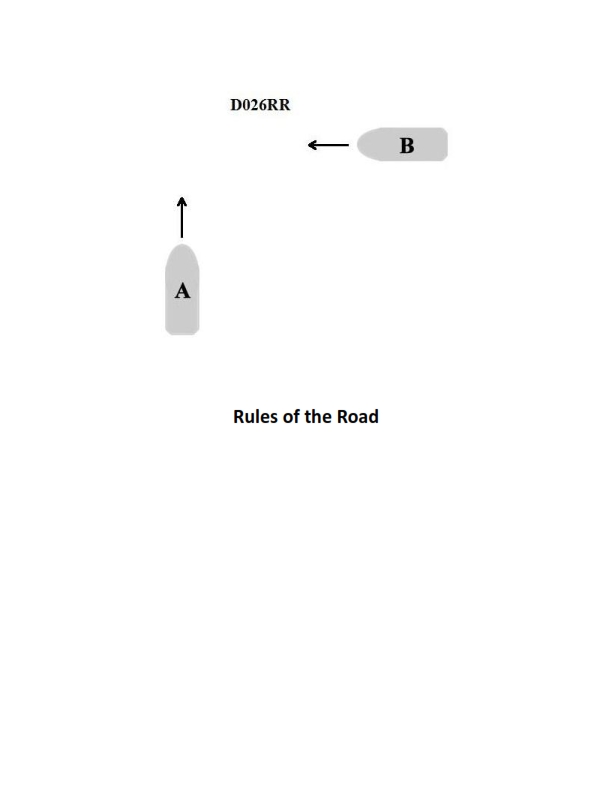
The Correct Answer is B **Explanation of Correct Option (B):** The scenario described is a crossing situation between two power-driven vessels (Vessel A and Vessel B). According to the International Regulations for Preventing Collisions at Sea (COLREGS), Rule 15 (Crossing Situation), when two power-driven vessels are crossing so as to involve risk of collision, the vessel which has the other vessel on her own starboard side shall keep out of the way. In illustration D026RR (which depicts a standard crossing situation where A is approaching B's port bow and B is approaching A's starboard bow), **Vessel A has Vessel B on its own starboard side.** Therefore, Vessel A is the give-way vessel and **must keep clear** of Vessel B, the stand-on vessel. **Explanation of Incorrect Options:** * **A) Vessel "B" should alter course to the right.** Vessel B is the stand-on vessel (the vessel on Vessel A's port side). According to Rule 17 (Action by Stand-on Vessel), the stand-on vessel must maintain its course and speed. While Vessel B may take action if collision cannot be avoided by Vessel A's actions alone, its primary requirement is to hold course and speed, not to initiate an alteration to the right (which is the required action for the give-way vessel, Vessel A). * **C) Vessel "B" should pass under the stern of vessel "A".** Since Vessel A is the give-way vessel, Vessel A is required to take substantial action early and clearly to keep clear of Vessel B. Vessel A may choose to pass under the stern of B, but Vessel B (the stand-on vessel) does not have the obligation to initiate a maneuver to pass under the stern of A. Furthermore, passing under the stern of the give-way vessel is often considered poor seamanship for a stand-on vessel unless an emergency requires it. * **D) The vessels should pass starboard to starboard.** Rule 15 requires Vessel A to keep clear. The action generally required of the give-way vessel (A) in a crossing situation is to turn to starboard (right) to pass astern of the stand-on vessel (B), resulting in a **port-to-port** passage. Only when circumstances make the required starboard turn ineffective or dangerous might an alternative maneuver be considered, but starboard-to-starboard is not the standard or preferred action in a crossing situation.
Pass Your Coast Guard Licensing Exams!
Study offline, track your progress, and simulate real exams with the Coast Guard Exams app