Question 60 3AE02 - Third Assistant Engineer (Alt)
Referring to the illustrated bellows-type thermostatic steam trap, what statement is true concerning its operation? Illustration GS-0005
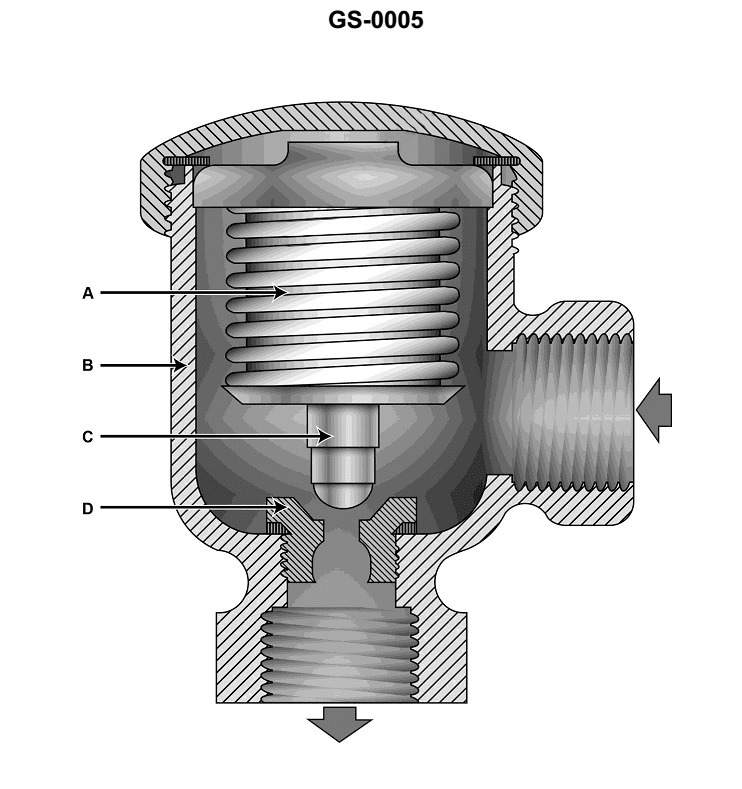
The Correct Answer is B **Explanation of why Option B is correct:** Bellows-type thermostatic steam traps operate based on the temperature difference between live steam and condensate/air. The bellows contains a volatile fluid (often an alcohol or water mixture) specifically chosen to have a saturation temperature slightly below that of saturated steam at the operating pressure. 1. **Cool Condensate/Air:** When relatively cool condensate or air enters the trap body, this lower temperature causes the vaporized filling fluid inside the bellows to cool down significantly. 2. **Condensation:** The vapor inside the bellows rapidly condenses back into a liquid state. 3. **Contraction and Opening:** This condensation drastically reduces the internal pressure within the bellows, causing it to contract (shorten). When the bellows contracts, it pulls the valve head away from the seat, opening the discharge port and allowing the cool condensate and air to be discharged from the system. **Explanation of why other options are incorrect:** * **A) Incorrect:** This describes the behavior when the trap is exposed to *hot* conditions (near steam temperature), not cool condensate. When exposed to cool condensate, the bellows *contracts* (not expands) and the valve *opens* (not closes). Furthermore, vaporization would cause expansion, not contraction. * **C) Incorrect:** This describes the initial exposure to hot steam, but the resulting action is wrong. When hot steam reaches the trap, the vapor inside the bellows does *not* condense; instead, the internal liquid *vaporizes* leading to expansion and valve *closing* (not opening). Condensation of the internal fluid only happens when it is cooled by condensate. * **D) Incorrect:** When the bellows comes into contact with relatively hot steam, the internal liquid does vaporize, which results in bellows *expansion* (not contraction). This expansion forces the valve *closed* (not open) to prevent steam loss.
Pass Your Coast Guard Licensing Exams!
Study offline, track your progress, and simulate real exams with the Coast Guard Exams app