Question 13 3AE02 - Third Assistant Engineer (Alt)
In the illustrated pneumatically operated, diaphragm actuated control valve, what statement is true concerning the opening and closing forces acting upon the control diaphragm? Illustration GS-0051
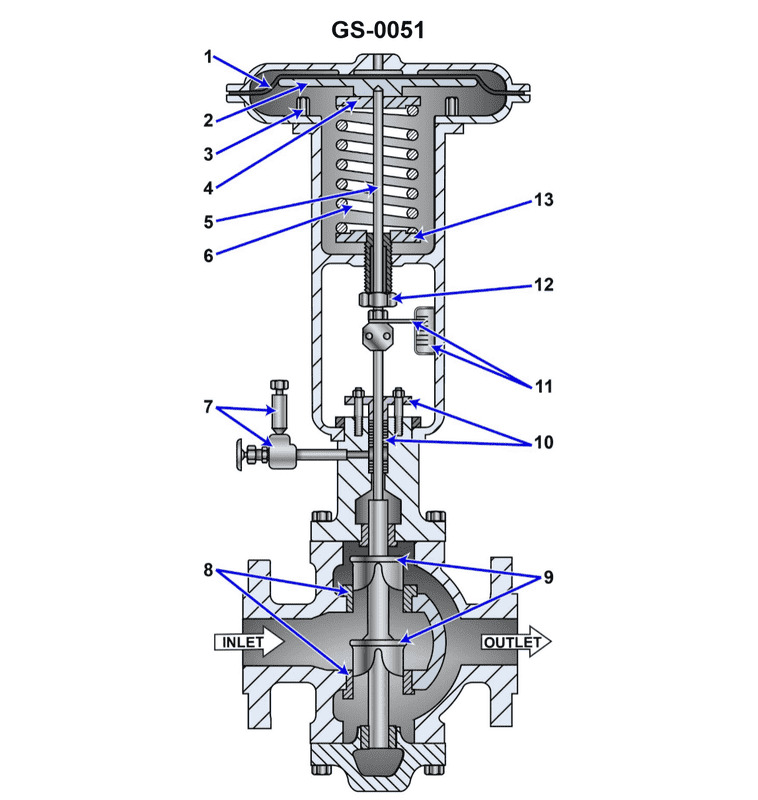
The Correct Answer is B **Explanation of why Option B is correct:** 1. **Identifying the Valve Type:** The question describes a pneumatically operated, diaphragm actuated control valve. These valves typically use a spring-diaphragm actuator to position the valve plug. 2. **Standard Actuator Configuration (GS-0051 Implied):** In a standard, direct-acting (or often called "air-to-close") actuator design common in industrial process control (where the pilot pressure acts on top of the diaphragm), the roles of the forces are defined by how they move the plug: * **Pilot Pressure:** The pneumatic pilot pressure is applied to the top of the diaphragm. Pushing the diaphragm down causes the valve stem to move down. If this downward movement closes the valve (pushing the plug onto the seat), the pilot pressure is the **valve closing force**. * **Spring Force:** The return spring is located underneath the diaphragm. As the pilot pressure decreases, the spring expands, pushing the diaphragm and stem upward. If this upward movement pulls the plug off the seat, the spring force is the **valve opening force**. 3. **Conclusion for Option B:** Option B states that "The spring force acting on the control diaphragm is a valve opening force, and the pilot pressure acting on the top of the control diaphragm is a valve closing force." This perfectly describes the forces in a standard, air-to-close, direct-acting diaphragm actuator. **Explanation of why the other options are incorrect:** * **A) The spring force acting on the control diaphragm is a valve closing force, and the pilot pressure acting on the top of the control diaphragm is a valve opening force.** This describes an "air-to-open" or reverse-acting actuator configuration (where applying pressure lifts the stem/opens the valve). This contradicts the standard setup implied by the correctness of B, or describes a situation where the spring is above the diaphragm and the pressure is below, which is a specialized configuration. * **C) The spring force acting on the control diaphragm is a valve opening force, and the pilot pressure acting on the bottom of the control diaphragm is a valve closing force.** This statement places the pilot pressure on the bottom of the diaphragm. If the pressure is on the bottom, it would push the stem up, making it a valve opening force (assuming the valve opens when the stem moves up). This statement incorrectly identifies the resulting movement as a closing force. * **D) The spring force acting on the control diaphragm is a valve closing force, and the pilot pressure acting on the bottom of the control diaphragm is a valve opening force.** This describes an "air-to-open" actuator configuration where the pressure is applied beneath the diaphragm. This configuration is the opposite of the standard air-to-close configuration described in B (which has pressure acting on the top).
Pass Your Coast Guard Licensing Exams!
Study offline, track your progress, and simulate real exams with the Coast Guard Exams app