Question 70 1AE01 - First Assistant Engineer
A command signal input to the steering gear has initiated rudder movement for 20° right rudder. The follow-up mechanism at the beginning of the rudder movement will __________. Illustration GS-0123
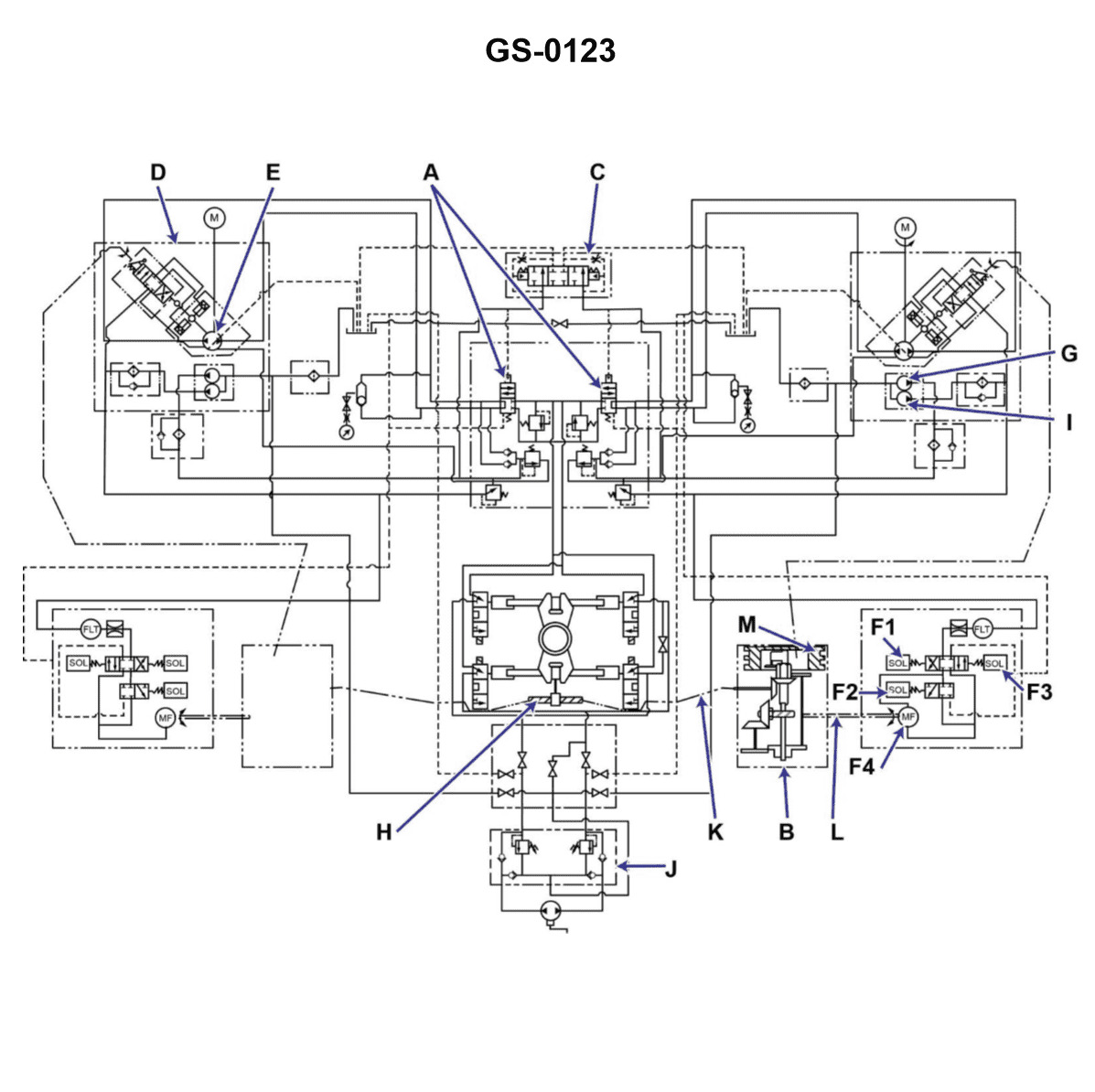
The Correct Answer is A ### 2. Explanation of why option A is correct: The follow-up mechanism (or hunting gear) serves to compare the commanded rudder position (input from the bridge) with the actual rudder position (feedback from the rudder stock). This comparison generates an error signal that controls the variable stroke pump. When the command signal (e.g., 20° Right Rudder) is initiated, two things happen immediately: 1. **The mechanism is in motion:** The physical linkage corresponding to the command signal moves to the new set-point position (20° R). 2. **Creation of the error signal:** Because the command linkage has moved but the actual rudder (and its feedback linkage) has not, a large differential (error) signal is created. This signal immediately commands the pump to maximum stroke (full flow) to begin turning the rudder. However, the question asks about the state of the mechanism *at the beginning* of the rudder movement, after the command has been set. The "null input" refers to the fact that the *command signal* itself has stabilized (the helm is holding 20° R and is no longer moving). The mechanism is physically displaced (in motion) to maintain this position, but the primary input *to* the mechanism from the helm has become static or "null," even though the *output* of the mechanism (the error signal) is still maximum. The follow-up linkage itself is moving to the required position but has settled into the configuration required to generate the maximum error signal. ### 3. Explanation of why the other options are incorrect: **B) not be in motion, thus a null input** This is incorrect because the follow-up mechanism must physically move to register the new command signal (20° Right Rudder). If the mechanism did not move, the pump would not be signaled to start the rudder movement. **C) be in motion providing an input to place the variable stroke pump on maximum stroke** While functionally correct—the mechanism *does* generate the input needed for maximum stroke—Option C describes the *output* or function of the mechanism. Option A describes the *state* of the mechanical linkage itself immediately following the command input, which has physically moved the linkage to the new set-point (in motion) and settled the command input signal ("null input"). In this context, A is considered the intended description of the mechanism's status. **D) be in motion providing an input to place the variable stroke pump at null stroke** This is fundamentally incorrect. Null stroke means zero flow, which would prevent the rudder from moving. Since a 20° command has been given, the pump must be commanded to maximum or near-maximum stroke to achieve the desired rudder speed.
Pass Your Coast Guard Licensing Exams!
Study offline, track your progress, and simulate real exams with the Coast Guard Exams app