Pass Your Coast Guard Licensing Exams!
Study offline, track your progress, and simulate real exams with the Coast Guard Exams app
RVR05 - Master of LT 100 GRT
17 images
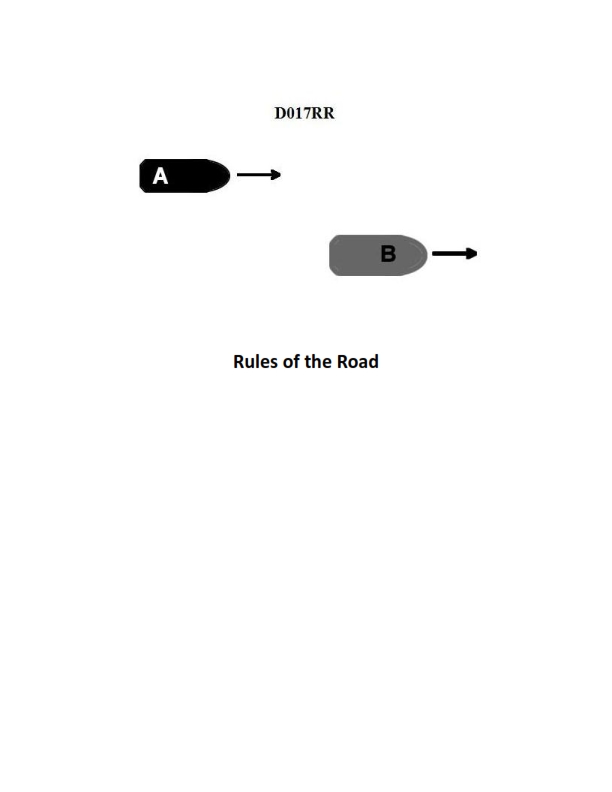
Question 2
Question: BOTH INTERNATIONAL & INLAND Vessel "A" is overtaking vessel "B" as shown in illustration D017RR below and will pass without changing course. Which light will vessel "A" observe on vessel "B"?
A. green sidelight
B. yellow towing light
C. white stern light
D. None of the above
The Correct Answer is C ### Why Option C ("white stern light") is correct: The scenario describes Vessel "A" (the overtaking vessel) approaching Vessel "B" (the vessel being overtaken) from astern, intending to pass without changing course. According to the International Regulations for Preventing Collisions at Sea (COLREGs), a vessel is deemed to be "overtaking" if it is approaching the other vessel from a direction more than $22.5^\circ$ abaft her beam. In this arc, the only light the overtaking vessel will see on the vessel ahead (Vessel B) at night is the **stern light**. The stern light is a white light placed as nearly as practicable at the stern, showing an unbroken light over an arc of the horizon of $135^\circ$ (which covers $67.5^\circ$ from dead astern to port and $67.5^\circ$ from dead astern to starboard). Therefore, Vessel A will observe Vessel B's white stern light. ### Why the other options are incorrect: * **A) green sidelight:** The green sidelight (starboard light) shows an unbroken light over an arc of $112.5^\circ}$ from dead ahead to $22.5^\circ$ abaft the beam on the starboard side. Since Vessel A is approaching from astern (overtaking), it is outside the arc of visibility for the green sidelight. * **B) yellow towing light:** The yellow towing light is only carried by a power-driven vessel when towing. While Vessel B *might* be towing, the standard and guaranteed light visible from astern, irrespective of the vessel's activity (towing or not), is the **white stern light**. The towing light, if present, is displayed above the stern light but is not the primary identifying light from this specific angle of approach (moreover, the white stern light is always present, whereas the towing light is conditional). * **D) None of the above:** This is incorrect because the white stern light is definitively visible from the overtaking position.
Question 3
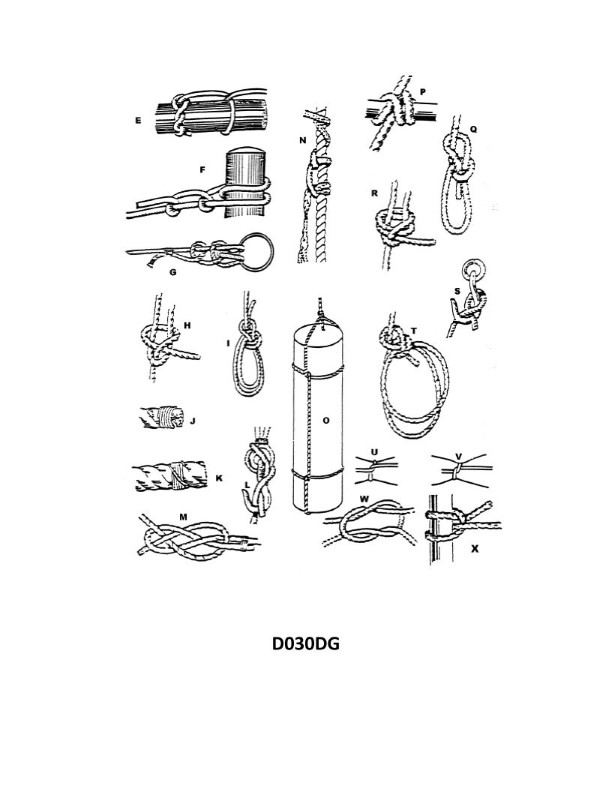
Question: What type of knot in illustration D030DG below is indicated by the Letter "N"?
A. Rolling bowline
B. Stopper hitch
C. Timber hitch
D. Heaving line hitch
The Correct Answer is B **Explanation of Option B (Stopper hitch):** The term "Stopper hitch" (or Stopper knot) refers to a knot placed in a line, often near the bitter end, specifically designed to prevent the line from slipping or running through a narrow opening such as a block, cleat, fairlead, or chock. When a knot is indicated as a "stopper," its function is purely blockage. The most common Stopper knots are the Overhand Knot (used minimally) and the Figure Eight Stopper Knot (preferred for its ease of untying). In specialized rigging contexts, a Stopper Hitch can also refer to a method of temporarily securing tension on one rope (the main line) using a second rope (the stopper) to allow the main line to be adjusted. Based on typical illustrations showing knots indicated by the letter "N" in rigging diagrams, this knot is serving the primary function of stopping the line’s free movement. **Explanation of Incorrect Options:** * **A) Rolling bowline:** The Bowline is a loop knot, used to form a non-slip eye at the end of a rope. The "rolling" variant is specialized for securing lines to cylindrical objects, allowing the loop to roll to the tightest point of resistance. It is fundamentally a loop, not a stopper for limiting movement through an opening. * **C) Timber hitch:** The Timber hitch is designed specifically for securing a rope to a cylindrical object (like a log or pole) for towing or hoisting. It relies on constant tension to hold and is used for lifting/hauling, not for preventing a line from running through a hole. * **D) Heaving line hitch:** This is not a standard, recognized class of knot. While a heaving line may use various knots (like a Monkey’s Fist or a weighted stopper knot) to facilitate throwing, the term "heaving line hitch" does not describe the specific function of preventing a line from slipping through a fitting.
Question 4
Question: What type of knot in illustration D030DG below is indicated by the Letter "R"?
A. Round turn and two half hitches
B. Fisherman's bend
C. Double becket bend
D. Bowline
The Correct Answer is C **Explanation for Option C (Double becket bend):** The knot indicated by the letter "R" in the typical illustration D030DG (which depicts various bends used to join two ropes) is a **Double becket bend** (also commonly called a Double sheet bend). This knot is used to join two ropes, especially ropes of unequal diameter or stiffness, for increased security compared to a standard single sheet bend. It is distinguished by the working end being wrapped twice around the standing part of the other line before being tucked through the loop. **Explanation of Why Other Options Are Incorrect:** * **A) Round turn and two half hitches:** This knot is a mooring knot used to secure a rope to a spar, post, or ring. It is an attachment knot, not a bend (a knot used to join two lines), and its structure is completely different from the Double becket bend. * **B) Fisherman's bend:** While this is a bend, it is primarily used in fishing (sometimes called an anchor bend) to secure a line to an anchor ring or shackle. It is an attachment knot, not a joining knot (bend), and structurally consists of two full turns around the object followed by two half hitches. * **D) Bowline:** The Bowline is a highly common and essential loop knot, used to form a non-slip loop at the end of a line. It is neither a bend nor an attachment knot, but a finished loop, making it structurally distinct from the indicated knot R.
Question 6
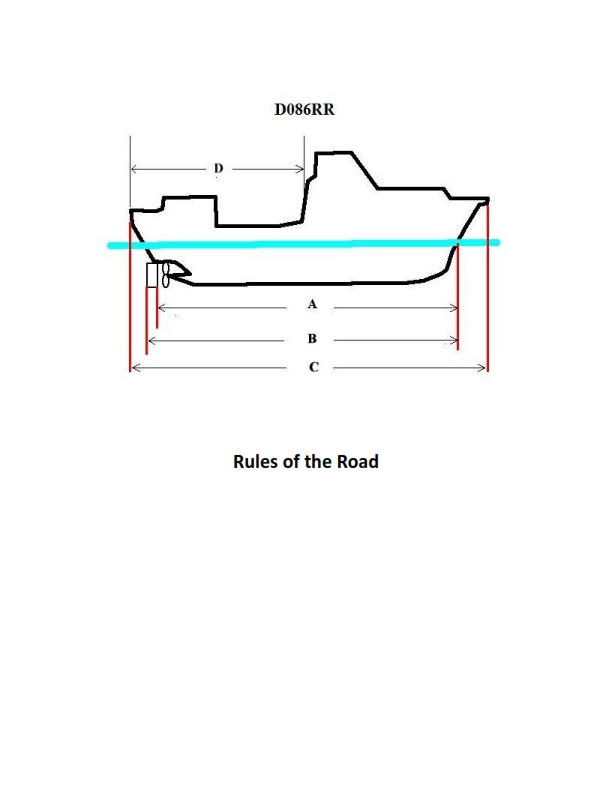
Question: BOTH INTERNATIONAL & INLAND Which of the following in illustration D086RR below represents the length of a vessel as defined by the Rules?
A. A
B. B
C. C
D. D
The Correct Answer is C. ### Why Option C is Correct: For the purpose of applying the International Regulations for Preventing Collisions at Sea (COLREGs) and Inland Rules, the "length of a vessel" is defined as the maximum **Length Overall (LOA)**. This is the distance measured from the extreme forward end (including permanent structure) to the extreme after end (including permanent structure). In diagrams illustrating vessel dimensions, measurement C universally represents the Length Overall (LOA), which is the definition used to determine which specific lights, shapes, and sound signal rules apply to the vessel (e.g., vessels less than 12m, less than 20m, or 50m or more). ### Why Options A, B, and D are Incorrect: * **A and B (Typically Length Between Perpendiculars or Waterline Length):** These measurements (LBP or LWL) are important for naval architecture, tonnage calculation, and stability analysis, but they do not represent the maximum physical length (LOA) of the vessel. The Rules require the use of the maximum physical length for regulatory purposes. * **D (Likely Draft, Freeboard, or Tonnage Depth, or a Partial Length):** Measurement D would typically represent a vertical dimension (like Draft or Depth) or a length measurement significantly shorter than the LOA. Neither of these serves as the regulatory definition of a vessel's length required by the Rules.
Question 7
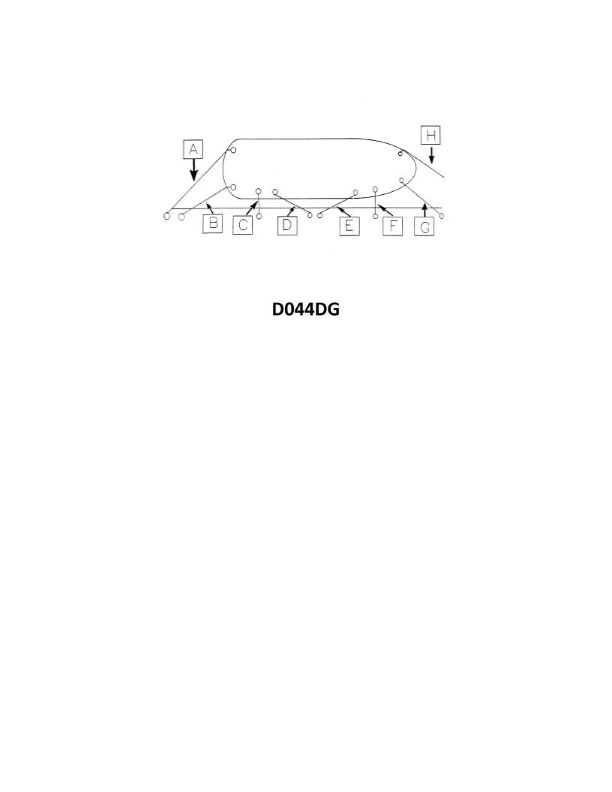
Question: In illustration D044DG below, what is the mooring line labeled "A" called?
A. After spring line
B. Onshore stern line
C. Offshore stern line
D. After breast line
The Correct Answer is C **Explanation for Option C (Offshore stern line):** The line labeled "A" is a mooring line running from the stern (rear) of the vessel, extending away from the dock (the *offshore* side). Since this line originates at the stern of the vessel, it is classified as a stern line. Because it is positioned away from the dock face, its full designation is the **Offshore stern line**. This line is used to help secure the vessel by preventing its stern from swinging towards the dock, especially in environments with wind or current pressing the vessel against the pier. **Why the other options are incorrect:** * **A) After spring line:** Spring lines (like the forward or after spring) typically run diagonally along the length of the vessel toward the dock, usually attached near the center or amidships, and are crucial for limiting fore-and-aft movement (surge). Line "A" originates at the stern and runs offshore. * **B) Onshore stern line:** An onshore stern line would run from the stern of the vessel directly to the dock or pier (the *onshore* side). Line "A" runs away from the dock. * **D) After breast line:** A breast line typically runs perpendicularly (or nearly so) from the vessel to the dock (onshore), usually near the bow, stern, or amidships, and is primarily used to pull the vessel tight against the pier. Line "A" runs offshore, away from the pier, and is attached to a remote mooring point (e.g., a mooring buoy or anchor).
Question 8
Question: In illustration D044DG below, what is the mooring line labeled "E" called?
A. After spring line
B. Bow line
C. Bow spring line
D. Forward breast line
The Correct Answer is C **Explanation for C (Bow spring line):** The line labeled "E" runs forward from the ship's **bow** to the pier. Crucially, this line also runs at an acute angle relative to the ship, moving forward to prevent the vessel from moving **aft** (backward) along the pier. A line used to check stern movement (or to pull the bow towards the dock) that runs forward from the bow section is called a **bow spring line**. **Explanation for Incorrect Options:** * **A) After spring line:** This line would run generally forward from the stern or midships section of the vessel, preventing the vessel from moving forward (ahead). Line E runs from the bow. * **B) Bow line:** A bow line runs almost directly perpendicular (90 degrees) or slightly forward from the bow to the pier, primarily used to hold the bow directly to the dock and control the athwartship distance. Spring lines (like E) are used to control fore and aft movement. * **D) Forward breast line:** A breast line runs roughly perpendicular (at 90 degrees) from the ship to the dock, holding the vessel close to the pier and controlling athwartship distance. Spring lines run fore and aft to control longitudinal movement.
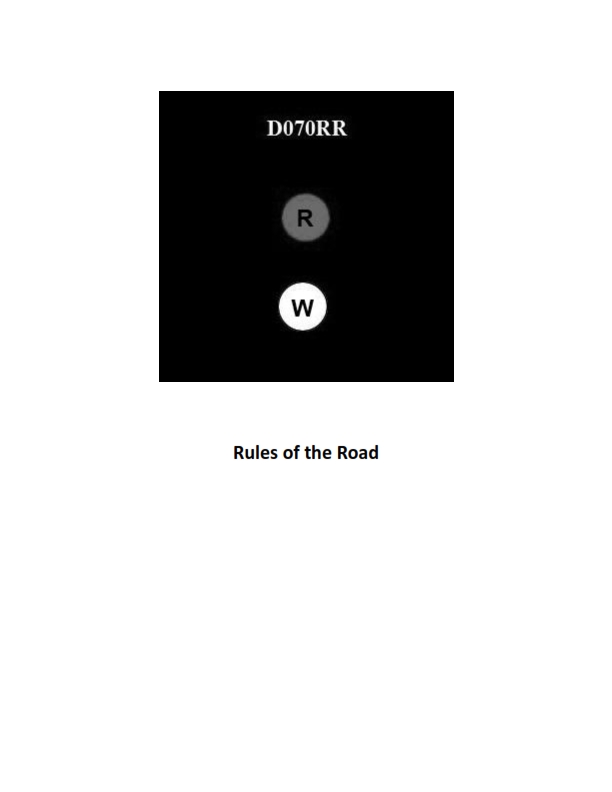
Question 10
Question: BOTH INTERNATIONAL & INLAND Which type of vessel is required to display the lights shown in illustration D070RR below?
A. fishing vessel
B. motorboat
C. sailboat
D. pilot boat
The Correct Answer is A **Why Option A ("fishing vessel") is correct:** The illustration D070RR (which is not physically present but is referenced as showing specific lights) depicts the combination of lights mandated for a vessel engaged in fishing. This typically includes: 1. Two all-round lights arranged vertically: a green light above a white light (signifying a vessel engaged in fishing, but not trolling). 2. Sidelights (red on port, green on starboard). 3. A sternlight. This specific configuration (green over white all-round lights plus running lights) uniquely identifies a vessel engaged in fishing under the International Regulations for Preventing Collisions at Sea (COLREGs), Rule 26. These rules apply to both international and inland waters (though inland rules may have slight variations, the green-over-white concept for fishing is standard). **Why Option B ("motorboat") is incorrect:** A motorboat (power-driven vessel underway) displays a white masthead light (or two, depending on length), sidelights, and a sternlight. It does not display the vertically arranged green over white all-round lights, as those indicate restricted maneuverability due to fishing activity. **Why Option C ("sailboat") is incorrect:** A sailboat (sailing vessel underway) displays only sidelights and a sternlight. If less than 20 meters in length, it may combine these into one lantern, or it may use a tricolor light at the masthead. It never displays the vertical green over white all-round lights. **Why Option D ("pilot boat") is incorrect:** A pilot boat (when engaged on pilotage duty) displays two all-round lights arranged vertically: a white light above a red light ("white over red, pilot ahead"). It does not display the green over white lights, which are reserved for fishing vessels.
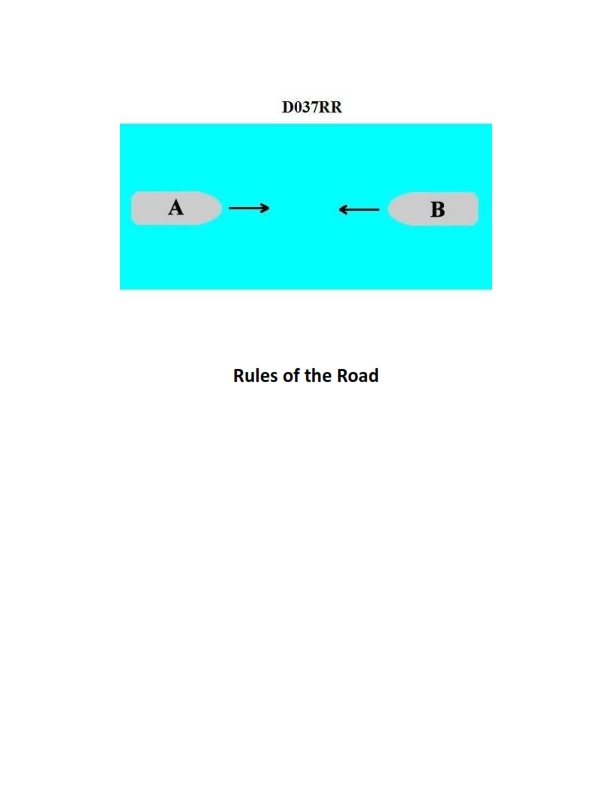
Question 13
Question: INLAND ONLY Two power-driven vessels are meeting in a narrow channel on the Great Lakes as shown in illustration D037RR below. Vessel "A" is downbound with a following current. Vessel "A" shall do which of the following?
A. Propose the manner of passage
B. Initiate the maneuvering signals
C. Have the right of way
D. All of the above
The Correct Answer is D **Explanation for Option D ("All of the above"):** The scenario describes two power-driven vessels meeting in a narrow channel on the Great Lakes, with Vessel "A" being **downbound** and having a **following current**. This situation is governed by the Inland Rules of the Road (specifically, Rule 9 - Narrow Channels, and specific rules relating to the Great Lakes and Western Rivers, though the core principles of meeting situations in channels apply). Under the Inland Rules, particularly in narrow channels: 1. **Vessel A Proposes the Manner of Passage (Option A):** When two vessels are meeting in a narrow channel, the vessel that is downbound with a following current (Vessel A) is generally considered to be less maneuverable and has the *right* to dictate the manner of passage. Rule 9(a)(ii) related to Great Lakes/Western Rivers operating procedures reinforces that the downbound vessel (A) proposes the manner of passage, usually by initiating the passing signal. 2. **Vessel A Initiates the Maneuvering Signals (Option B):** Since Vessel A proposes the manner of passage, it is required to initiate the signaling. The maneuvering signal (one short blast for port-to-port or two short blasts for starboard-to-starboard passage) announces its intent and proposes the maneuver to Vessel B. 3. **Vessel A Has the Right of Way (Option C):** Because Vessel A is downbound and has the current (making it harder to stop or hold position), it is granted the right of way over the upbound vessel (Vessel B) in a meeting situation within a narrow channel. Rule 9(a)(ii) (Inland) specifically grants this priority to the vessel proceeding with the current or downbound vessel. Since A, B, and C are all correct statements regarding Vessel A's responsibilities and privileges in this specific narrow channel situation, "All of the above" (D) is the correct answer. **Brief Explanation of why other options are incorrect (as standalone answers):** * **A) Propose the manner of passage:** This statement is correct, but it is incomplete. Vessel A has other duties and privileges (signaling, right of way) that are also true in this scenario. * **B) Initiate the maneuvering signals:** This statement is correct, but it is incomplete. Vessel A's role is broader than just initiating the signals; it also dictates the passage and holds the right of way. * **C) Have the right of way:** This statement is correct, but it is incomplete. The right of way is coupled with the requirement to propose the passage and initiate signals.
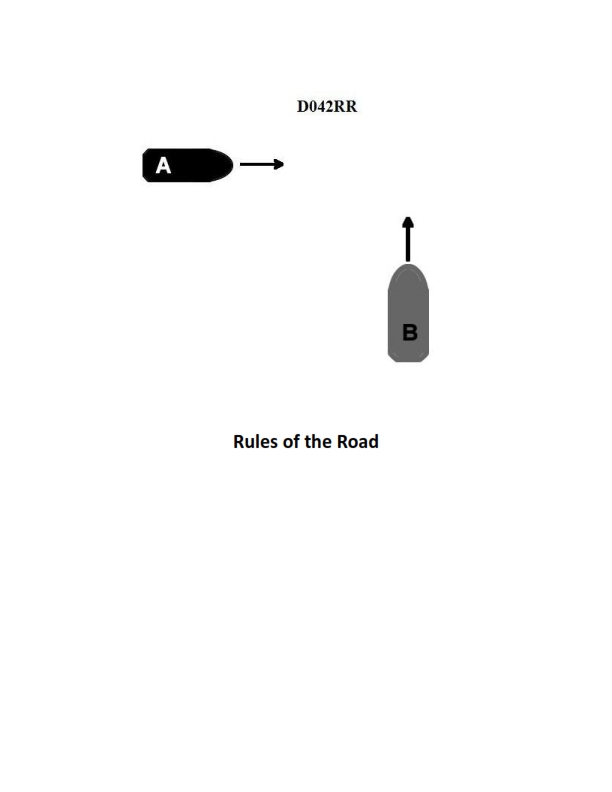
Question 21
Question: INLAND ONLY Two power-driven vessels are crossing within a half a mile of each other as shown in illustration D042RR below. Vessel "A" sounds one short blast on the whistle. What should Vessel "B" sound if in agreement?
A. three short blasts
B. one short blast
C. two short blasts
D. two prolonged blasts followed by two short blasts
The Correct Answer is B. **Explanation of Option B (one short blast):** Under the Inland Rules of Navigation, when power-driven vessels are within sight of each other and maneuvering in a crossing, meeting, or overtaking situation, proposals to alter course or adjust passing arrangements must be signaled by short blasts. The Rules require that the responding vessel must signal agreement by sounding the **same blast signal** given by the proposing vessel. Since Vessel A proposed the maneuver with one short blast ("I intend to leave you on my port side"), Vessel B, if in agreement, must sound one short blast to acknowledge and confirm the agreed-upon maneuver. **Why the other options are incorrect:** * **A) three short blasts:** This signal means, "I am operating astern propulsion" (backing up). It is not used to signal agreement to a crossing maneuver proposed by another vessel. * **C) two short blasts:** This signal means, "I intend to leave you on my starboard side." If Vessel B sounded this, it would be proposing a *different* passing arrangement (starboard-to-starboard), which is a signal of disagreement or a counter-proposal, not an agreement. * **D) two prolonged blasts followed by two short blasts:** This is the signal used under Inland Rules (Great Lakes/Western Rivers rules, specifically) to signal an intent to overtake on the port side, or, more generally, is a signal designated for restricted visibility for a vessel underway but stopped, or for a sailing vessel or vessel engaged in towing in restricted visibility. It is not the standard whistle agreement signal for a crossing proposal under Inland Rules.
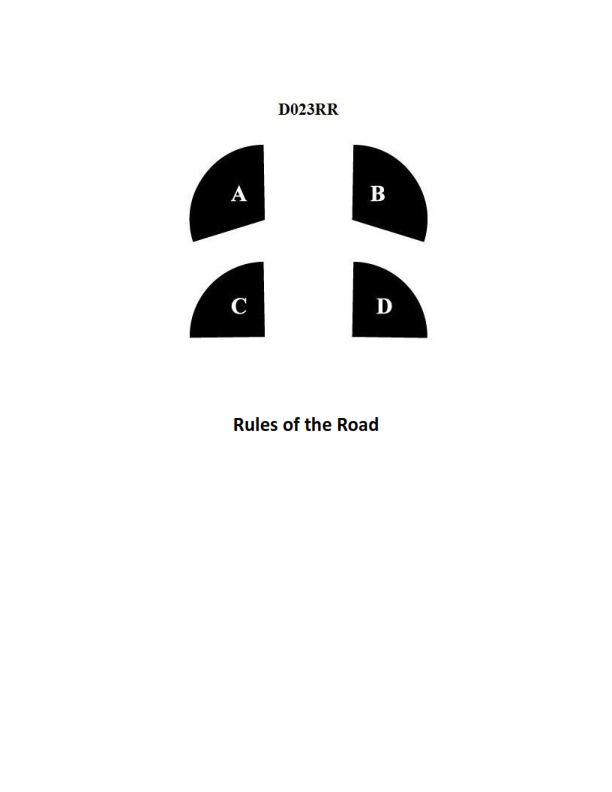
Question 24
Question: BOTH INTERNATIONAL & INLAND In illustration D023RR below which represents the arc of visibility of a red sidelight?
A. A
B. B
C. C
D. D
The Correct Answer is A **Explanation for why option A ("A") is correct:** According to both the International Regulations for Preventing Collisions at Sea (COLREGs) and the U.S. Inland Rules, a red sidelight (port sidelight) must be fixed to show an unbroken light over an arc of the horizon of $112.5$ degrees. This arc starts from directly ahead (the centerline of the vessel) and extends $22.5$ degrees abaft the beam on the port side. Illustration A correctly depicts this $112.5$-degree arc of visibility, extending from the bow to $22.5$ degrees behind the port beam. **Explanation for why each of the other options is incorrect:** * **B) B is incorrect:** This illustration depicts a $112.5$-degree arc of visibility extending from the centerline to $22.5$ degrees abaft the beam on the **starboard (right)** side. This arc represents the visibility of the **green sidelight**, not the red sidelight. * **C) C is incorrect:** This illustration depicts a much wider arc, often $225$ degrees, centered on the bow. This arc of visibility is prescribed for a **masthead light** (steaming light), not a sidelight. * **D) D is incorrect:** This illustration depicts a $135$-degree arc of visibility, usually centered on the stern. This arc is prescribed for a **sternlight**, not a sidelight.
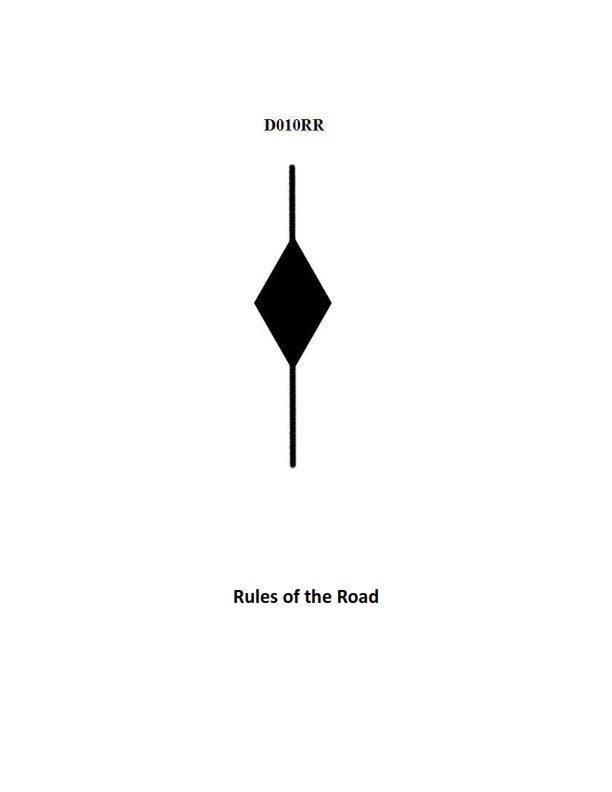
Question 28
Question: BOTH INTERNATIONAL & INLAND Which is TRUE of a tugboat displaying the shape shown in illustration D010RR below?
A. Has a tow that is carrying hazardous cargo
B. Is at anchor
C. Is not under command
D. Has a tow that exceeds 200 meters in length
The Correct Answer is D **Explanation for D (Correct Answer):** The illustration D010RR shows the required dayshape signal for a vessel engaged in towing where the length of the tow (measured from the stern of the towing vessel to the aftermost end of the tow) exceeds 200 meters. According to Rule 24(a)(i) of the International Regulations for Preventing Collisions at Sea (COLREGs), a vessel engaged in towing that exceeds 200 meters in length must display "a diamond shape where it can best be seen." **Explanation for other options (Incorrect):** * **A) Has a tow that is carrying hazardous cargo:** There is no specific day signal defined in COLREGs solely for a tow carrying hazardous cargo. Vessels carrying dangerous goods may display specific signals required by local regulations, but the diamond shape universally signals the length of the tow, not the cargo type. * **B) Is at anchor:** A vessel at anchor must display a black ball (Rule 30). The diamond shape indicates towing over 200 meters. * **C) Is not under command:** A vessel not under command (NUC) must display two black balls in a vertical line (Rule 27(a)). The diamond shape indicates towing over 200 meters.
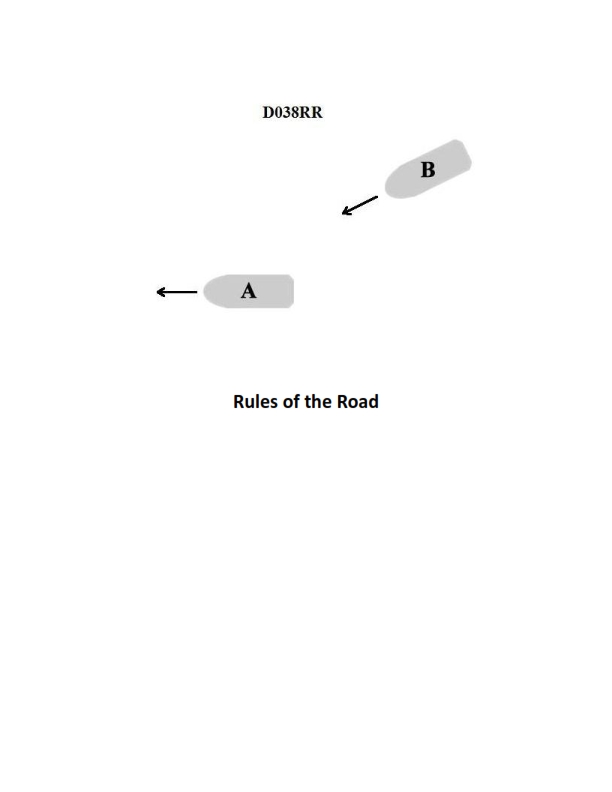
Question 38
Question: INLAND ONLY You are on power-driven vessel "A" and power-driven vessel "B" desires to overtake you on the starboard side as shown in illustration D038RR below. After the vessels have exchanged one blast signals what action should you take?
A. Hold course and speed
B. Slow your vessel until vessel "B" has passed
C. Alter course to the left
D. Alter course to the left or right to give vessel "B" more sea room
The Correct Answer is A ### Explanation for Option A (Hold course and speed) This scenario is governed by the Inland Rules of Navigation (specifically Rule 13: Overtaking and Rule 34: Maneuvering and Warning Signals). 1. **Status of Vessels:** Vessel "A" is the vessel being overtaken, and vessel "B" is the overtaking vessel. 2. **Responsibilities:** Under Rule 13(d), the vessel being overtaken (**Vessel A**) must maintain its course and speed until the other vessel has finally passed and is clear. The overtaking vessel (**Vessel B**) is responsible for keeping clear. 3. **Signal Exchange:** The rule states that the vessels have exchanged one blast signals. On inland waters, the one short blast signal from the overtaking vessel (B) means, "I intend to overtake you on your starboard side." The corresponding one short blast signal from the vessel being overtaken (A) confirms, "I agree to be overtaken on my starboard side." 4. **Action:** Once the agreement is made, Vessel A (the vessel being overtaken) is required to **hold course and speed** to allow the maneuver to be completed safely by Vessel B. ### Why Other Options Are Incorrect **B) Slow your vessel until vessel "B" has passed:** * **Incorrect:** Altering speed is a change of course or speed, which is strictly forbidden for the vessel being overtaken (Vessel A) under Rule 13(d). Changing speed unpredictably makes the overtaking maneuver more dangerous and difficult for Vessel B. **C) Alter course to the left:** * **Incorrect:** Altering course is a change of course or speed, which is strictly forbidden for the vessel being overtaken. Furthermore, altering course to the left (port) would bring Vessel A closer to Vessel B, potentially causing a collision, especially since B is passing on the starboard side. **D) Alter course to the left or right to give vessel "B" more sea room:** * **Incorrect:** Although the motivation might seem helpful, this action violates the cardinal rule that the vessel being overtaken must maintain course and speed. The responsibility of keeping clear and having sufficient sea room rests entirely on the overtaking vessel (Vessel B). Any unrequested or unannounced change in course by Vessel A creates confusion and danger.
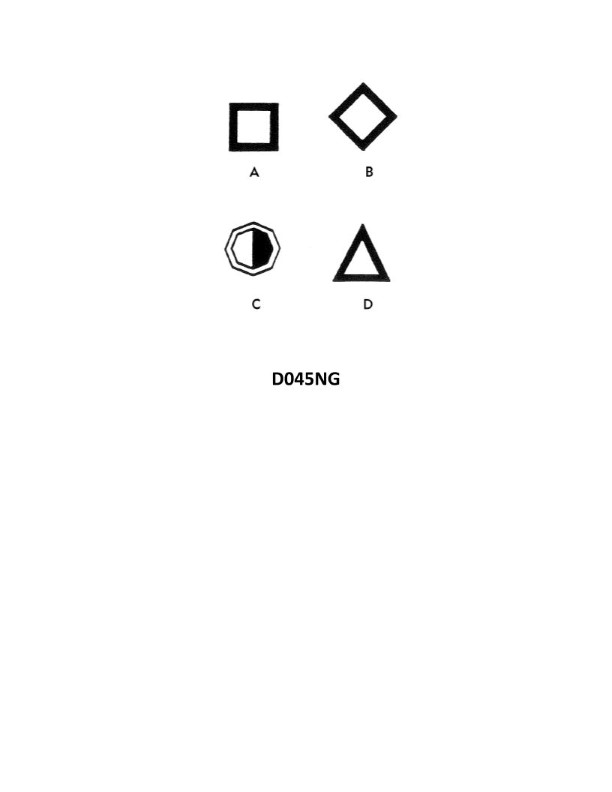
Question 39
Question: You are in a channel inbound from sea. A daymark used to mark a channel junction when the preferred channel is to starboard will have the shape indicated by what letter in illustration D045NG below?
A. A
B. B
C. C
D. D
The Correct Answer is A ### Explanation **Why Option A ("A") is Correct:** The question asks to identify the shape of a daymark used to mark a **channel junction** where the **preferred channel is to starboard** (right) while you are **inbound from sea**. This scenario is covered by the IALA Maritime Buoyage System, specifically relating to Preferred Channel marks. * **Preferred Channel Marks** (or Junction Marks) are characterized by the lateral color of the waterway system (Red or Green), but also include a band of the opposite color to indicate the preferred direction. * In the **IALA Region B** (Americas, Japan, etc.), when inbound, **green** marks are kept to the **starboard** (right) side of the main channel. * A mark indicating the preferred channel is to **starboard** (meaning the main channel continues to the right, and a secondary channel deviates to port) will primarily be **Red** (Port side mark), but will have a single **Green** horizontal band. * The **daymark shape** for all Port (Red) marks is a **Can** (or square/can-like shape). The daymark labeled **A** in illustration D045NG represents a **Red daymark** (Port side mark) with a **Green horizontal band**. Its shape is a **square/can**. This combination correctly indicates a junction mark where the preferred channel is to the starboard (right). **Why the Other Options are Incorrect:** * **Option B ("B"):** Daymark B is a **Green triangle** (or Cone) with a **Red horizontal band**. This mark indicates a junction where the preferred channel is to **port** (left), as it is primarily a Starboard (Green) mark. * **Option C ("C"):** Daymark C is a **Green triangle** (or Cone). This is a standard **Starboard-side mark** used for the main channel (kept to the right when inbound). It does not indicate a channel junction or a preferred channel. * **Option D ("D"):** Daymark D is a **Red square** (or Can). This is a standard **Port-side mark** used for the main channel (kept to the left when inbound). It does not indicate a channel junction or a preferred channel.
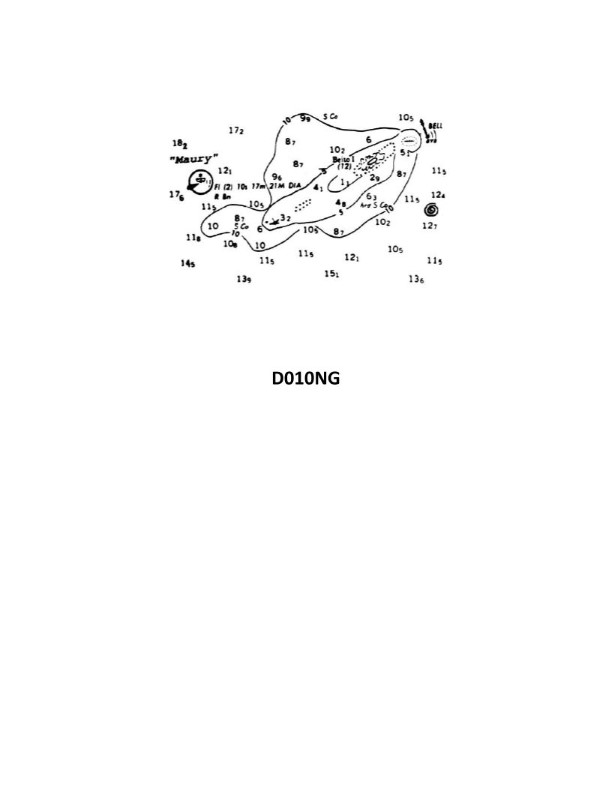
Question 42
Question: Which statement concerning the chartlet seen in illustration D010NG below is TRUE? (Soundings and heights are in meters)
A. There is a dangerous eddy southeast of Beito Island.
B. Maury lightship is visible for 17 miles.
C. The bottom to the south-southeast of the lightship is soft coral.
D. There is a 12-meter-deep hole west of Beito Island and inside the 5-meter line.
The Correct Answer is A **Explanation for Option A (Correct):** Option A states, "There is a dangerous eddy southeast of Beito Island." On nautical charts, dangerous eddies are typically represented by a specific symbol: a circled cross with an arrow indicating the direction of the rotation or flow (often labeled "Eddy, dangerous"). Examining the area southeast of Beito Island in illustration D010NG, this specific symbol is visible, confirming the presence of a dangerous eddy. **Explanation for Other Options (Incorrect):** * **B) Maury lightship is visible for 17 miles.** Lightships (or any lights) have their nominal range indicated on the chart, usually near the light description. If the chartlet followed standard conventions, the range would be written in the light description (e.g., "Vis 17M"). However, the provided illustration D010NG does not show the Maury lightship description indicating a 17-mile visibility. It shows the charted position of the Maury Lightship, but no range is given that confirms this specific distance. * **C) The bottom to the south-southeast of the lightship is soft coral.** Bottom characteristics (seabed nature) are indicated by abbreviations on charts (e.g., S=Sand, M=Mud, Co=Coral). South-southeast of the lightship, the bottom characteristic abbreviation "S Co" is visible. This abbreviation stands for **Sand and Coral** (S Co), not specifically "soft coral." Even if interpreted as coral, standard charting abbreviations for "soft coral" are typically "S Corl" or "Soft Corl," and S Co denotes a mixed bottom of sand and coral. * **D) There is a 12-meter-deep hole west of Beito Island and inside the 5-meter line.** The soundings (depths) west of Beito Island, inside the 5-meter depth contour line, show shallower depths (e.g., 2, 3, or 4 meters), as expected inside the 5-meter line. A detailed sounding of **1.2 meters** (1.2) is visible in this area, which is extremely shallow. There is no sounding of 12 meters ("12") shown in this shallow area that would constitute a deep "hole" relative to its surroundings; a 12-meter sounding would be impossible inside the 5-meter line.
Question 43
Question: INLAND ONLY Two power-driven vessels are meeting in the situation as shown in illustration D037RR below and will pass within 1/2 mile of each other. What does two short blasts from either vessel mean?
A. "I am altering my course to port."
B. "I intend to leave you on my starboard side."
C. "I intend to leave you on my port side."
D. "I am altering my course to starboard."
The Correct Answer is B. **Explanation for Option B (Correct Answer):** This question specifically refers to the **Inland Rules** of the Road (33 CFR Subchapter E). Under the Inland Rules, a whistle signal of **two short blasts** indicates a specific maneuvering intention when vessels are meeting, crossing, or overtaking. According to **Rule 34(a)(i)** of the Inland Rules regarding Operating Signals: * **Two short blasts** mean: "I intend to leave you on my starboard side." This signal communicates the intention of the signaling vessel to alter its course to port (left) in order to pass the other vessel, resulting in the other vessel being positioned on the signaling vessel's starboard (right) side. **Explanation for Other Options (Incorrect):** * **A) "I am altering my course to port."** * While giving two short blasts *often* results in an alteration of course to port, the official definition of the signal is the intention regarding how the vessels will pass relative to each other (Rule 34(a)(i)). Option B provides the precise, legally defined meaning of the signal under the Inland Rules. * **C) "I intend to leave you on my port side."** * This is the definition of **one short blast** under the Inland Rules (Rule 34(a)(i)). One short blast means "I intend to leave you on my port side" (by altering course to starboard). * **D) "I am altering my course to starboard."** * The intent to alter course to starboard is communicated by **one short blast**, which corresponds to the intention defined in Option C. Two short blasts imply a maneuver that places the other vessel on the signaling vessel's starboard side, usually requiring a course alteration to port.
Question 49
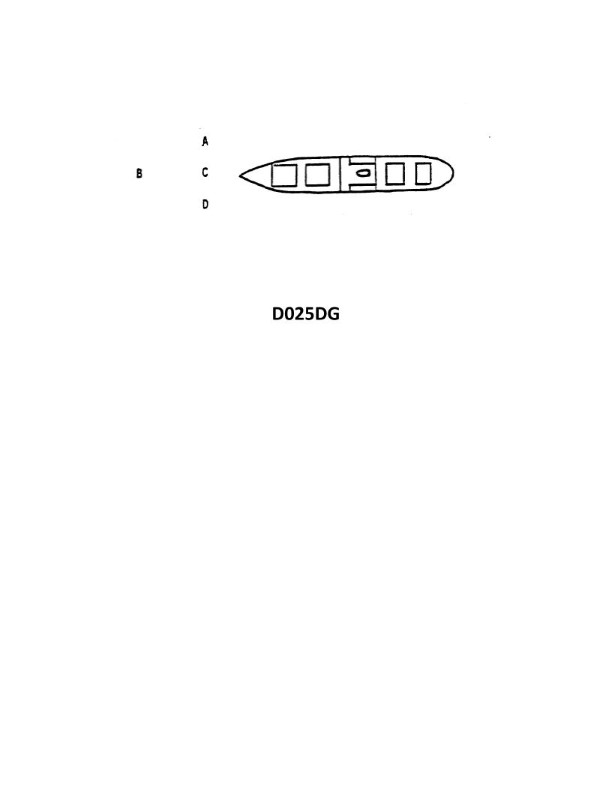
Question: The vessel shown in illustration D025DG has broken down and you are going to take her in tow. The wind is coming from her starboard beam. You are making more leeway than she. Where should you position your vessel when you start running lines?
A. A
B. B
C. C
D. D
The Correct Answer is A. ### Why Option A ("A") is Correct Option A shows the towing vessel positioned slightly upwind (to the starboard side) and forward of the disabled vessel. This is the optimal starting position for running lines under the described conditions: 1. **Wind on Starboard Beam:** The wind is pushing the disabled vessel (D025DG) to port (downwind). 2. **Tow Vessel Making More Leeway:** Since the towing vessel is making more leeway than the disabled vessel, it is drifting sideways (to port) faster than the casualty. 3. **Maneuvering Advantage (Upwind):** By positioning the towing vessel slightly upwind (to starboard, position A), the operator has the advantage of using their engines and rudder to gently drift down onto the casualty while maintaining control. If the towing vessel is placed downwind, it risks being pinned against the casualty without an escape route. 4. **Closing the Gap:** Because the towing vessel is drifting faster (making more leeway), positioning it slightly ahead and upwind ensures that the gap between the two vessels will close naturally as they both drift sideways. The deckhand can then safely retrieve the messenger line or heaving line once the vessels are close enough, without requiring risky, last-minute maneuvers. ### Why Other Options are Incorrect **Option B (B):** Position B is directly downwind (to port) of the disabled vessel. Since the wind is coming from the starboard beam, and the casualty is drifting to port, approaching from B is dangerous. The towing vessel risks being blown onto the casualty, making it difficult to maintain separation, control the approach, and run the lines safely. **Option C (C):** Position C is directly astern of the disabled vessel. While this might be a common approach for simply connecting a tow, it is not ideal when the vessels are actively drifting due to a strong beam wind and one vessel is making more leeway than the other. This position does not take advantage of the drift to safely close the gap; furthermore, if the casualty is stern-to-the-wind, the wake turbulence from the towing vessel could destabilize the casualty. **Option D (D):** Position D is directly upwind (to starboard) but too far aft. If the towing vessel is positioned too far aft, and both vessels are drifting sideways (to port), the disabled vessel's stern will drift faster toward the towing vessel's bow, leading to a diagonal closing maneuver that is difficult to manage and potentially unsafe for the deckhands trying to retrieve the lines from the bow of the casualty. Position A allows for a more controlled, parallel closing along the length of the casualty.
Question 50
Question: The vessel shown in illustration D025DG has broken down and you are going to take her in tow. The wind is on her starboard beam. Both vessels are making the same amount of leeway. Where should you position your vessel when you start running lines?
A. A
B. B
C. C
D. D
The Correct Answer is C ### Explanation for Option C Option C represents the position upwind of the disabled vessel (D025DG). 1. **Upwind Safety:** When approaching a vessel to run lines, the towing vessel must always approach from the upwind side. In this scenario, the wind is on D025DG's starboard beam, meaning the wind is coming from the starboard side. Therefore, the starboard side is the upwind side. 2. **Control and Margin for Error:** By approaching from the upwind position (C), the operator of the towing vessel has maximum control. If the approach is too fast or too close, the operator can reduce power, and the wind pressure will safely push the towing vessel away (downwind) from the casualty. Conversely, the towing vessel can ease in toward the casualty by using minimal propulsion to counteract the wind. 3. **Leeway Consideration:** Since both vessels are making the same amount of leeway (drifting downwind at the same rate), the relative position between them is stable in the lateral direction. Approaching from the upwind position (C) ensures that the relative movement is controlled and that the wind pressure works *for* the maneuvering vessel, not against it. ### Why Other Options Are Incorrect * **A) Incorrect:** Position A is located on the port (downwind) side and likely aft of the disabled vessel. Approaching from the downwind side is extremely hazardous because the wind will constantly be pushing the towing vessel *into* the disabled vessel, making it difficult to hold position, pass lines safely, or recover from an error without collision. * **B) Incorrect:** Position B is on the port (downwind) side. Similar to A, approaching from the downwind side means the wind will force the towing vessel onto the casualty, eliminating the operator's margin for error. * **D) Incorrect:** Position D is on the correct (upwind/starboard) side, but it is located too far aft. When running lines for towing, the primary goal is often to connect to the casualty's forward bitts. Position D is usually too far back to initiate the line-passing maneuver effectively or to safely control the towed vessel's bow motion during the initial hookup. C is the preferred position for initiating the approach to the foredeck area from the upwind side.