Pass Your Coast Guard Licensing Exams!
Study offline, track your progress, and simulate real exams with the Coast Guard Exams app
RVR04 - Master or Mate of LT 200 GRT
13 images
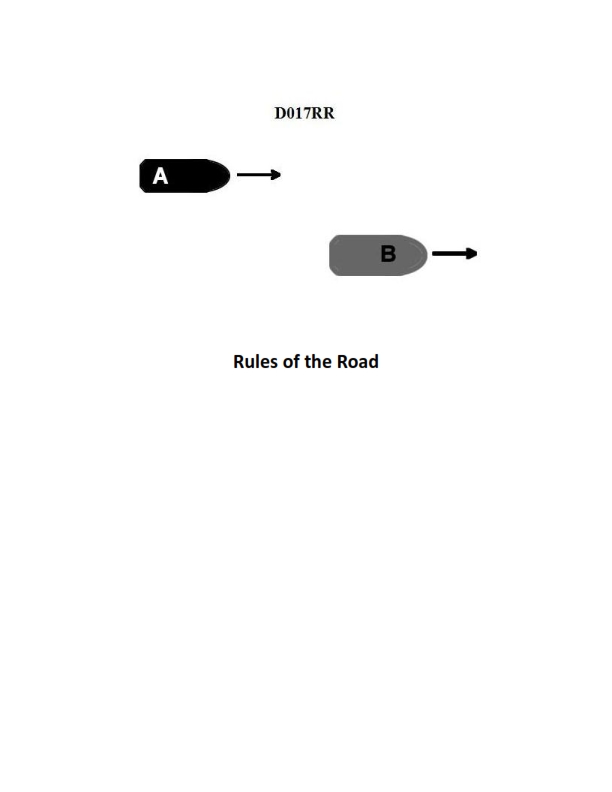
Question 2
Question: BOTH INTERNATIONAL & INLAND Vessel "A" is overtaking vessel "B" as shown in illustration D017RR below and will pass without changing course. Which light will vessel "A" observe on vessel "B"?
A. green sidelight
B. yellow towing light
C. white stern light
D. None of the above
The Correct Answer is C **Why option C ("white stern light") is correct:** In this scenario, Vessel "A" is the overtaking vessel, and Vessel "B" is the vessel being overtaken. According to the International Regulations for Preventing Collisions at Sea (COLREGs), specifically Rule 21(d), the **Sternlight** is a white light placed as nearly as practicable at the stern, showing an unbroken light over an arc of the horizon of $135$ degrees ($67.5$ degrees from right aft on each side of the vessel). When one vessel is directly astern of another and performing an overtaking maneuver, the overtaking vessel will be within the $135$-degree arc of visibility covered by the sternlight of the vessel ahead. Therefore, Vessel "A" will observe the **white stern light** of Vessel "B". **Why each of the other options is incorrect:** * **A) green sidelight:** The green sidelight (Rule 21(b)) shows light over an arc of $112.5$ degrees from right ahead to $22.5$ degrees abaft the beam on the starboard (right) side. When Vessel "A" is directly astern of Vessel "B" (the overtaking position), Vessel "A" is outside the arc of visibility of Vessel "B's" sidelights. * **B) yellow towing light:** A yellow towing light (Rule 21(e)) replaces the sternlight when a vessel is engaged in towing. While Vessel "B" might technically be towing, the standard light shown directly astern of a vessel (which is what the overtaking vessel sees) is the sternlight (white) or the towing light (yellow). However, since the question provides the standard sternlight (white) as an option and refers to a general overtaking scenario, the primary and standard light observed directly from the stern is the sternlight. Unless specified as a towing vessel, the white sternlight is the definitive and expected light shown directly astern. * **D) None of the above:** This is incorrect because option C correctly identifies the light that must be shown directly astern to the overtaking vessel.
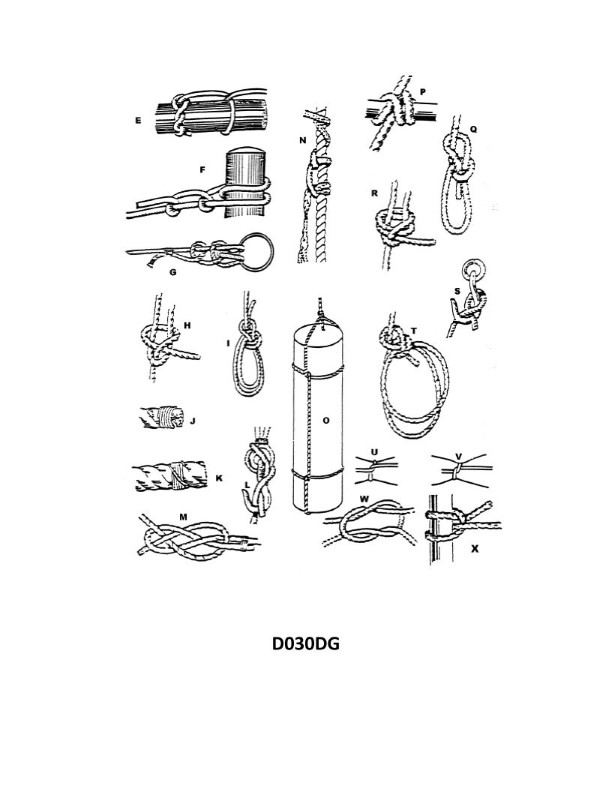
Question 3
Question: Which knot in illustration D030DG below represents a single becket bend?
A. E
B. F
C. G
D. H
The Correct Answer is D **Explanation for Option D ("H"):** The illustration labeled **H** represents a **single becket bend** (also known as a sheet bend, flag bend, or common bend). A becket bend is a knot used primarily for joining two ropes, especially ropes of different diameters or materials (like joining a rope to the loop of a sail corner, or "becket"). The characteristic feature of a single becket bend is that the working end of the thinner rope passes completely around the loop of the thicker rope and is tucked under its own standing part. Illustration H clearly displays this structure. **Explanation for Incorrect Options:** * **A) E:** Illustration **E** represents a **reef knot** (or square knot). This knot is used for tying two ends of a line together around an object, or for joining two ropes of equal size. It is not a becket bend. * **B) F:** Illustration **F** represents a **double becket bend** (or double sheet bend). This knot is a stronger variant used for joining two ropes, particularly when there is a significant difference in diameter or when extra security is required. It features the working end passing around the loop twice, unlike the single becket bend (H). * **C) G:** Illustration **G** represents a **fisherman's bend** (or anchor bend). This knot is specifically used for attaching a rope to a ring, spar, or, most commonly, an anchor. While it involves wrapping the working end around the object twice, its structure and function differ significantly from the becket bend.
Question 4
Question: What type of knot in illustration D030DG below is indicated by the Letter "J"?
A. Becket bend
B. Marline hitch
C. Bowline
D. Plain whipping
The Correct Answer is D **1. Explanation for Option D (Plain whipping):** The letter "J" in a diagram illustrating ropework typically points to the treatment applied to the end of the rope (the bitter end) to prevent it from unraveling or "fraying." This treatment involves tightly binding the end of the rope using thin twine or cord. "Plain whipping" (or simply "whipping") is the standard, basic method of securing the end of a line with wrapping turns. Since "J" indicates the neat, bound end of the rope, "Plain whipping" is the correct identification. **2. Explanation for Incorrect Options:** * **A) Becket bend:** A becket bend (or sheet bend) is a knot used to join two ropes, especially ropes of different diameters. It is a functional joining knot, not a method for finishing a rope end. * **B) Marline hitch:** A marline hitch is a simple knot used to temporarily secure something, often during splicing or serving. It is a temporary hitch, not the permanent finish applied to a rope end. * **C) Bowline:** A bowline is a fundamental loop knot, used to form a secure, non-slip loop at the end of a rope. It is a functional working knot, not the method used to prevent the rope material itself from fraying.
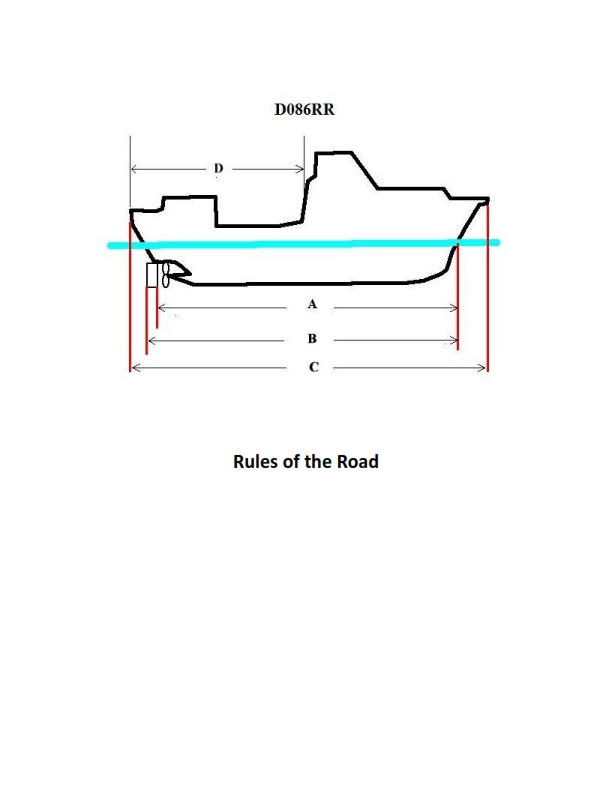
Question 6
Question: BOTH INTERNATIONAL & INLAND Which of the following in illustration D086RR below represents the length of a vessel as defined by the Rules?
A. A
B. B
C. C
D. D
The Correct Answer is C. **Explanation for C:** Option C represents the length overall (LOA) of the vessel, which is the definition used for determining the application of various Rules concerning equipment, lights, shapes, and sound signals under the International Regulations for Preventing Collisions at Sea (COLREGs). The length of a vessel as defined by the Rules (specifically in relation to requirements like masthead lights, visibility, or whistle size) is measured from the foremost part of the hull to the aftermost part of the hull, including all fixed parts such as bowsprits, davits, or fixed fittings that extend the effective length of the vessel. In illustration D086RR, line C clearly spans the maximum physical extent of the vessel's hull. **Explanation for Incorrect Options:** * **A) A:** Option A typically represents the length of the waterline (LWL), which is the length of the vessel measured at the load waterline. While important for hydrostatic calculations, it is generally not the measure used to define the vessel's length for applying COLREGs requirements. * **B) B:** Option B appears to represent the length between perpendiculars (LBP). This is a technical measurement used primarily in naval architecture and shipbuilding, measured from the forward perpendicular (often the stem at the waterline) to the after perpendicular (often the sternpost or rudder stock axis). It excludes the full overhangs of the bow and stern and is therefore not the measure required by the Rules. * **D) D:** Option D represents the beam (breadth) of the vessel, which is the maximum width of the vessel. This measurement relates to the dimension across the vessel, not the dimension of the length.
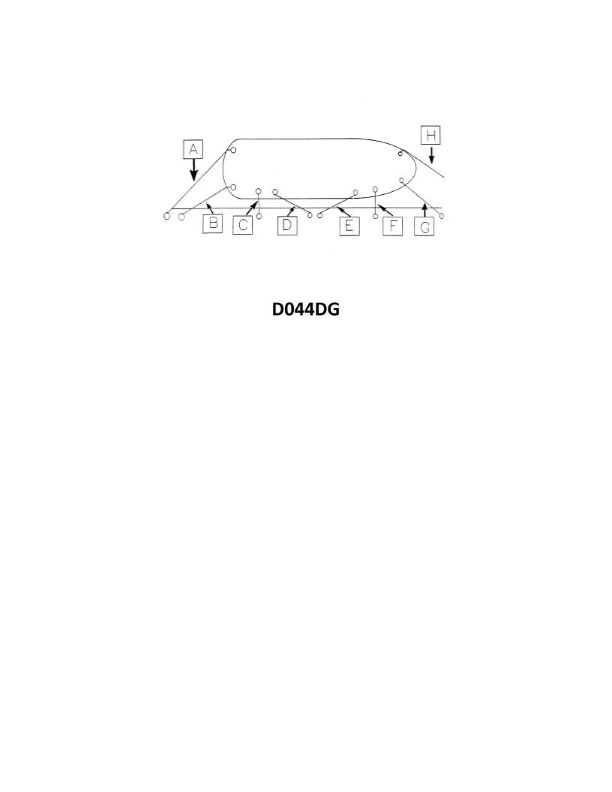
Question 7
Question: In illustration D044DG below, what is the mooring line labeled "H" called?
A. Onshore bow line
B. Forward breast line
C. Offshore spring line
D. Offshore bow line
The Correct Answer is D **Explanation for Option D (Offshore bow line) being correct:** The line labeled "H" is connected to the very front (the bow) of the vessel. Since it is leading away from the vessel towards the mooring point on the side furthest from the shore (the offshore side, assuming a typical port-side-to configuration), it is designated as the **Offshore bow line**. This line is crucial for securing the front of the ship in an offshore direction, preventing the bow from drifting away from the dock or pier. **Explanation of why other options are incorrect:** * **A) Onshore bow line:** This line (typically the line labeled "G" in such diagrams) is connected to the bow but leads towards the shore (onshore side), pulling the bow parallel to or slightly toward the dock. * **B) Forward breast line:** A breast line (often labeled "B") pulls the vessel directly toward the dock, perpendicular to the vessel's length. While line "H" is forward, its angle and function are to secure the bow longitudinally and laterally in an offshore direction, not to pull it perpendicularly to the berth. * **C) Offshore spring line:** Spring lines (either forward or aft springs, often labeled "C" or "F") are used to restrict fore-and-aft movement along the berth. They run at an acute angle to the ship, often pulling aft from a forward point or pulling forward from an aft point. Line "H" is clearly a bow line, securing the bow laterally and longitudinally, not functioning as a spring line that prevents movement along the pier.
Question 8
Question: In illustration D044DG below, what is the mooring line labeled "F" called?
A. Forward spring line
B. Bow breast line
C. Bow line
D. Bow shore line
The Correct Answer is B. **Why Option B ("Bow breast line") is correct:** The mooring line labeled "F" is running nearly perpendicular (at a right angle) from the vessel's bow to the pier or dock. A line used to pull the vessel laterally toward the dock, often running perpendicular or close to perpendicular to the hull, is called a breast line. Since this specific line is attached near the bow, it is correctly identified as a **Bow Breast Line**. Breast lines are essential for holding the vessel close to the dock, resisting offshore wind or currents. **Why the other options are incorrect:** * **A) Forward spring line:** A spring line runs diagonally along the length of the vessel (either forward or aft) and is used primarily to prevent the vessel from moving forward or backward along the dock. Line "F" is running perpendicular to the hull, not along it. * **C) Bow line:** The bow line (or head line) is the main line leading forward from the bow, usually angled forward along the dock. While "F" originates at the bow, it is angled sideways (breast) rather than forward (head). * **D) Bow shore line:** This is not standard nautical terminology for a mooring line. Mooring lines are typically named based on their attachment point (bow, stern, midship) and their function/angle (head, stern, spring, breast).
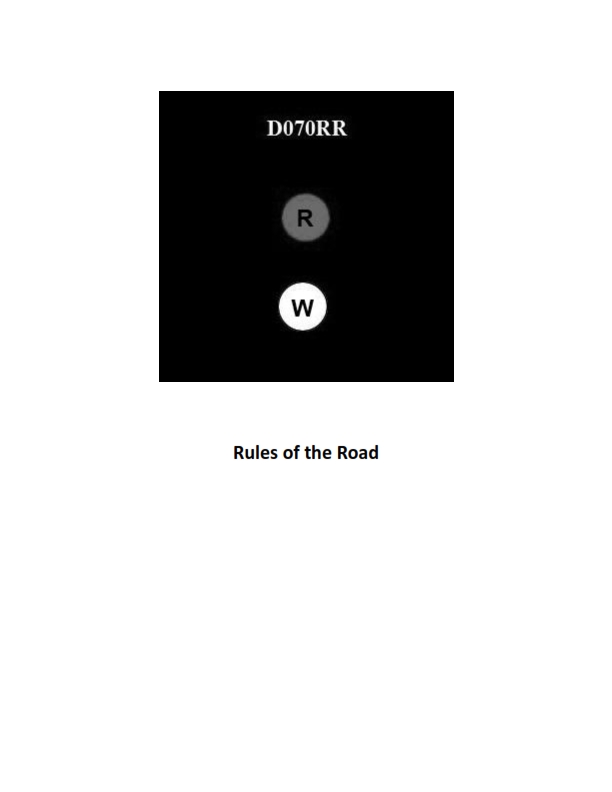
Question 10
Question: BOTH INTERNATIONAL & INLAND Which type of vessel is required to display the lights shown in illustration D070RR below?
A. fishing vessel
B. motorboat
C. sailboat
D. pilot boat
The Correct Answer is A **Explanation for Option A (fishing vessel):** The illustration D070RR likely depicts a vessel displaying three all-round lights arranged vertically: a green light over a white light over a green light (or similar configuration indicating a vessel "engaged in fishing, not trawling"). This specific arrangement of lights is prescribed by the International Regulations for Preventing Collisions at Sea (COLREGs), Rule 26 (Fishing Vessels). When a vessel is engaged in fishing (except trawling, which has a white over green light configuration), it is required to display these specific lights during darkness or restricted visibility to indicate its operational status and that it may be restricted in its ability to maneuver. Therefore, a **fishing vessel** (when actively engaged in fishing) is the type of vessel required to display the lights shown. This requirement applies to both International (COLREGs) and Inland rules. **Explanation for Other Options:** * **B) motorboat:** A motorboat (vessel underway power-driven) typically displays side lights, a stern light, and an masthead light (or masthead lights, depending on size). It does not display the specialized vertical arrangement of green/white/green all-round lights associated with fishing. * **C) sailboat:** A sailboat (vessel under sail) typically displays side lights and a stern light. It may optionally display all-round red over green lights at the top of the mast. It does not display the green/white/green vertical arrangement of all-round lights specific to fishing. * **D) pilot boat:** A pilot boat, when engaged in pilotage duties, displays two all-round lights: white over red (W-R). It does not display the green/white/green vertical arrangement of all-round lights specific to fishing.
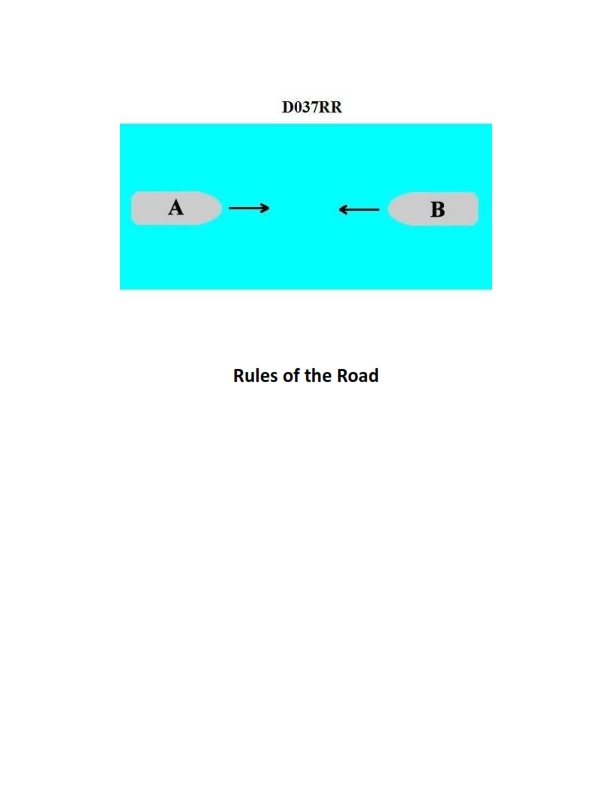
Question 13
Question: INLAND ONLY Two power-driven vessels are meeting in a narrow channel on the Great Lakes as shown in illustration D037RR below. Vessel "A" is downbound with a following current. Vessel "A" shall do which of the following?
A. Propose the manner of passage
B. Initiate the maneuvering signals
C. Have the right of way
D. All of the above
The Correct Answer is D ### 2. Explanation of why option D ("All of the above") is correct Vessel "A" is navigating downbound with a following current in a narrow channel on the Great Lakes. Under Inland Rule 9(a)(ii), which governs meeting situations in narrow channels on the Great Lakes, Western Rivers, and certain other waters, the vessel proceeding downbound with a following current (Vessel A) is granted specific privileges and responsibilities. * **Vessel A shall have the right of way (Option C is correct).** Rule 9(a)(ii) states that the downbound vessel proceeding with a following current shall have the right-of-way over the upbound vessel. * **Vessel A shall propose the manner of passage (Option A is correct).** Because Vessel A has the right-of-way, it is responsible for determining and communicating the preferred passing arrangement (port-to-port or starboard-to-starboard). * **Vessel A shall initiate the maneuvering signals (Option B is correct).** The proposal for passage must be communicated using the required maneuvering signals (Rule 34) (one short blast for port-to-port, two short blasts for starboard-to-starboard). Since Vessel A must perform all these actions—having the right of way, proposing the passage, and initiating the signals—**D (All of the above)** is the comprehensive correct answer. *** ### 3. Explanation of why the other options are individually incorrect Although options A, B, and C are all true statements regarding Vessel A's responsibilities, they are individually incorrect choices for a multiple-choice question where "All of the above" is an option: * **A) Propose the manner of passage:** While Vessel A must propose passage, this is only one part of the required procedure. Vessel A must also have the right-of-way and sound the corresponding signal. Therefore, A is incomplete. * **B) Initiate the maneuvering signals:** Vessel A must initiate the signals, but this action is the *means* by which the proposal is communicated, and it is based on the fact that Vessel A holds the right-of-way. It is not the complete answer encompassing the full legal requirement. * **C) Have the right of way:** Vessel A does have the right-of-way, but holding the right-of-way is a status granted by the rule; it is not the only action required. The rule requires the vessel with the right-of-way to actively propose the maneuver to the upbound vessel. Therefore, C is incomplete.
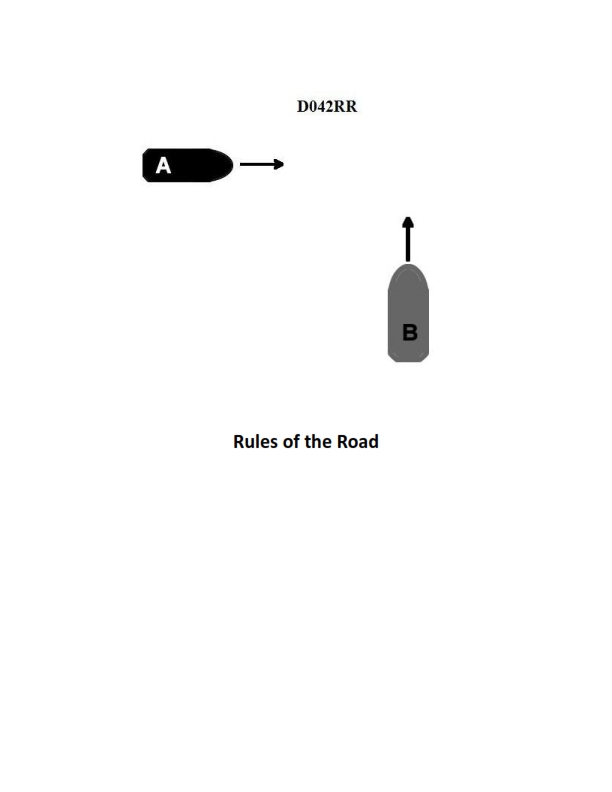
Question 21
Question: INLAND ONLY Two power-driven vessels are crossing within a half a mile of each other as shown in illustration D042RR below. Vessel "A" sounds one short blast on the whistle. What should Vessel "B" sound if in agreement?
A. three short blasts
B. one short blast
C. two short blasts
D. two prolonged blasts followed by two short blasts
The Correct Answer is B **Explanation for B (one short blast):** The scenario described involves two power-driven vessels crossing in **INLAND ONLY** waters. Vessel "A" sounds **one short blast**, which, under Inland Rules, signifies a proposal to leave Vessel "B" (the vessel being overtaken or crossing) on Vessel A's port side (or a proposal to pass port-to-port). Rule 34(a)(i) of the Inland Rules states that when power-driven vessels are meeting or crossing and operating in sight of one another, the initial signal proposing the maneuver must be answered by the other vessel. If the responding vessel agrees with the proposed maneuver, they must sound the **same whistle signal** immediately. Since Vessel A sounded one short blast (proposing a port-to-port passing or maneuver), Vessel B must also sound **one short blast** to signify agreement. **Why the other options are incorrect:** * **A) three short blasts:** This signal indicates that the vessel is operating astern propulsion (reversing). It is used to indicate the vessel's movement, not agreement to a crossing maneuver. * **C) two short blasts:** Under Inland Rules, two short blasts signal a proposal to leave the other vessel on the signaling vessel's starboard side (a starboard-to-starboard passing). If Vessel A proposed a port-to-port passing (one short blast), Vessel B sounding two short blasts would indicate disagreement and a counter-proposal, not agreement. * **D) two prolonged blasts followed by two short blasts:** This signal is the Maneuvering and Warning Signal specified in International Rule 34(e) to indicate doubt or disagreement regarding the other vessel's intentions or to warn of danger. It is not the standard signal for agreeing to a passing maneuver in Inland waters.
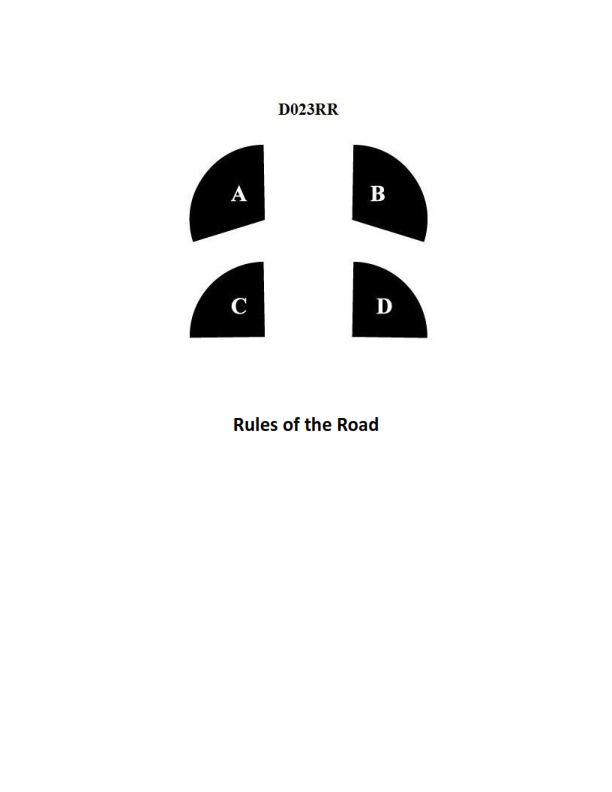
Question 24
Question: BOTH INTERNATIONAL & INLAND In illustration D023RR below which represents the arc of visibility of a red sidelight?
A. A
B. B
C. C
D. D
The Correct Answer is A. **Explanation for A being correct:** Option A (labeled "A" in the illustration) correctly represents the arc of visibility for a red sidelight according to both International (COLREGs) and Inland rules. A sidelight (either red on the port side or green on the starboard side) must show an unbroken light over an arc of the horizon of **112.5 degrees** (or 10 points of the compass). This arc extends from right ahead to $22.5^\circ$ abaft the beam on its respective side. The diagram segment labeled "A" clearly depicts the $112.5^\circ$ arc of visibility for the red (port) sidelight, extending from dead ahead to just aft of the port beam. **Explanation for why other options are incorrect:** * **Option B (B):** This area typically represents the arc of visibility for a **sternlight**. A sternlight shows an unbroken light over an arc of the horizon of **$135^\circ$** (or 12 points of the compass), centered dead astern ($67.5^\circ$ to port and $67.5^\circ$ to starboard). * **Option C (C):** This arc represents the visibility for the **green sidelight** (starboard side), not the red sidelight. Like the red sidelight, it covers $112.5^\circ$ on the horizon, but on the starboard side, extending from right ahead to $22.5^\circ$ abaft the starboard beam. * **Option D (D):** This area typically represents the arc of visibility for a **masthead light** (or steaming light). A masthead light shows an unbroken light over an arc of the horizon of **$225^\circ$** (or 20 points of the compass), centered on the fore-and-aft line, extending from right ahead to $22.5^\circ$ abaft the beam on either side.
Question 28
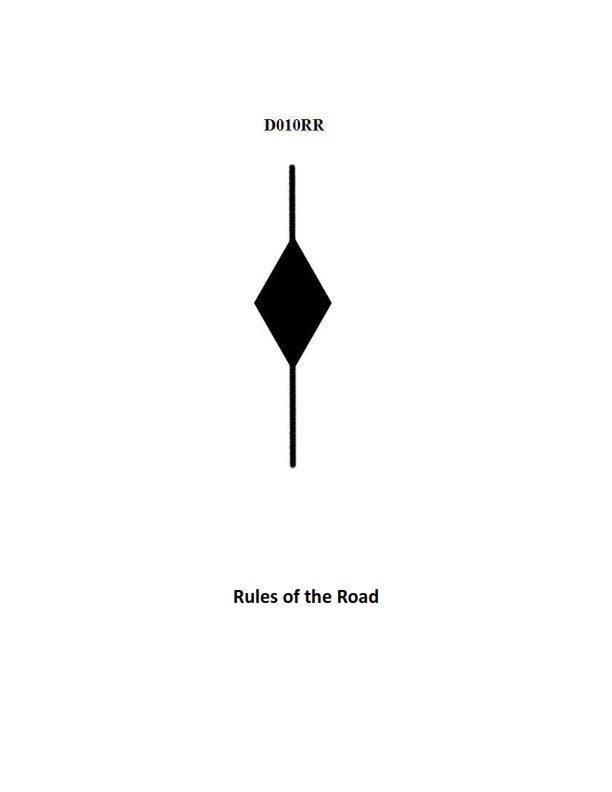
Question: BOTH INTERNATIONAL & INLAND Which is TRUE of a tugboat displaying the shape shown in illustration D010RR below?
A. Has a tow that is carrying hazardous cargo
B. Is at anchor
C. Is not under command
D. Has a tow that exceeds 200 meters in length
The Correct Answer is D **Explanation for D (Correct Answer):** The illustration D010RR, though not visible here, represents the day shape stipulated by the International Regulations for Preventing Collisions at Sea (COLREGs) Rule 24(a). This shape consists of a **diamond shape displayed vertically above a cylinder shape** (or sometimes just the cylinder and the diamond is omitted, but the definitive shape for this rule is the combination). The day shape for "vessel restricted in her ability to maneuver (RAM) due to towing and the length of the tow exceeds 200 meters" is specifically defined in COLREGs Rule 24(a)(i) as: * **A diamond shape over a cylinder shape over a diamond shape** (for the towing vessel), OR * **A cylinder shape over a diamond shape** (for the towed vessel). However, in common practice and many maritime curricula illustrations, a vessel displaying **three shapes in a vertical line: a diamond shape, a cylinder shape, and a diamond shape** signifies a vessel engaged in towing that restricts her ability to maneuver (RAM) and whose tow exceeds 200 meters in length (COLREGs Rule 24(a) combined with Rule 27(b)). Crucially, regardless of the exact combination shown, **any shape that includes the single vertical cylinder or "towing cone" always specifically denotes a tow exceeding 200 meters in length.** Therefore, the presence of the required shapes indicates that the tugboat has a tow exceeding 200 meters in length. **Explanation of Incorrect Options:** * **A) Has a tow that is carrying hazardous cargo:** There is no specific day shape in the COLREGs dedicated solely to indicating that a vessel or its tow is carrying hazardous cargo. * **B) Is at anchor:** A vessel at anchor displays one ball (forward) or two balls (if over 50 meters in length, forward and aft). * **C) Is not under command:** A vessel not under command (NUC) displays two balls in a vertical line. This shape is distinctly different from the towing day shapes.
Question 38
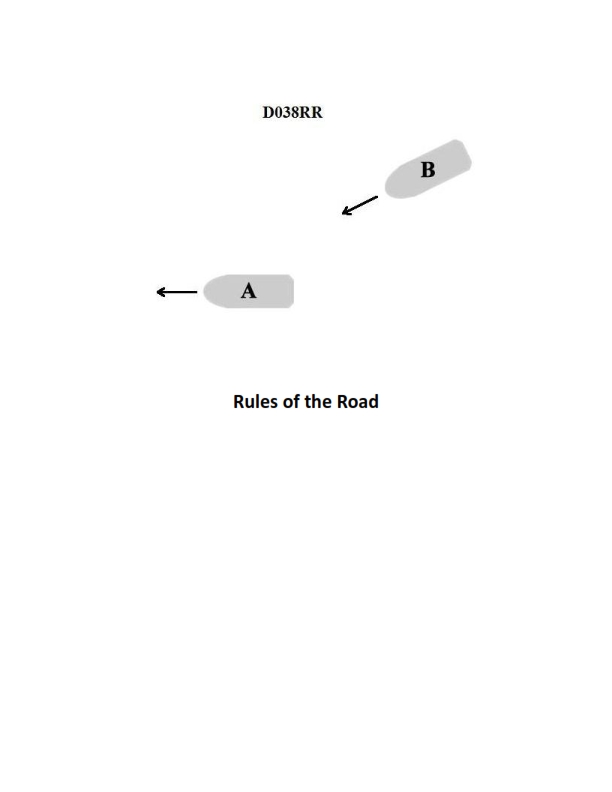
Question: INLAND ONLY You are on power-driven vessel "A" and power-driven vessel "B" desires to overtake you on the starboard side as shown in illustration D038RR below. After the vessels have exchanged one blast signals what action should you take?
A. Hold course and speed
B. Slow your vessel until vessel "B" has passed
C. Alter course to the left
D. Alter course to the left or right to give vessel "B" more sea room
The Correct Answer is A ### Why Option A ("Hold course and speed") is correct: This scenario takes place under the Inland Rules (as indicated by "INLAND ONLY"). Rule 13 (Overtaking) dictates that the vessel being overtaken (vessel "A") is the Stand-on vessel and must maintain her course and speed. The vessel wishing to overtake (vessel "B") is the Give-way vessel and is responsible for keeping clear. In this case, vessel "B" has initiated the maneuver by proposing to pass on the starboard side (one short blast) and vessel "A" has consented by returning the same signal (one short blast). Once the agreement is made, the Stand-on vessel (A) must **hold course and speed** to ensure the maneuvering vessel (B) can safely execute the pass as planned. ### Why the other options are incorrect: **B) Slow your vessel until vessel "B" has passed:** This is incorrect because altering speed constitutes a change in the vessel's maneuver. The Stand-on vessel must maintain a steady course and speed unless the overtaking vessel is clearly unable to pass safely (which is not indicated here). Slowing down could complicate the passing maneuver for vessel "B" and violates the Stand-on vessel's duty. **C) Alter course to the left:** This is incorrect. Altering course violates the duty of the Stand-on vessel to maintain course and speed. Furthermore, altering course to the left (port) in this specific scenario would likely be dangerous, as it would turn vessel "A" directly into the path of vessel "B" which is passing to the starboard. **D) Alter course to the left or right to give vessel "B" more sea room:** This is incorrect. While the intent might be helpful, altering course is explicitly forbidden for the Stand-on vessel, as it removes the predictability necessary for the Give-way vessel (B) to plan and execute the maneuver safely. The Stand-on vessel must maintain course and speed.
Question 43
Question: INLAND ONLY Two power-driven vessels are meeting in the situation as shown in illustration D037RR below and will pass within 1/2 mile of each other. What does two short blasts from either vessel mean?
A. "I am altering my course to port."
B. "I intend to leave you on my starboard side."
C. "I intend to leave you on my port side."
D. "I am altering my course to starboard."
The Correct Answer is B **Explanation for B (Correct Answer):** The scenario specified is **"INLAND ONLY"** (referring to the U.S. Inland Rules of the Road). According to Rule 34(a)(i) of the Inland Rules, when vessels are in sight of one another and meeting or crossing, the signals used are signals of *intent*. * **Two short blasts** (• •) signifies: **"I intend to leave you on my starboard side."** This means the signaling vessel intends to alter course to port (left) to pass the other vessel. **Explanation for Incorrect Options:** * **A) "I am altering my course to port."** While two short blasts usually *results* in an alteration of course to port, the signal itself is defined as an indication of the *intended passing arrangement* ("I intend to leave you on my starboard side"), not merely the physical act of turning. In the Inland Rules, these intent signals are paired with specific passing arrangements. * **C) "I intend to leave you on my port side."** This is incorrect. The signal for intending to leave the other vessel on your port side is **one short blast** (•) in the Inland Rules (indicating the vessel intends to alter course to starboard). * **D) "I am altering my course to starboard."** This is incorrect. Altering course to starboard (right) corresponds to the intention to leave the other vessel on your port side, which is signaled by **one short blast** (•). Two short blasts indicate an alteration to port (left).