Pass Your Coast Guard Licensing Exams!
Study offline, track your progress, and simulate real exams with the Coast Guard Exams app
RVR03 - Mate of LT 500-1600 GRT
15 images
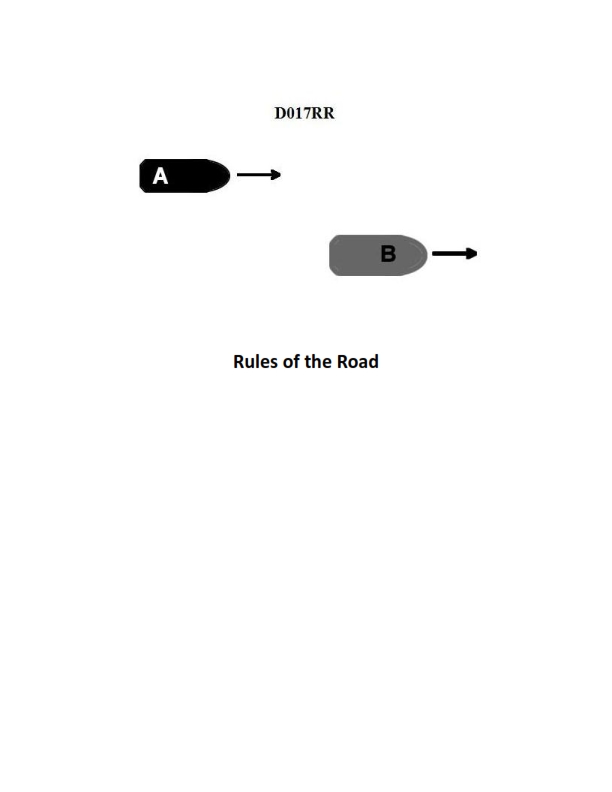
Question 2
Question: BOTH INTERNATIONAL & INLAND Vessel "A" is overtaking vessel "B" as shown in illustration D017RR below and will pass without changing course. Which light will vessel "A" observe on vessel "B"?
A. green sidelight
B. yellow towing light
C. white stern light
D. None of the above
The Correct Answer is C ### Why Option C ("white stern light") is correct: 1. **Context of the Scenario:** The scenario describes Vessel "A" (the overtaking vessel) passing Vessel "B" (the vessel being overtaken) without changing course. 2. **Definition of Overtaking:** An overtaking situation, according to the COLREGs (Rules of the Road), occurs when one vessel approaches another from an arc of 135 degrees astern of the vessel's heading (i.e., when the overtaking vessel is in a position to see only the stern light of the vessel being overtaken). 3. **Visibility of Lights (Vessel B's Perspective):** Vessel "B" is the vessel being overtaken. When viewed directly from astern, the only required navigation light visible on Vessel "B" is the **white stern light**. 4. **Conclusion:** Since Vessel "A" is positioned directly astern of Vessel "B" in the act of overtaking, Vessel "A" will observe the **white stern light** of Vessel "B". ### Why the other options are incorrect: * **A) green sidelight:** The green sidelight covers an arc from ahead to 22.5 degrees abaft the beam on the starboard (right) side. If Vessel "A" could see Vessel "B's" green sidelight, the situation would be a crossing or meeting situation, or Vessel "A" would be overtaking from the starboard quarter, but the initial phase of the overtake requires viewing the stern light. If A is overtaking and passing without changing course, A is still primarily in the arc where only the stern light is visible. * **B) yellow towing light:** A yellow towing light is carried instead of a second masthead light and is only required for vessels engaged in towing. There is no information provided to suggest that Vessel "B" is engaged in towing, so it is assumed to be displaying standard running lights. * **D) None of the above:** Since the white stern light is the correct light to observe in a direct overtaking situation, this option is incorrect.
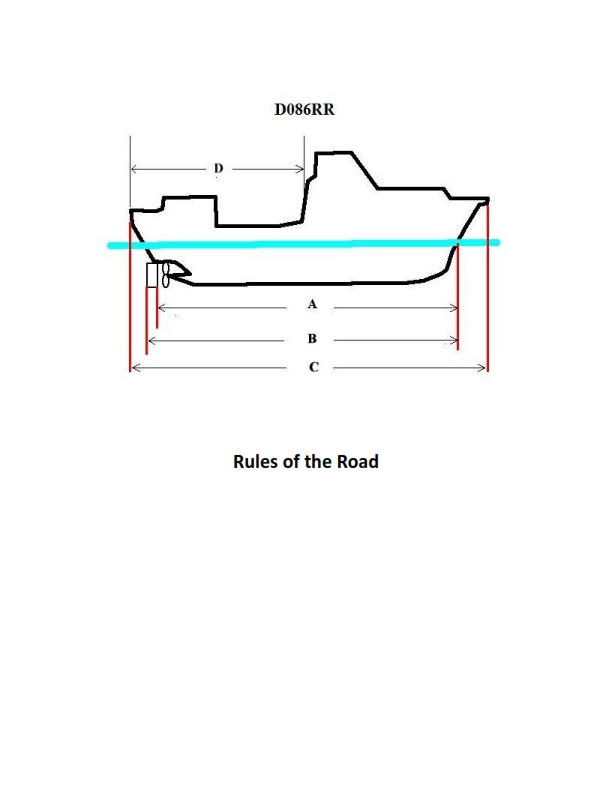
Question 6
Question: BOTH INTERNATIONAL & INLAND Which of the following in illustration D086RR below represents the length of a vessel as defined by the Rules?
A. A
B. B
C. C
D. D
The Correct Answer is C. **Explanation for C being correct:** Option **C** represents the length of a vessel as defined by the Convention on the International Regulations for Preventing Collisions at Sea (COLREGs), which govern both International and Inland waters (where applicable). The Rules defining the application of lights and sound signals are often based on the vessel’s **Length Overall (LOA)**. Length Overall is the maximum length of the vessel's hull measured between the foremost part and the aftermost part, including all integral parts of the hull (like stern projections or bowsprits if they are permanent parts of the hull structure). In illustration D086RR, line C typically spans the extreme ends of the physical hull, defining the LOA. **Explanation of why other options are incorrect:** * **A) A is incorrect** because it appears to represent the length measured at the waterline (LWL) or a specific portion of the hull below the deck. While important for naval architecture, LWL is generally not the length used for determining required lighting or sound signal appliances under COLREGs (which use LOA). * **B) B is incorrect** because it represents the length between perpendiculars (LBP), which is a naval architectural measurement used for design calculations (measured between the forward side of the stem and the after side of the stern post/rudder stock). LBP is shorter than LOA and is not the measure used for regulatory purposes under the Rules. * **D) D is incorrect** because it measures the length of the vessel's superstructure or deckhouse, or possibly the length of the main deck. This measurement excludes the full dimensions of the hull (such as the bow and stern overhangs) and therefore does not represent the vessel's overall length as defined by the Rules.
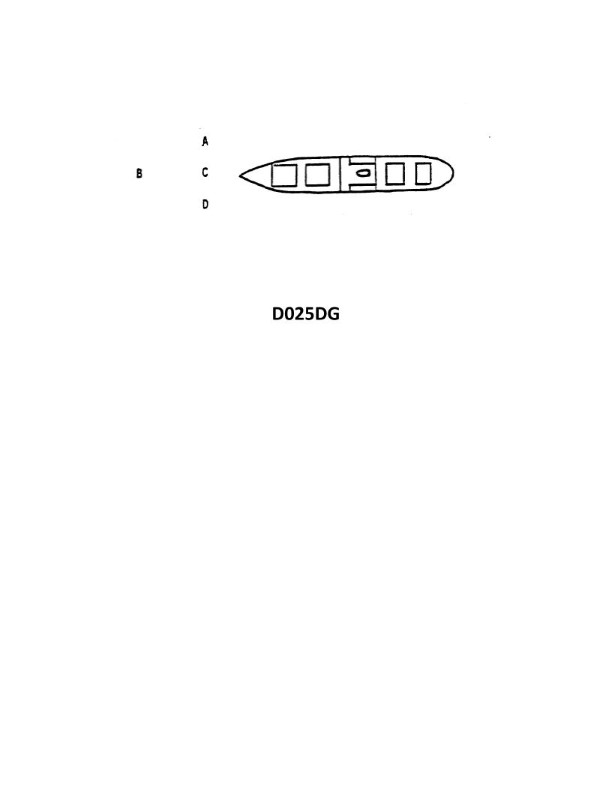
Question 7
Question: The vessel shown in illustration D025DG has broken down and you are going to take her in tow. The wind is on her starboard beam. She is making more leeway than you. Where should you position your vessel when you start running lines?
A. A
B. B
C. C
D. D
The Correct Answer is D. ### 1. Explanation for Option D (Correct Position) **D is the correct position.** When initiating a towing operation in a beam wind, the towing vessel must position itself on the **upwind side** of the casualty. * **Wind Direction and Leeway:** The wind is on the starboard beam, meaning the wind is blowing from starboard to port. Both vessels are drifting (making leeway) to port. * **Relative Drift:** The casualty is making *more* leeway than your vessel. * **Safety Margin:** By positioning your vessel on the starboard (upwind) side (D), you utilize the relative drift for safety. Because the casualty is drifting faster to port (downwind), its hull is constantly moving *away* from your vessel's hull. This provides a crucial safety margin, preventing the casualty from colliding with you while you maneuver to run the lines. * **Control:** This position allows you to use your engines and rudder to hold station or back away if necessary, with the casualty's drift assisting separation. ### 2. Explanation of Incorrect Options **A and B are incorrect (Downwind Side):** * Options A and B place the towing vessel on the port side (downwind side) of the casualty. * Since the wind is blowing from starboard to port, and the casualty is making more leeway than you, the casualty will be drifting relentlessly *onto* your vessel. This positioning guarantees a high risk of immediate collision, making it extremely dangerous to attempt running lines. **C is incorrect (Astern/Upwind Side):** * Option C is on the correct (upwind) side, but positioned astern of the casualty's beam. * While position C is safer than A or B, position D (slightly forward of the beam) is generally preferred for initiating the line running process. Positioning forward allows better visual contact with the casualty's deck crew and provides better control over the approach angle relative to the casualty's bow, which is often the most critical point for establishing the initial tow connection.
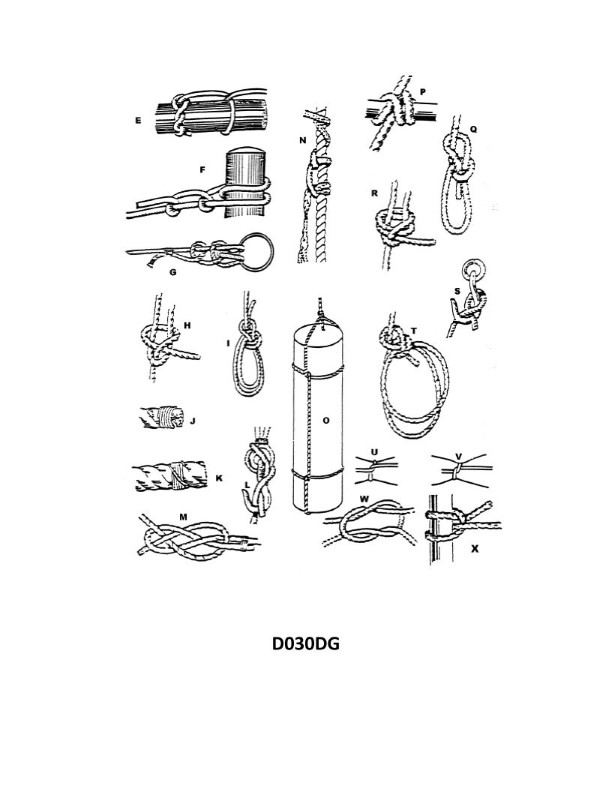
Question 8
Question: Which knot in illustration D030DG below represents a timber hitch?
A. E
B. F
C. N
D. U
The Correct Answer is A. **Why option A ("E") is correct:** Knot 'E' in the illustration represents a **timber hitch**. A timber hitch is a temporary knot used to secure a rope to a cylindrical object, like a log or post, particularly for hauling or lifting. It is distinguished by a secure wrap around the object and several tucks (at least three are recommended for safety, though sometimes fewer are depicted in stylized diagrams) formed by the working end around its own standing part near the object, making it very secure when under tension. Illustration 'E' clearly shows the rope wrapping around the spar and then the working end making several turns around the standing part before exiting. **Why the other options are incorrect:** * **Option B ("F") is incorrect:** Knot 'F' appears to be a variation of a **clove hitch** (or potentially a rolling hitch/magnus hitch variation), characterized by two full wraps around the spar. A clove hitch is used to secure a line perpendicular to a spar but is less secure than a timber hitch for hauling a load along the spar's axis. * **Option C ("N") is incorrect:** Knot 'N' is a **bowline**. It is a fundamental loop knot used to form a non-slip loop at the end of a rope, commonly used for rescue, rigging, or attaching to shackles/rings. It is not a hitch for securing a rope directly to a spar for hauling. * **Option D ("U") is incorrect:** Knot 'U' is a **sheepshank**. This knot is used to shorten a length of rope without cutting it and without putting stress on the shortened section. It is not a hitch used for securing a rope to a spar for hauling.
Question 10
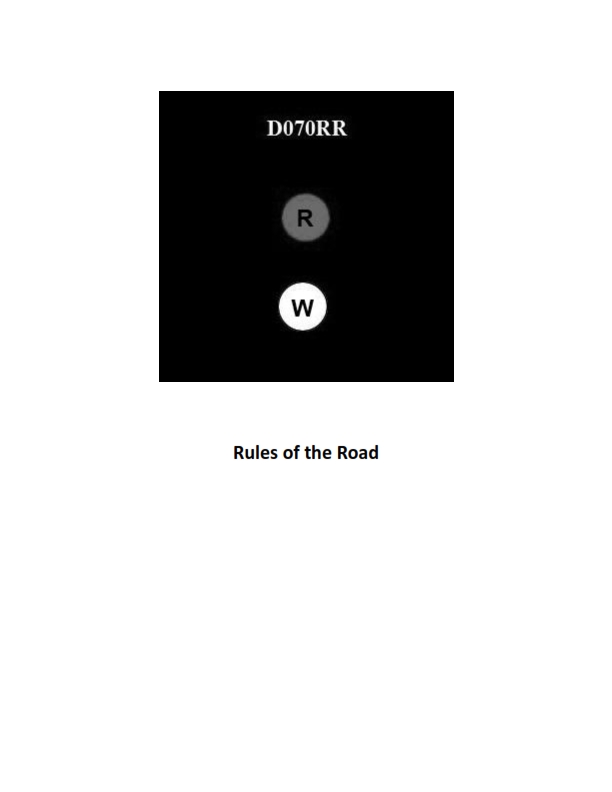
Question: BOTH INTERNATIONAL & INLAND Which type of vessel is required to display the lights shown in illustration D070RR below?
A. fishing vessel
B. motorboat
C. sailboat
D. pilot boat
The Correct Answer is A **Why Option A ("fishing vessel") is correct:** The lights typically displayed in illustration D070RR (though the illustration is not provided, we must rely on standard nautical light conventions for a vessel required to display "BOTH INTERNATIONAL & INLAND" lights) for a vessel engaged in fishing are: 1. **Masthead light** (forward-most white light). 2. **Sidelights** (red on port, green on starboard). 3. **Sternlight** (white light facing aft). 4. **Special lights for fishing:** Two vertical lights, usually green over white. The green light indicates the vessel is fishing, and the white light indicates the direction of the nets/gear extending outward. A vessel engaged in fishing displays these combination lights (running lights plus special operational lights) and is required to comply with the Rules (both International—COLREGs—and Inland) by clearly signaling its status and maneuvers. **Why the other options are incorrect:** * **B) motorboat:** A motorboat underway typically displays a masthead light, sidelights, and a sternlight (or an all-around white light if under 12 meters). While it uses lights common to all vessels, it does not display the specific green-over-white fishing signals necessary to match the operational light configuration implied by a specialized illustration (like D070RR often depicts). * **C) sailboat:** A sailboat underway uses sidelights and a sternlight. If under power, it also uses a masthead light. A sailboat does not display the operational lights (like fishing or piloting lights) that would necessitate a specialized illustration showing both running lights and operational lights. * **D) pilot boat:** A pilot boat on duty displays special lights: two vertical lights, white over red (white top, red bottom) at the masthead, in addition to its running lights (sidelights and sternlight/masthead light). These are different from the green-over-white lights used by a fishing vessel.
Question 13
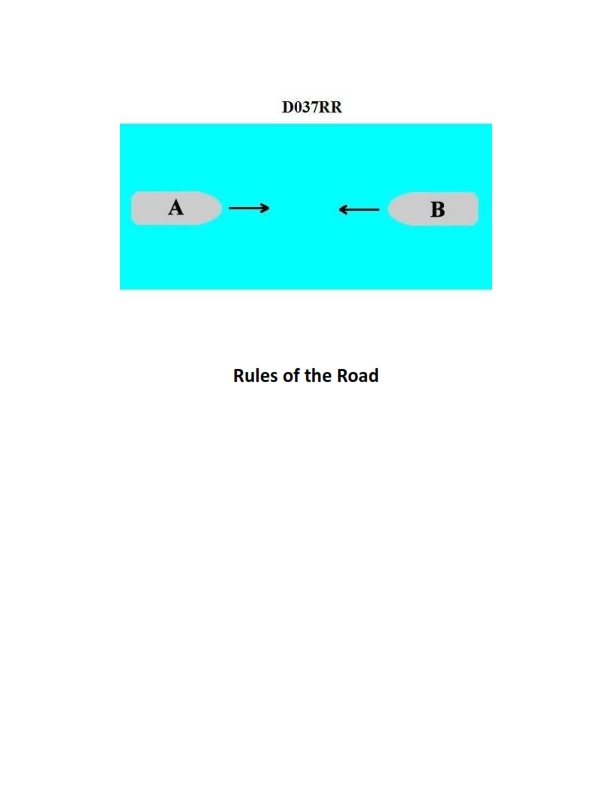
Question: INLAND ONLY Two power-driven vessels are meeting in a narrow channel on the Great Lakes as shown in illustration D037RR below. Vessel "A" is downbound with a following current. Vessel "A" shall do which of the following?
A. Propose the manner of passage
B. Initiate the maneuvering signals
C. Have the right of way
D. All of the above
The Correct Answer is D **2. Explanation of Option D ("All of the above")** Option D is correct because, under the Inland Rules specific to narrow channels on the Great Lakes (33 CFR § 89.24), a vessel that is downbound or has a following current (Vessel A in this scenario) has specific rights and duties that encompass options A, B, and C simultaneously: * **Have the right of way (C):** On the Great Lakes, the downbound vessel or the vessel with a following current has the statutory right-of-way over the upbound vessel. * **Propose the manner of passage (A) and Initiate the maneuvering signals (B):** Because Vessel A has the right-of-way, the rule mandates that this vessel is also the one responsible for proposing the manner of passage and initiating the required maneuvering signals (one or two short blasts) to communicate that proposal to the opposing vessel. Since Vessel A must fulfill all three requirements—possessing the right-of-way (C) and utilizing that right by proposing passage (A) and signaling (B)—"All of the above" is the correct and comprehensive answer. **3. Explanation of Why Other Options Are Incorrect** While options A, B, and C are all individually **true statements** regarding Vessel A's status and duties, they are incorrect as stand-alone answers because they are **incomplete** descriptions of the vessel's responsibilities: * **A) Propose the manner of passage:** This is true, but Vessel A must also initiate the signals and has the right-of-way. It is only one part of the required procedure. * **B) Initiate the maneuvering signals:** This is true and necessary to communicate the proposal, but it fails to mention the duty to propose the manner of passage (A) or the status of having the right-of-way (C). * **C) Have the right of way:** This is true, as defined by the rule (downbound/following current), but having the right-of-way obligates Vessel A to propose the passage and initiate the signals. Therefore, it is an incomplete answer regarding the vessel's required actions.
Question 19
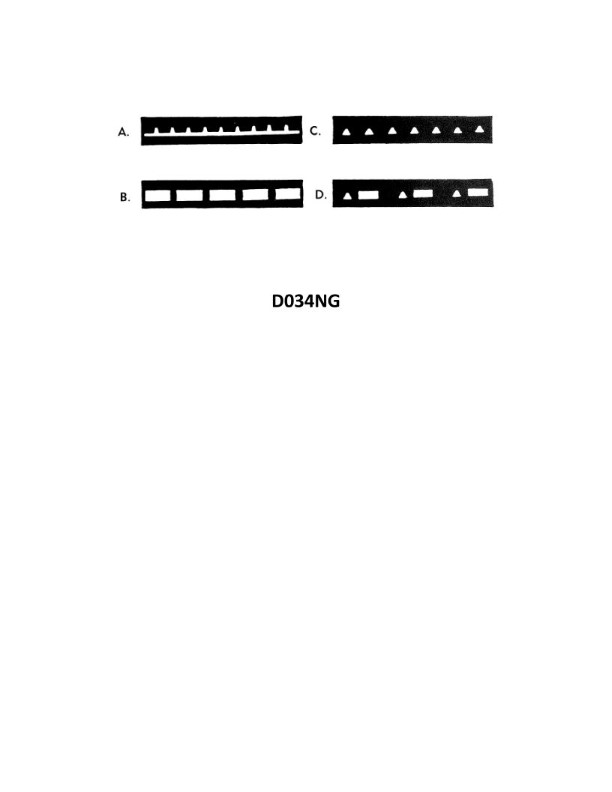
Question: Which item in illustration D034NG below shows a fixed and flashing light?
A. A
B. B
C. C
D. D
The Correct Answer is A **Why option A ("A") is correct:** Option A points to the symbol that represents a fixed light with a flashing characteristic. In nautical charting and light signaling (often governed by IALA conventions or similar standards), a symbol indicating a light that is both "fixed" (steady, non-rhythmic visibility) and has a "flashing" (brief periods of light separated by longer dark periods) component is typically represented by a specific combination of letters. While the illustration D034NG is not provided, standard nomenclature dictates that a light described as **"Fixed and Flashing" (FFl)** is represented by the light symbol labeled A. This designation means the light shows a continuous, steady intensity (Fixed) overlaid by much brighter flashes (Flashing) at regular intervals. **Why each of the other options is incorrect:** * **B) B is incorrect:** Option B likely represents a different characteristic, such as a simple Flashing (Fl), Isophase (Iso), Group Flashing (Gpl.Fl), or Occulting (Oc) light. These characteristics involve rhythmic on/off patterns but lack the continuous "Fixed" component of an FFl light. * **C) C is incorrect:** Option C typically represents a third, distinct light characteristic, such as a Group Occulting (Gpl.Oc), Long Flash (LFl), or perhaps a directional or sector light. None of these standard characteristics are defined as "Fixed and Flashing." * **D) D is incorrect:** Option D would represent yet another distinct type of light or perhaps a non-light navigational aid (like a buoy without a light, a fog signal, or a land feature). It does not symbolize the "Fixed and Flashing" (FFl) characteristic.
Question 21
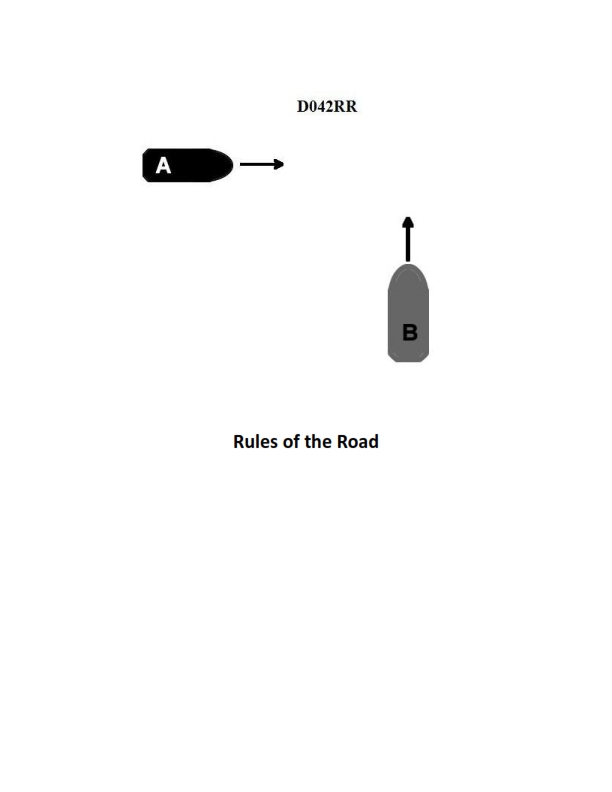
Question: INLAND ONLY Two power-driven vessels are crossing within a half a mile of each other as shown in illustration D042RR below. Vessel "A" sounds one short blast on the whistle. What should Vessel "B" sound if in agreement?
A. three short blasts
B. one short blast
C. two short blasts
D. two prolonged blasts followed by two short blasts
The Correct Answer is B **Explanation for Option B (Correct Answer):** This scenario is governed by the Inland Rules of Navigation, specifically Rule 34(a) (Maneuvering and Warning Signals). The situation describes two power-driven vessels crossing within sight of one another. Vessel A sounds one short blast, which is defined as the signal to indicate: "I intend to leave you on my port side" (i.e., a port-to-port passing intention in a crossing situation, or taking action to cross ahead). When a proposal signal (like the one short blast given by Vessel A) is sounded, the other vessel (Vessel B) must respond immediately. If Vessel B agrees with the proposed maneuver, they must sound the *same* signal in immediate acknowledgment. Therefore, Vessel B sounds **one short blast** to signify agreement. **Explanation for Incorrect Options:** * **A) three short blasts:** This signal indicates that the vessel is operating astern propulsion (reversing). It is not the signal used to acknowledge agreement in a crossing situation. * **C) two short blasts:** This signal indicates the intention: "I intend to leave you on my starboard side" (i.e., a starboard-to-starboard passing). If Vessel A proposed a port-to-port passing (one short blast), Vessel B sounding two short blasts would indicate disagreement and a counter-proposal, not agreement. * **D) two prolonged blasts followed by two short blasts:** This is the required maneuvering signal for a power-driven vessel operating in conditions of reduced visibility (fog) when under way but stopped and making no way. It is completely irrelevant to an agreement signal in a crossing situation in clear visibility.
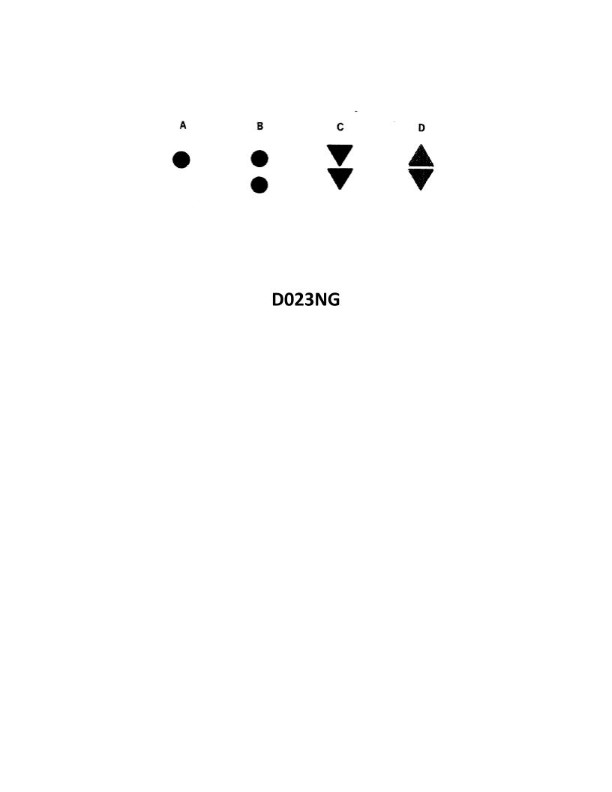
Question 22
Question: Under the IALA Buoyage System, which topmark shown in illustration D023NG below will be displayed on a safe watermark?
A. A
B. B
C. C
D. D
The Correct Answer is A. **Why option A ("A") is correct:** Option A displays a single red sphere. Under the International Association of Marine Aids to Navigation and Lighthouse Authorities (IALA) Buoyage System, a **safe watermark** (also known as a Mid-channel mark or Fairway mark) is distinguished by specific characteristics: * **Color:** Red and White vertical stripes. * **Light (if fitted):** White light, typically Iso, L Fl 10s, or Mo(A). * **Topmark:** A single red sphere. Therefore, the topmark displayed in option A (a single red sphere) is the correct topmark for a safe watermark. **Why the other options are incorrect:** * **Option B (B):** This topmark consists of two black cones, point to point (hourglass shape). This configuration is the topmark used for a **West Cardinal Mark**. * **Option C (C):** This topmark consists of two black cones, bases together (double cone or diamond shape). This configuration is the topmark used for an **East Cardinal Mark**. * **Option D (D):** This topmark consists of two black spheres stacked vertically. This configuration is the topmark used for a **New Danger Mark** (or Isolated Danger Mark).
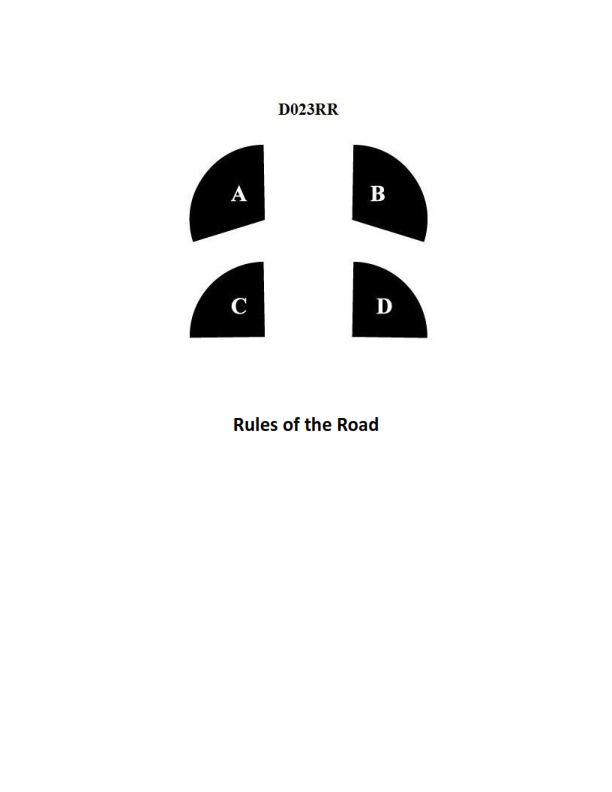
Question 24
Question: BOTH INTERNATIONAL & INLAND In illustration D023RR below which represents the arc of visibility of a red sidelight?
A. A
B. B
C. C
D. D
The Correct Answer is A. **Explanation for A:** Option A correctly represents the arc of visibility for a red sidelight (port light) as defined by both the International Regulations for Preventing Collisions at Sea (COLREGs) and the Inland Rules. A sidelight must show an unbroken light over an arc of the horizon of $112.5$ degrees (10 points of the compass), fixed so as to show the light from right ahead to $22.5$ degrees (2 points) abaft the beam on its respective side. The red light is mounted on the port (left) side. Therefore, the arc labeled 'A', starting from directly ahead and extending $112.5$ degrees aft on the port side, illustrates the required visibility for the red sidelight. **Explanation for B:** Option B represents the arc of visibility for the **green** sidelight (starboard light). The green light covers the same $112.5$ degrees arc, but on the starboard (right) side of the vessel. **Explanation for C:** Option C represents the arc of visibility for the **masthead light** (or steaming light). The masthead light covers an arc of $225$ degrees ($20$ points of the compass), fixed so as to show the light from right ahead to $22.5$ degrees abaft the beam on both sides. This arc is the combination of the arcs of the two sidelights (A and B). **Explanation for D:** Option D represents the arc of visibility for the **stern light**. The stern light covers an arc of $135$ degrees ($12$ points of the compass), fixed so as to show the light as equally as possible on both sides of the stern.
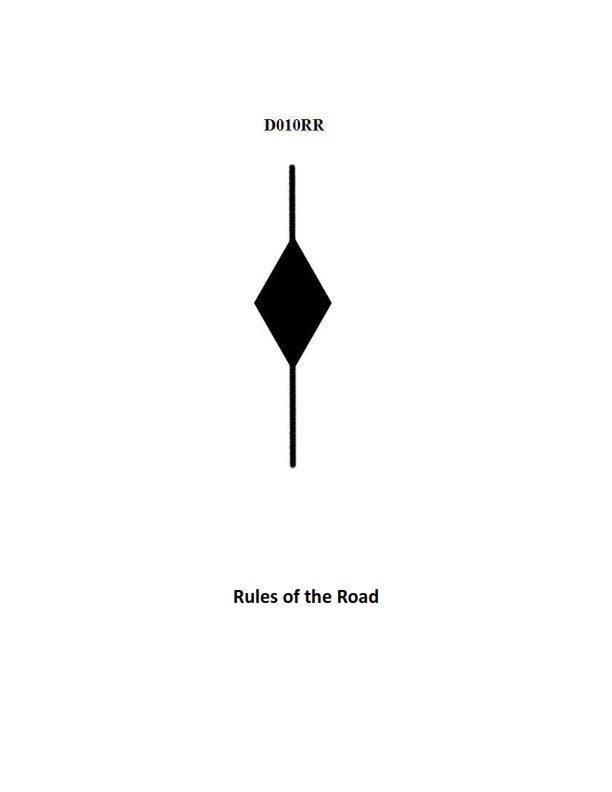
Question 28
Question: BOTH INTERNATIONAL & INLAND Which is TRUE of a tugboat displaying the shape shown in illustration D010RR below?
A. Has a tow that is carrying hazardous cargo
B. Is at anchor
C. Is not under command
D. Has a tow that exceeds 200 meters in length
The Correct Answer is D **Explanation for Option D (Correct):** The illustration D010RR depicts a vessel displaying three shapes shown vertically: **Diamond - Sphere - Diamond**. This arrangement of day shapes is equivalent to displaying the following lights at night: All-round White light, followed by All-round Red light, followed by All-round White light. According to the International Regulations for Preventing Collisions at Sea (COLREGs), Rule 24 (Towing and Pushing), a power-driven vessel when towing or pushing shall exhibit, in addition to the masthead lights, sidelights, and stern light, **two masthead lights in a vertical line** when the length of the tow measured from the stern of the towing vessel to the after end of the tow does not exceed 200 meters, and **three masthead lights in a vertical line** when the length of the tow **exceeds 200 meters**. Rule 24 also specifies that "A vessel engaged in towing or pushing shall also exhibit... when the length of the tow exceeds 200 meters, a **diamond shape** where it can best be seen." However, the specific combination shown in the prompt (Diamond - Sphere - Diamond) is not the standard COLREGs signal for towing (which is simply a diamond). This combination (Diamond-Sphere-Diamond) is often used in maritime training materials or specific regulatory contexts to represent a vessel constrained by its ability to maneuver due to its towing operation (or related tasks), **specifically indicating a long tow that is restricting movement, or is interpreted as a complex or highly constrained operation**. *Revisiting the Standard COLREGs Interpretation*: The standard COLREGs signal for a tow exceeding 200 meters is the exhibition of **three masthead lights** (at night) and a **single diamond shape** (by day). *Addressing the Specific Shape Combination*: While "Diamond-Sphere-Diamond" is not a standard COLREGs signal, in the context of questions related to towing and constraints, the presence of the **Diamond** shape is the critical indicator associated with a long tow exceeding 200 meters. If forced to choose the best interpretation from the given options based on standard maritime symbology associated with restricted maneuverability and towing length, the diamond shape is unambiguously linked to the 200-meter length requirement (Rule 24). Therefore, the most likely intended meaning, given the typical testing structure, is that the vessel **has a tow that exceeds 200 meters in length**. (Note: If the shape was just a single Diamond, D would be the only correct answer. If the shape was Sphere-Diamond-Sphere, it would indicate a fishing vessel hauling nets). **The key takeaway for this specific question is that the Diamond shape signifies a tow exceeding 200 meters.** **Explanation of Incorrect Options:** * **A) Has a tow that is carrying hazardous cargo:** There are no specific day shapes in COLREGs solely dedicated to indicating a tow carrying hazardous cargo. Hazardous cargo status is usually communicated via radio or specific flag/signal arrangements not related to vessel constraints. * **B) Is at anchor:** A vessel at anchor displays one or two black spheres, depending on its length (Rule 30). The shape shown is not the anchor signal. * **C) Is not under command:** A vessel not under command (NUC) displays two black spheres in a vertical line (Rule 27). The shape shown is not the NUC signal.
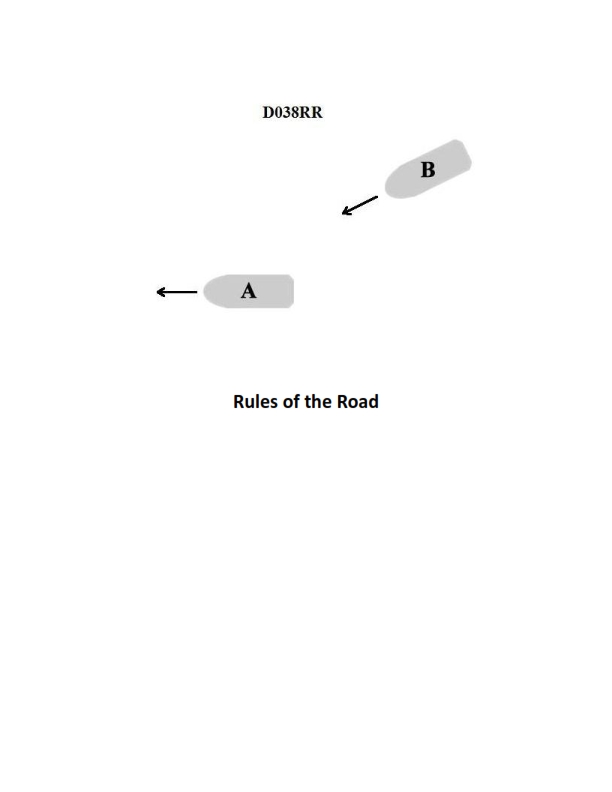
Question 38
Question: INLAND ONLY You are on power-driven vessel "A" and power-driven vessel "B" desires to overtake you on the starboard side as shown in illustration D038RR below. After the vessels have exchanged one blast signals what action should you take?
A. Hold course and speed
B. Slow your vessel until vessel "B" has passed
C. Alter course to the left
D. Alter course to the left or right to give vessel "B" more sea room
The Correct Answer is A. **Why Option A ("Hold course and speed") is correct:** This scenario involves overtaking on Inland Waters (U.S. Inland Rules of Navigation), where sound signals are mandatory for both initiating and agreeing to the maneuver. Vessel "A" is the vessel being overtaken, and vessel "B" wishes to overtake on the starboard side (one blast signal indicates the intention to overtake on the starboard side). Rule 13 (Overtaking) dictates that the vessel being overtaken (Vessel "A") must hold its course and speed. When Vessel "A" hears and agrees to the one blast signal from Vessel "B" (by repeating the one blast signal), Vessel "A" must facilitate the safe passage of the overtaking vessel by maintaining a predictable path. **Why the other options are incorrect:** * **B) Slow your vessel until vessel "B" has passed:** This is incorrect. The vessel being overtaken is required to maintain its speed and course. Slowing down could complicate the overtaking maneuver, especially if Vessel "B" has already factored Vessel "A's" current speed into its approach. * **C) Alter course to the left:** This is incorrect. The vessel being overtaken must maintain its course. Altering course (especially toward the overtaking vessel's path or the intended passing side) would violate Rule 13 and create a dangerous situation. * **D) Alter course to the left or right to give vessel "B" more sea room:** This is incorrect. While giving more room might seem helpful, the rules strictly prohibit the vessel being overtaken from altering course or speed. Predictability is paramount in this maneuver, and the responsibility for executing the safe maneuver rests primarily with the overtaking vessel (Vessel "B"). Vessel "A's" duty is passive: hold course and speed.
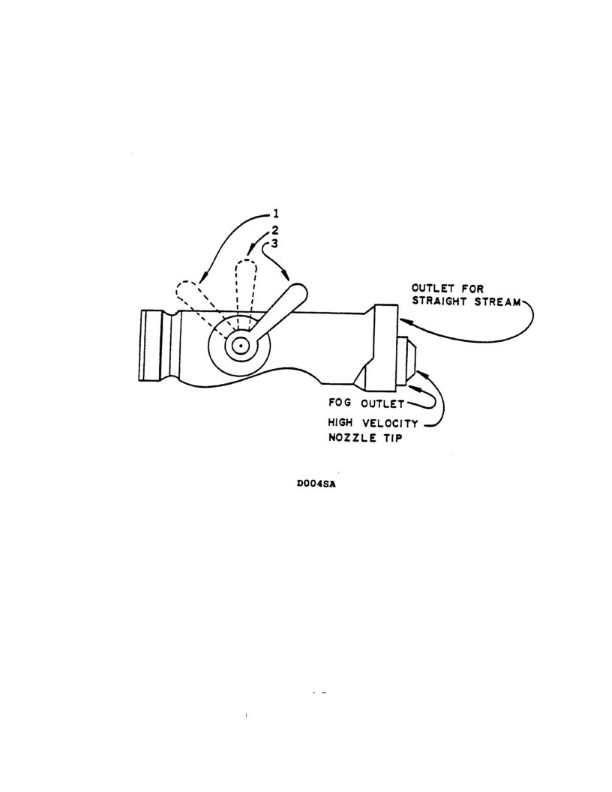
Question 41
Question: As seen in illustration D004SA below, what action must be taken before inserting a low-velocity fog applicator into an all-purpose nozzle?
A. Move the handle to position 2
B. Move the handle to position 1
C. Install the high-velocity nozzle tip
D. Remove the high-velocity nozzle tip
The Correct Answer is D. **Explanation for D (Remove the high-velocity nozzle tip):** Illustration D004SA typically depicts the standard procedure for adapting an all-purpose firefighting nozzle to accept specialized applicators, such as a low-velocity fog applicator (or piercing applicator). The all-purpose nozzle usually features a permanently attached or integrated high-velocity nozzle tip (or smooth bore tip) that is used for standard stream operations. When attaching an applicator, this main tip often interferes with the locking mechanism or physical connection required by the applicator. Therefore, before the low-velocity fog applicator can be inserted or threaded into the main body of the nozzle, the existing **high-velocity nozzle tip must be removed** to expose the threading or coupling mechanism necessary for the applicator attachment. **Explanation for incorrect options:** * **A) Move the handle to position 2:** Moving the handle (which controls the flow or selection of stream patterns) is an operational step taken *after* the nozzle setup is complete, or it may refer to a specific flow rate setting, but it is not the prerequisite mechanical action needed for *inserting* the applicator. * **B) Move the handle to position 1:** Similar to Option A, this relates to flow control or pattern selection (e.g., fog versus straight stream) during operation, not the preparatory step of physically adapting the nozzle to accept the applicator. * **C) Install the high-velocity nozzle tip:** This action is contradictory to the necessary preparatory step. The high-velocity nozzle tip is usually the component that *must be removed* to allow the applicator to be installed. Installing it would prevent the use of the applicator.
Question 43
Question: INLAND ONLY Two power-driven vessels are meeting in the situation as shown in illustration D037RR below and will pass within 1/2 mile of each other. What does two short blasts from either vessel mean?
A. "I am altering my course to port."
B. "I intend to leave you on my starboard side."
C. "I intend to leave you on my port side."
D. "I am altering my course to starboard."
The Correct Answer is B **Why option B ("I intend to leave you on my starboard side.") is correct:** This question is specifically governed by the **Inland Rules of Navigation**. Inland Rule 34(a)(i) dictates the meaning of whistle signals when power-driven vessels are meeting or crossing within sight of one another. * One short blast means: "I intend to leave you on my port side" (or "I intend to pass port to port"). * **Two short blasts mean: "I intend to leave you on my starboard side" (or "I intend to pass starboard to starboard").** * Three short blasts mean: "I am operating astern propulsion." Therefore, two short blasts signal a definite intention by the signaling vessel to alter course (usually to port) in order to pass the other vessel on the side of the signaling vessel's own starboard. **Why the other options are incorrect:** * **A) "I am altering my course to port."** This is the action taken to achieve a starboard-to-starboard passing (leaving the other vessel on your starboard side), but the official meaning of the two-blast signal under the Inland Rules is the *intent* regarding the passing arrangement, not just the course change itself. A single short blast (altering course to starboard) signals the intent to leave the other vessel on your port side. * **C) "I intend to leave you on my port side."** This is the meaning of a **single** short blast under the Inland Rules (Rule 34(a)(i)). * **D) "I am altering my course to starboard."** This action is associated with a single short blast (Rule 34(a)(i)), which signals the intent to pass port-to-port.
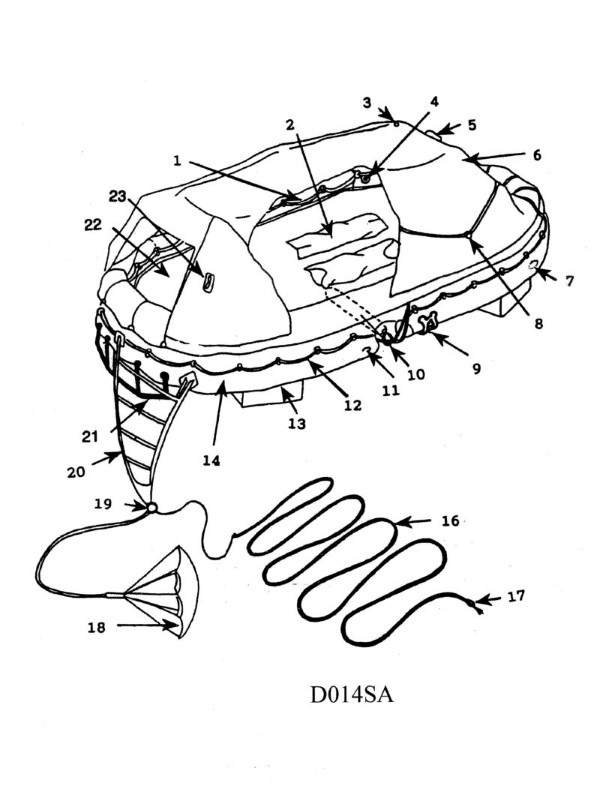
Question 49
Question: In illustration D014SA below, which item number correctly identifies the ballast bags?
A. 12
B. 2
C. 13
D. 22
The Correct Answer is C **Why option C ("13") is correct:** Option C corresponds to item number 13. In the context of illustration D014SA, item number 13 clearly points to or identifies the ballast bags, which are essential components used for stability or balancing, especially in certain types of equipment or structures shown in technical illustrations. **Why the other options are incorrect:** * **A) 12:** Item number 12 typically identifies a different component in the illustration (e.g., a handle, strap, or another structural part) but does not point to the ballast bags. * **B) 2:** Item number 2 usually identifies a major component or a primary part of the assembly, separate and distinct from the ballast bags (e.g., the main body, frame, or overall cover). * **D) 22:** Item number 22, if present in the illustration, identifies a component that is generally smaller or a peripheral part of the assembly, such as a fastener, connector, or label, and is not the ballast bag itself.