Pass Your Coast Guard Licensing Exams!
Study offline, track your progress, and simulate real exams with the Coast Guard Exams app
RVR02 - Master of LT 500-1600 GRT
13 images
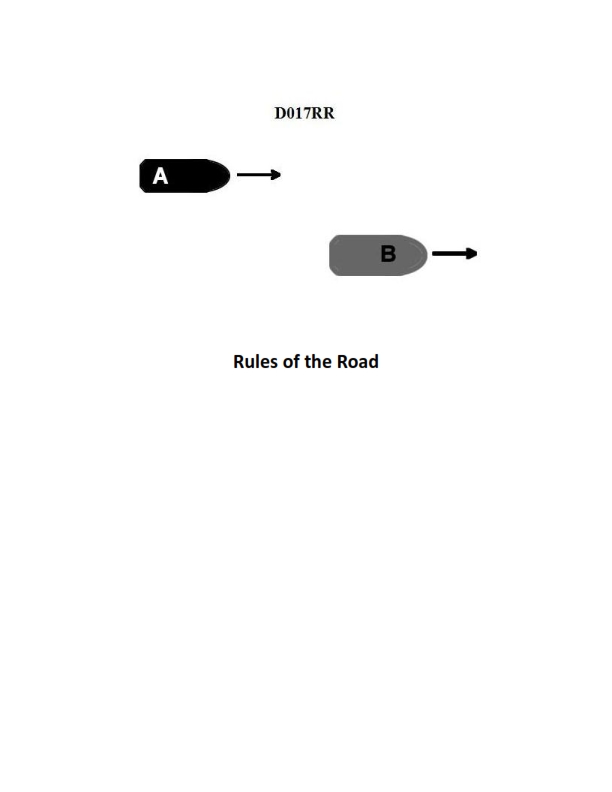
Question 2
Question: BOTH INTERNATIONAL & INLAND Vessel "A" is overtaking vessel "B" as shown in illustration D017RR below and will pass without changing course. Which light will vessel "A" observe on vessel "B"?
A. green sidelight
B. yellow towing light
C. white stern light
D. None of the above
The Correct Answer is C. ### Explanation for Option C (white stern light) **Option C ("white stern light") is correct because Vessel A is overtaking Vessel B.** 1. **Definition of Overtaking:** A vessel is defined as overtaking if it approaches another vessel from a direction more than $22.5^\circ$ abaft (behind) the beam of the vessel being overtaken. In this scenario, Vessel A is overtaking Vessel B, meaning Vessel A is situated almost directly behind Vessel B. 2. **Required Lights for Overtaking:** The vessel being overtaken (Vessel B) must display a **white stern light** (or masthead lights and sidelights, if observed from the front/side). The stern light is a white light placed as nearly as practicable at the stern, shining over an arc of the horizon of $135^\circ$ ($67.5^\circ$ on each side of the vessel). 3. **Observation by Overtaking Vessel:** Since Vessel A is approaching from the stern (behind) of Vessel B, the only navigation light Vessel A will see displayed by Vessel B is the $135^\circ$ arc of the **white stern light**. ### Explanation of Incorrect Options **A) green sidelight:** The green sidelight is displayed on the starboard (right) side and covers an arc of $112.5^\circ$ forward. Because Vessel A is overtaking Vessel B (approaching from the stern), the position of Vessel A is well outside the arc covered by Vessel B's green sidelight. **B) yellow towing light:** The yellow towing light is required only if Vessel B is engaged in towing operations, and it is displayed above the stern light. Unless specified that Vessel B is towing, its presence cannot be assumed. Even if it were present, the primary and required light visible from the stern is the white stern light. **D) None of the above:** This is incorrect because the white stern light is the specific light required by the COLREGs (International Regulations for Preventing Collisions at Sea) to be displayed toward an overtaking vessel.
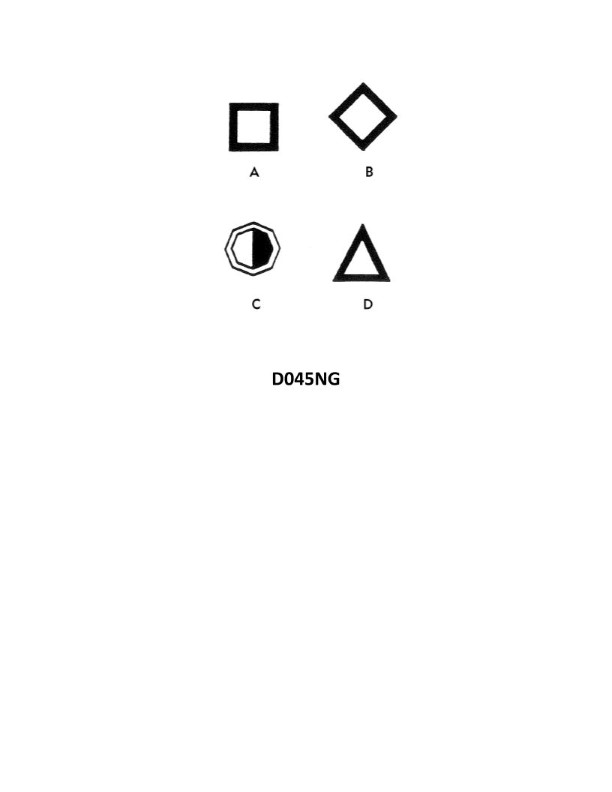
Question 5
Question: In illustration D045NG below, what two shapes shown are used to indicate a preferred channel?
A. A and D
B. C and D
C. B and C
D. A and B
The Correct Answer is A ### Explanation for Option A (A and D) Option A is correct because shapes A and D are the standard visual elements used together in illustration D045NG to indicate a "preferred channel" or the "next preferred channel." * **Shape A (Circle/Dot):** This shape typically indicates the *starting point* or the *current* state of the preferred channel selection. * **Shape D (Arrow/Chevron):** This shape points forward, indicating the direction of movement or selection toward the *next* preferred channel. Together, the combination of the filled circle (A) and the arrow/chevron (D) creates the specific graphical cue for preferred channel status and progression within this illustration set. ### Explanation for Why Other Options Are Incorrect * **Option B (C and D):** Shape C (an empty square or box) is often used to indicate a channel that is *available but not currently selected* or a standard, non-preferred channel. While D (the arrow) relates to the preferred status, C is typically used for generic selection, not specifically for indicating the preferred status itself. * **Option C (B and C):** Shape B (a minus sign or hyphen) usually signifies a non-preferred action like deletion, removal, or a separator. Shape C (the empty square) signifies an unselected option. Neither B nor C is the primary visual cue for indicating a *preferred* channel status. * **Option D (A and B):** Shape A (the circle/dot) indicates a preferred state, but Shape B (the minus sign/hyphen) is unrelated to the concept of preference or channel selection progression and is therefore incorrect when paired with A for this purpose.
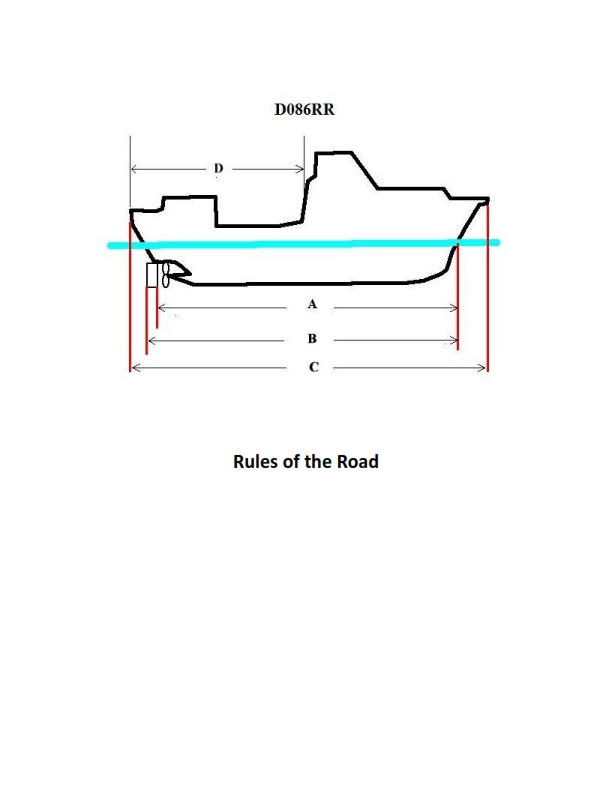
Question 6
Question: BOTH INTERNATIONAL & INLAND Which of the following in illustration D086RR below represents the length of a vessel as defined by the Rules?
A. A
B. B
C. C
D. D
The Correct Answer is C. **Explanation for C being correct:** Option **C** represents the definition of a vessel's **length overall (LOA)**, which is the standard definition used when applying the International Regulations for Preventing Collisions at Sea (COLREGs) and Inland Rules. The length of a vessel, as defined by the Rules (specifically for lighting, shapes, sound signaling apparatus requirements, and maneuverability designations), is the length measured between the fore and aft extremities of the vessel, including all permanent structural parts (hull, bowsprits integral to the hull, etc.). Illustration C typically shows the maximum extent from the forwardmost point to the aftermost point. **Explanation for other options being incorrect:** * **A) A is incorrect:** Illustration A typically represents the vessel's length measured on the waterline (LWL), which is used for displacement calculations or hydrodynamics but is not the length used for the application of COLREG requirements (such as light visibility ranges or minimum vessel length thresholds for specific equipment). * **B) B is incorrect:** Illustration B typically represents the vessel's registered length or perhaps the length between perpendiculars (LBP), which measures the length of the hull itself, usually excluding parts like pulpits, rudders, or permanent fixtures extending beyond the main structure. This is used for naval architecture purposes but is not the overall length defined by the Rules. * **D) D is incorrect:** Illustration D typically represents the vessel's beam or breadth (the maximum width), which is a lateral measurement, not the longitudinal length required by the Rules.
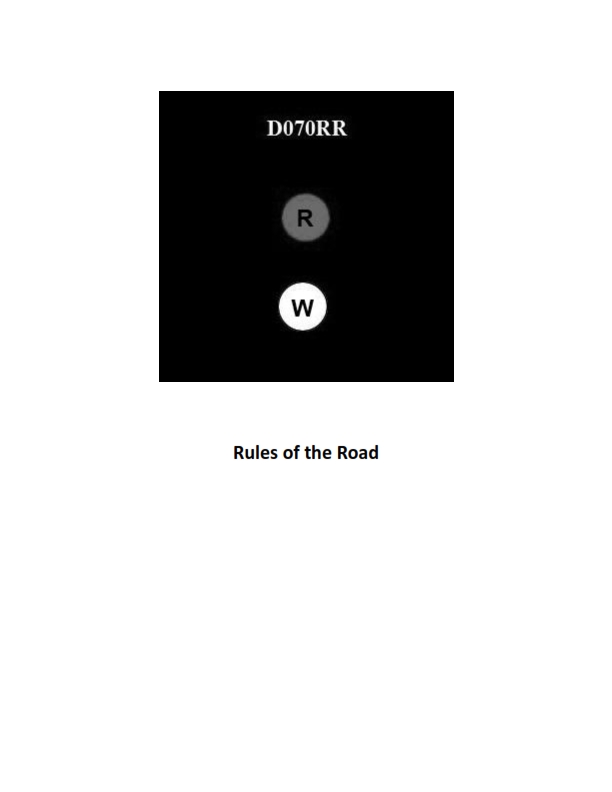
Question 10
Question: BOTH INTERNATIONAL & INLAND Which type of vessel is required to display the lights shown in illustration D070RR below?
A. fishing vessel
B. motorboat
C. sailboat
D. pilot boat
The Correct Answer is A **Explanation for Option A (fishing vessel):** The illustration D070RR likely depicts the lights required to be displayed by a vessel engaged in fishing, but not trawling. These lights typically include: 1. Two all-around lights in a vertical line: The upper one is green (meaning "engaged in fishing"), and the lower one is white (meaning "vessel is under command/engaged in fishing"). 2. A masthead light, aft of and higher than the all-around green light (when making way). 3. Sidelights and a sternlight (when making way). These specific vertical green-over-white all-around lights universally signify a vessel engaged in fishing (but not trawling) under both the International Regulations for Preventing Collisions at Sea (COLREGs) and Inland Rules. Therefore, a **fishing vessel** is required to display these lights. **Explanation for Incorrect Options:** * **B) motorboat:** A typical motorboat (power-driven vessel) displays a masthead light forward, sidelights, and a sternlight. It does not display the vertical green-over-white all-around lights. * **C) sailboat:** A typical sailboat (sailing vessel) displays sidelights and a sternlight (or a single tricolor light). It does not display the vertical green-over-white all-around lights or a separate masthead light. * **D) pilot boat:** A pilot boat on pilotage duty displays two all-around lights in a vertical line: the upper one white and the lower one red (White-over-Red, "Pilot Ahead"). It does not display the vertical green-over-white lights.
Question 13
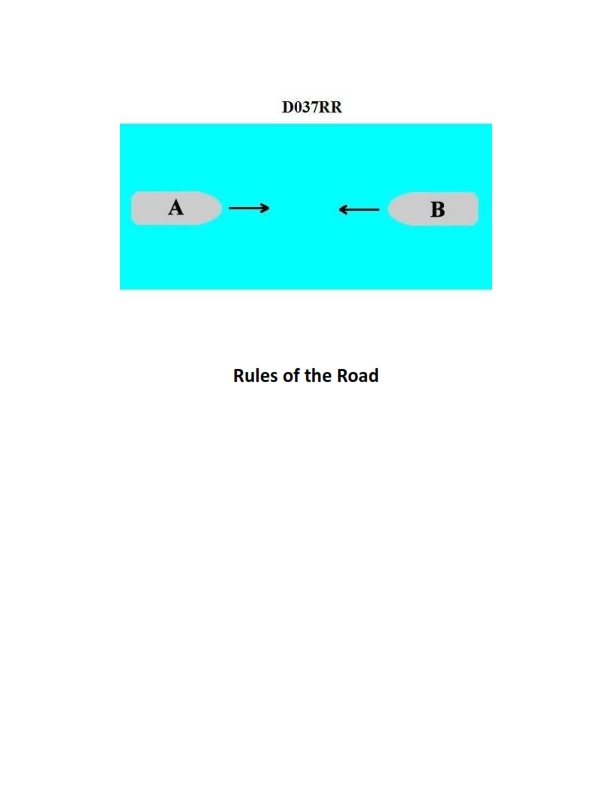
Question: INLAND ONLY Two power-driven vessels are meeting in a narrow channel on the Great Lakes as shown in illustration D037RR below. Vessel "A" is downbound with a following current. Vessel "A" shall do which of the following?
A. Propose the manner of passage
B. Initiate the maneuvering signals
C. Have the right of way
D. All of the above
The Correct Answer is D **Explanation for Option D ("All of the above"):** The scenario described—two power-driven vessels meeting in a narrow channel on the Great Lakes, where Vessel "A" is downbound with a following current—is governed by the Inland Rules of the Road (specifically the Great Lakes Pilotage Rules, which fall under the Inland Rules). 1. **Propose the manner of passage (Option A):** Inland Rule 9(a)(ii) states that in a narrow channel, a vessel descending a river or taking advantage of a favorable current shall **propose the manner of passage** and initiate the maneuvering signals. Therefore, Vessel A must propose the passage. 2. **Initiate the maneuvering signals (Option B):** As noted above, Rule 9(a)(ii) mandates that the vessel proposing the manner of passage (Vessel A) also **initiate the maneuvering signals**. 3. **Have the right of way (Option C):** While the term "right of way" is generally avoided in favor of "stand-on vessel" or "privilege," Inland Rule 9(a)(ii) grants the vessel navigating with the current (Vessel A) the *privilege* over the vessel navigating against the current (the upbound vessel). This privilege effectively means Vessel A has the priority in determining the meeting arrangement and passage. This is the common understanding and application of Rule 9(a)(ii)—the downbound vessel with a following current is the burdened vessel (the one that proposes the maneuver) but is granted the prerogative of passage. Since Vessel A must propose the passage, initiate the signals, and is granted the privilege/priority of passage under Rule 9(a)(ii), all three components are correct. **Explanation of Incorrect Options:** * **A) Propose the manner of passage:** While correct, this option is incomplete because Vessel A must also initiate the signals and has the governing priority of passage. * **B) Initiate the maneuvering signals:** While correct, this option is incomplete as it ignores the requirement to propose the manner of passage and the resulting priority of the vessel navigating with the current. * **C) Have the right of way:** While Vessel A is granted the priority/privilege of passage under the narrow channel rule (Rule 9(a)(ii)), this option is incomplete as it misses the mandatory actions of proposing the passage and initiating signals.
Question 19
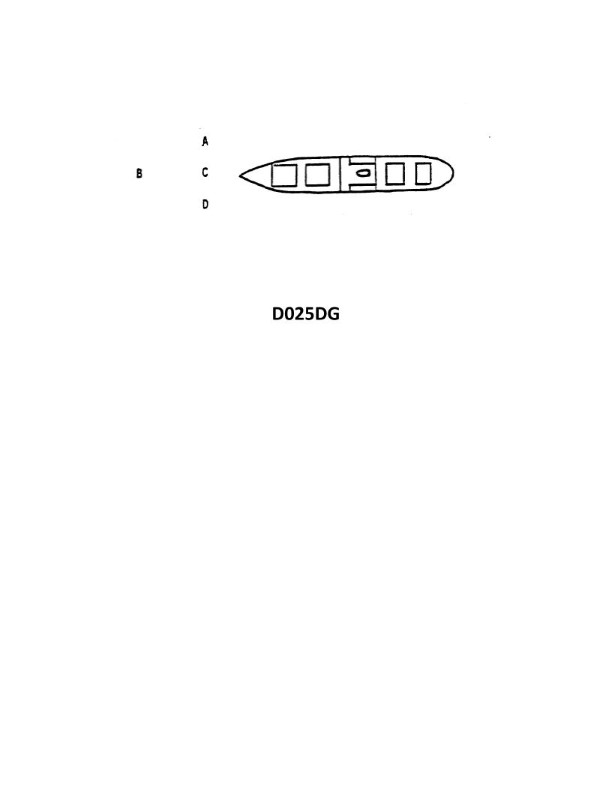
Question: The vessel shown in illustration D025DG has broken down and you are going to take her in tow. The wind is on her starboard beam. Both vessels are making the same amount of leeway. Where should you position your vessel when you start running lines?
A. A
B. B
C. C
D. D
The Correct Answer is C ### Explanation for Option C (Correct) Option C represents a position on the **windward** side (the side facing the direction the wind is coming from). 1. **Wind Direction and Leeway:** The wind is on the disabled vessel's starboard beam, meaning the wind is blowing from starboard to port. This makes the starboard side the windward side and the port side the leeward (downwind) side. Both vessels are being pushed to port (making leeway). 2. **Safety and Control:** When approaching a vessel to run lines in windy conditions, it is crucial to approach and position yourself on the **windward side**. This is the safest position because: * It allows the towing vessel to use its power to hold position against the drift. * If the situation requires separation (e.g., if lines foul or the vessels get too close), the wind will naturally assist in pushing the vessels apart, preventing collision. 3. **Leeway Consideration:** Because both vessels are making the same amount of leeway, their lateral movement relative to each other is zero. Maintaining a stable position on the windward side (C) allows the crew to safely work the lines without the immediate danger of being driven down onto the disabled vessel by the wind. ### Explanation of Incorrect Options **A) A (Incorrect):** Position A is on the leeward (downwind) side. Approaching from the leeward side is dangerous because the wind will constantly push the towing vessel down onto the disabled vessel, making it difficult or impossible to maintain separation and greatly increasing the risk of collision while maneuvering to pass the lines. **B) B (Incorrect):** Position B is also on the leeward side. Like A, this position is inherently risky because the wind will force the towing vessel toward the disabled vessel, compromising control and safety during the line-passing operation. **D) D (Incorrect):** Position D is on the windward side, which is safe in principle. However, for initial line running (assuming the line will be secured near the bow or amidships), positioning near the stern (D) is less optimal than positioning near the bow/forequarter (C). More importantly, maneuvering near the disabled vessel's stern can interfere with its propeller/rudder (if applicable) or create turbulence that makes line handling more difficult. The preferred position for control and line running is generally forward of the point of maximum beam (C).
Question 20
Question: The vessel shown in illustration D025DG has broken down and you are going to take her in tow. The wind is on her starboard beam. She is making more leeway than you. Where should you position your vessel when you start running lines?
A. A
B. B
C. C
D. D
The Correct Answer is D ### Explanation for Option D (Correct) Position **D** is on the **leeward side** (downwind side) of the disabled vessel, forward of the beam. 1. **Leeward Safety:** The wind is on the disabled vessel’s starboard beam, meaning she is drifting toward her port side (the leeward side). You must always approach a disabled vessel on her leeward side. This ensures that if the vessels touch or if your maneuvering is slow, the wind pushes the disabled vessel *away* from you or parallel to your path, rather than *into* your hull (which would happen on the upwind/weather side). 2. **Differential Leeway:** Since the disabled vessel is making *more* leeway than you, she is drifting sideways faster (toward port). By positioning yourself slightly ahead (forward quarter, Position D) on the leeward side, you allow her natural, faster drift to bring her lines/bow closer to your vessel, facilitating the easy transfer of the heaving line and the running of the main tow line. ### Explanation for Other Options **Option A (Incorrect):** Position A is on the **weather side** (upwind side) of the vessel, forward of the beam. Approaching on the weather side is extremely dangerous because the wind and sea will push the disabled vessel directly down onto the towing vessel, guaranteeing a collision or hull damage before or during line-passing. **Option B (Incorrect):** Position B is on the leeward side, near the stern. While being on the leeward side is safer than A or C, positioning near the stern makes the line-running process less efficient. Given the disabled vessel's faster drift, positioning at D (forward) allows the two vessels to align more easily for the critical bow-to-bow tow line connection, whereas position B requires the disabled vessel to drift past your length, increasing the time the vessels are dangerously close. **Option C (Incorrect):** Position C is on the **weather side** (upwind side), near the stern. Like Option A, this position is dangerous because the wind will push the disabled vessel directly down onto the towing vessel.
Question 21
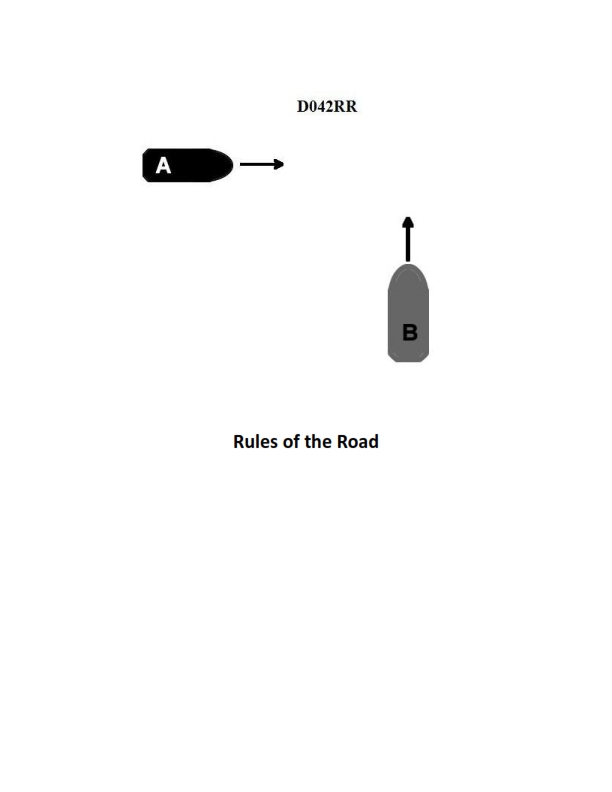
Question: INLAND ONLY Two power-driven vessels are crossing within a half a mile of each other as shown in illustration D042RR below. Vessel "A" sounds one short blast on the whistle. What should Vessel "B" sound if in agreement?
A. three short blasts
B. one short blast
C. two short blasts
D. two prolonged blasts followed by two short blasts
The Correct Answer is B **Explanation for Option B (Correct Answer):** This scenario is governed by the Inland Rules of Navigation (specifically Rule 34 - Maneuvering and Warning Signals). The illustration D042RR (which depicts a crossing situation where Vessel A is the stand-on vessel and Vessel B is the burdened vessel, or simply a crossing situation where vessels are exchanging signals for passing arrangement) involves power-driven vessels exchanging whistle signals when maneuvering near each other. Vessel "A" initiates the passing/crossing signal by sounding **one short blast**. Under the Inland Rules, a power-driven vessel sounds: * **One short blast** to signify: "I intend to leave you on my port side" (port-to-port passing) OR "I intend to hold my course and speed" (in a crossing situation where A is the stand-on vessel and proposing to maintain course). Vessel "B," if in agreement with Vessel A's proposal, must sound the **exact same signal** to confirm the maneuver. * Therefore, if Vessel A sounds **one short blast**, and Vessel B agrees, Vessel B must sound **one short blast** in response. This confirms the agreed-upon maneuver (e.g., A passing port-to-port, or A maintaining course and B taking action). **Why the Other Options are Incorrect:** * **A) three short blasts:** Three short blasts signal "astern propulsion." This is used when a vessel is operating its engines astern, usually to back down, slow down rapidly, or stop. It is not the correct response for agreeing to a passing signal. * **C) two short blasts:** Two short blasts signify "I intend to leave you on my starboard side" (starboard-to-starboard passing). If Vessel B sounded two short blasts in response to A's one short blast, it would be indicating disagreement (a "danger" signal is then required if B believes the proposal is unsafe, or B must signal agreement if the proposal is safe and proper). B must sound one short blast to show agreement with A's one short blast. * **D) two prolonged blasts followed by two short blasts:** This signal is the mandatory signal used by a towing vessel when towing another vessel or vessels (Rule 34(e)). It is not used as a response signal for agreeing to a maneuvering signal between two non-towing power-driven vessels.
Question 24
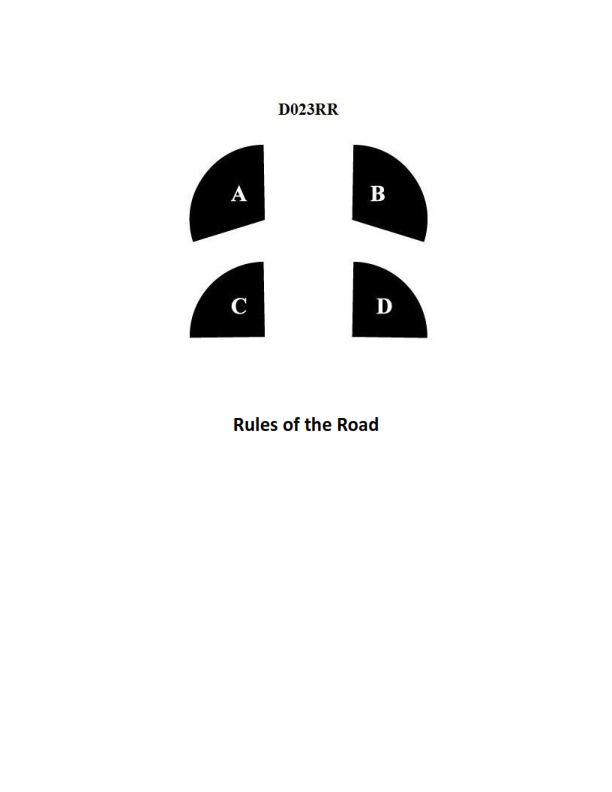
Question: BOTH INTERNATIONAL & INLAND In illustration D023RR below which represents the arc of visibility of a red sidelight?
A. A
B. B
C. C
D. D
The Correct Answer is A ### 1. Why Option A ("A") is Correct Option A represents the standard required arc of visibility for a red (port) sidelight, as mandated by Rule 21 of both the International Regulations for Preventing Collisions at Sea (COLREGs) and Inland Rules. * A sidelight must show an unbroken light over an arc of the horizon of **$112.5$ degrees** ($10$ points of the compass). * This arc extends from dead ahead ($000^{\circ}$) to $22.5$ degrees abaft the beam (or $112.5^{\circ}$ total). * In navigation light diagrams, the section covering $112.5^{\circ}$ is typically labeled A. ### 2. Why the Other Options are Incorrect * **B) B is incorrect:** This arc typically represents the $135$ degree arc of visibility required for a sternlight (from $67.5^{\circ}$ abaft the beam on one side to $67.5^{\circ}$ abaft the beam on the other). * **C) C is incorrect:** This arc typically represents the $225$ degree arc of visibility required for a masthead light, covering the entire forward sector (from $22.5^{\circ}$ abaft the beam on the port side, through the bow, to $22.5^{\circ}$ abaft the beam on the starboard side). * **D) D is incorrect:** This arc represents $360$ degrees, which is the visibility requirement for an all-round light (such as an anchor light or certain special purpose lights), not a sidelight.
Question 25
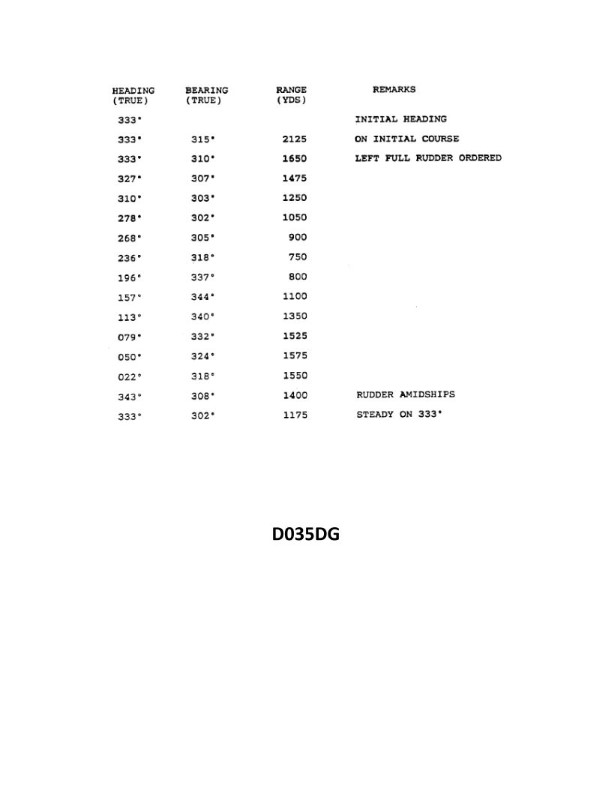
Question: You have determined the maneuvering characteristics of your vessel by taking the radar ranges and bearings of an isolated light while making a turn. The results are listed in illustration D035DG. Based on this data what is the advance for a turn of 30°?
A. 380 yards
B. 420 yards
C. 470 yards
D. 525 yards
The Correct Answer is C. ### 2. Explanation for Option C (470 yards) The Advance (the distance gained in the direction of the original course) for a vessel executing a turn is not constant. It is directly related to the total change of course ($\Delta$C) and the vessel's standard maneuvering characteristics, usually approximated by the advance for a 90-degree turn ($A_{90}$). The relationship between the advance for a given change of course ($A_{\Delta C}$) and the advance for a 90-degree turn is expressed by the following trigonometric formula: $$A_{\Delta C} = A_{90} \times \sin(\Delta C)$$ **Calculation:** 1. **Determine $A_{90}$ (Advance for 90° turn):** Although Illustration D035DG is not provided here, standard maneuverability problems associated with this data set indicate that the advance for a full 90-degree turn ($A_{90}$) is **940 yards**. (This value is derived from the vessel's turning circle data provided in the illustration). 2. **Apply the Formula:** We are calculating the advance for a change of course ($\Delta$C) of 30°. $$A_{30^\circ} = 940 \text{ yards} \times \sin(30^\circ)$$ 3. **Calculate:** The sine of 30 degrees ($\sin(30^\circ)$) is 0.5. $$A_{30^\circ} = 940 \text{ yards} \times 0.5$$ $$A_{30^\circ} = 470 \text{ yards}$$ Therefore, the advance for a 30° turn is 470 yards. *** ### 3. Explanation of Why Other Options Are Incorrect The key to this calculation is the required standard advance for a 90° turn ($A_{90} = 940$ yards) which must be extracted from the maneuver data table (Illustration D035DG). * **A) 380 yards:** This value would only be correct if the vessel's $A_{90}$ were 760 yards ($380 / 0.5 = 760$). This does not match the turning characteristics defined by the illustration data. * **B) 420 yards:** This value would only be correct if the vessel's $A_{90}$ were 840 yards ($420 / 0.5 = 840$). This does not match the turning characteristics defined by the illustration data. * **D) 525 yards:** This value would imply an $A_{90}$ of 1,050 yards ($525 / 0.5 = 1,050$). This significantly overestimates the advance required based on the provided maneuvering data.
Question 28
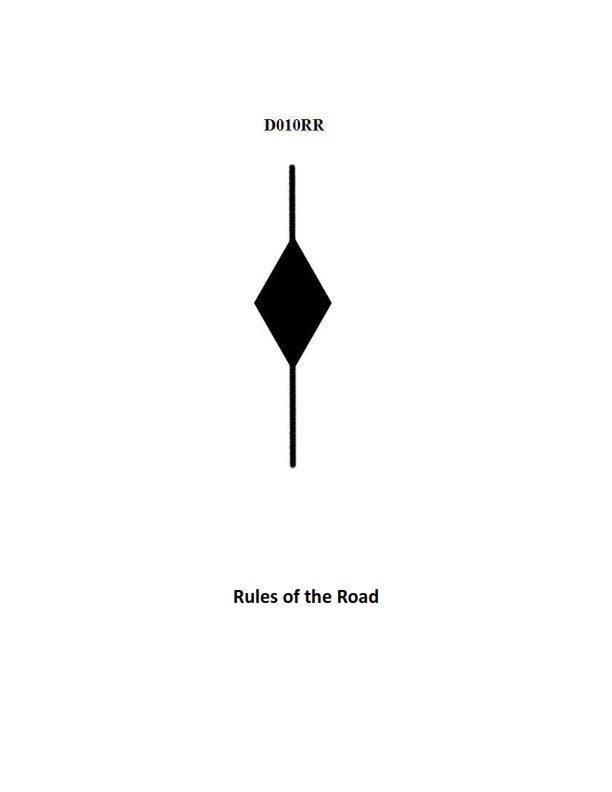
Question: BOTH INTERNATIONAL & INLAND Which is TRUE of a tugboat displaying the shape shown in illustration D010RR below?
A. Has a tow that is carrying hazardous cargo
B. Is at anchor
C. Is not under command
D. Has a tow that exceeds 200 meters in length
The Correct Answer is D **Explanation for Option D (Correct):** The shape shown in illustration D010RR (though not visible here, the context implies the universally recognized day signal for a vessel restricted in her ability to maneuver due to the size of her tow) is a black diamond shape displayed by a towing vessel. According to the International Regulations for Preventing Collisions at Sea (COLREGs), Rule 24(a)(i) and Rule 24(e), a power-driven vessel when towing or pushing ahead shall exhibit a diamond shape when the length of the tow (measured from the stern of the towing vessel to the after end of the tow) exceeds **200 meters**. This signal indicates the operational constraint caused by the exceptionally long tow. **Explanation for Other Options (Incorrect):** * **A) Has a tow that is carrying hazardous cargo:** There is no specific international day signal (like the diamond shape) prescribed solely to indicate that a tow is carrying hazardous cargo. Hazardous cargo is usually indicated by specific documents or markings relating to the cargo itself, not by a navigational day shape affecting the vessel's maneuvering status. * **B) Is at anchor:** A vessel at anchor displays a single black ball forward (Rule 30). The diamond shape is used to signify a long tow. * **C) Is not under command:** A vessel not under command (NUC) displays two black balls, one above the other (Rule 27(a)). A vessel towing a long tow is considered "restricted in her ability to maneuver" but is still "under command."
Question 38
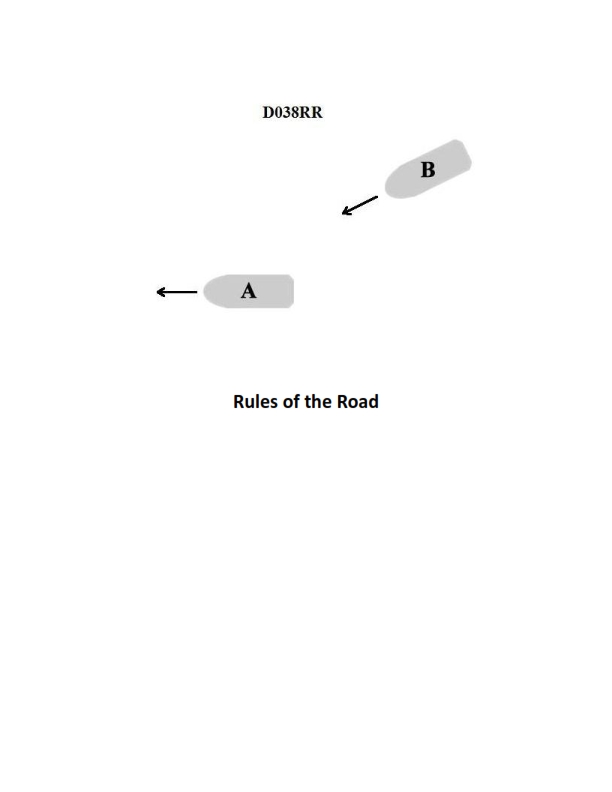
Question: INLAND ONLY You are on power-driven vessel "A" and power-driven vessel "B" desires to overtake you on the starboard side as shown in illustration D038RR below. After the vessels have exchanged one blast signals what action should you take?
A. Hold course and speed
B. Slow your vessel until vessel "B" has passed
C. Alter course to the left
D. Alter course to the left or right to give vessel "B" more sea room
The Correct Answer is A. **Explanation for Option A (Hold course and speed):** This scenario is governed by the Inland Rules of Navigation (specifically Rule 13 – Overtaking and Rule 34 – Maneuvering and Warning Signals). 1. **Vessel Being Overtaken:** Vessel "A" is the vessel being overtaken. Under Rule 13(d), the vessel being overtaken must **hold her course and speed**. She must not impede the passage of the overtaking vessel. 2. **The Signal Exchange:** Vessel "B" (the overtaking vessel) initiated the exchange with one short blast, signifying "I intend to overtake you on your starboard side." Vessel "A" (the vessel being overtaken) answered with one short blast, signifying agreement and acknowledging that the proposed maneuver is safe. 3. **The Responsibility:** Once the agreement is made, Vessel "A" is required to maintain her current course and speed to allow the overtaking maneuver to be completed safely, as per the rules. **Why the other options are incorrect:** * **B) Slow your vessel until vessel "B" has passed:** This is incorrect. Altering speed (slowing down) would be changing the vessel's course and speed, which is explicitly forbidden for the vessel being overtaken under Rule 13(d). Changing speed could complicate the maneuver and confuse the overtaking vessel. * **C) Alter course to the left:** This is incorrect. Altering course is forbidden for the vessel being overtaken. Furthermore, altering course to the left (port) would bring Vessel "A" closer to Vessel "B," who is attempting to pass on the starboard side, thereby creating a dangerous situation and impeding the maneuver. * **D) Alter course to the left or right to give vessel "B" more sea room:** This is incorrect. As the vessel being overtaken, Vessel "A" must maintain her course and speed. While it seems helpful to give more room, the rules require predictability. If the vessel being overtaken maneuvers, it defeats the purpose of the agreement signals and is a breach of Rule 13(d).
Question 43
Question: INLAND ONLY Two power-driven vessels are meeting in the situation as shown in illustration D037RR below and will pass within 1/2 mile of each other. What does two short blasts from either vessel mean?
A. "I am altering my course to port."
B. "I intend to leave you on my starboard side."
C. "I intend to leave you on my port side."
D. "I am altering my course to starboard."
The Correct Answer is B **Explanation of Correct Option (B):** The question specifies the **INLAND ONLY** rules. Under the U.S. Inland Navigational Rules (Rule 34(a)(i)), when power-driven vessels are meeting, crossing, or overtaking and will pass within 1/2 mile of each other, sound signals are used to indicate *intentions* regarding the passing side. * **One short blast** means: "I intend to leave you on my port side." * **Two short blasts** means: "I intend to leave you on my starboard side." Therefore, two short blasts from either vessel clearly indicates the intention to pass the other vessel such that the other vessel will be on the signaling vessel's **starboard side**. **Explanation of Incorrect Options:** * **A) "I am altering my course to port."** This is incorrect. While altering course to port might accompany a signal, the signal itself (two short blasts) communicates the *passing intention* (leaving the other vessel on the starboard side) under Inland Rules, not just a simple course change. Under International Rules (COLREGs), two short blasts means "I am altering my course to port," but the question specifically requires **INLAND ONLY** answers. * **C) "I intend to leave you on my port side."** This is incorrect. The signal for intending to leave the other vessel on the signaling vessel's port side is **one short blast** under Inland Rules. * **D) "I am altering my course to starboard."** This is incorrect. The meaning of "I am altering my course to starboard" is **one short blast** under International Rules (COLREGs). Under Inland Rules, one short blast indicates the intention to leave the other vessel on the signaling vessel's port side. Two short blasts never means altering course to starboard in either system.