Pass Your Coast Guard Licensing Exams!
Study offline, track your progress, and simulate real exams with the Coast Guard Exams app
MODU02 - Barge Supervisor
8 images
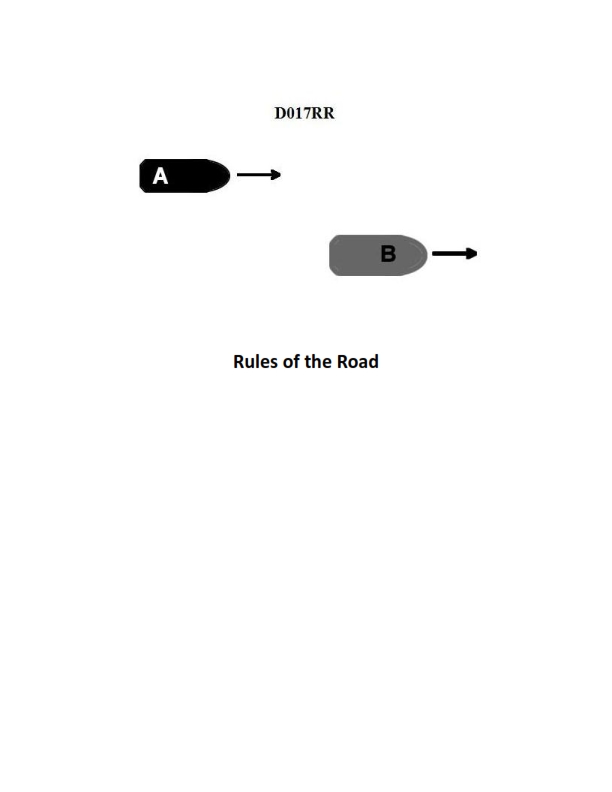
Question 10
Question: BOTH INTERNATIONAL & INLAND Vessel "A" is overtaking vessel "B" as shown in illustration D017RR below. Vessel "B" should do which of the following?
A. should slow down until vessel "A" has passed
B. should hold her course and speed
C. may steer various courses and vessel "A" must keep clear
D. should change course to the right
The Correct Answer is B **Explanation for B (Correct Answer):** The situation described is an overtaking situation where Vessel "A" is the overtaking vessel and Vessel "B" is the vessel being overtaken. According to both the International Regulations for Preventing Collisions at Sea (COLREGs) (Rule 13 - Overtaking) and the U.S. Inland Rules, the vessel being overtaken (Vessel "B") is the **Stand-on Vessel** relative to the overtaking vessel. Rule 13(d) states: "Any subsequent alteration of the bearing between the two vessels shall not make the overtaking vessel a crossing vessel within the meaning of these Rules or relieve her of the duty of keeping clear until she is finally past and clear." Rule 17 (Action by Stand-on Vessel) dictates the duties of the vessel that is required to keep her course and speed. Therefore, Vessel "B" should **hold her course and speed** while Vessel "A" (the Give-way Vessel) takes the necessary action to keep clear. **Explanation of Incorrect Options:** * **A) should slow down until vessel "A" has passed:** This is incorrect. The stand-on vessel (B) should maintain her course and speed. Slowing down could complicate the maneuver for the overtaking vessel (A) and is contrary to the required action under Rule 17. * **C) may steer various courses and vessel "A" must keep clear:** This is incorrect. While Vessel "A" must keep clear, Vessel "B"'s primary duty is to keep her course and speed. Varying course would make her actions unpredictable and violate the fundamental principle of maintaining the integrity of the stand-on/give-way relationship. (Note: Rule 17 does allow the stand-on vessel to act if collision cannot be avoided by the give-way vessel's action alone, but the initial duty is to maintain course and speed). * **D) should change course to the right:** This is incorrect. Vessel "B" is the stand-on vessel and must maintain her course and speed. Changing course (left or right) would violate her primary duty and transfer the burden of avoiding collision, which rests solely with the give-way vessel (A).
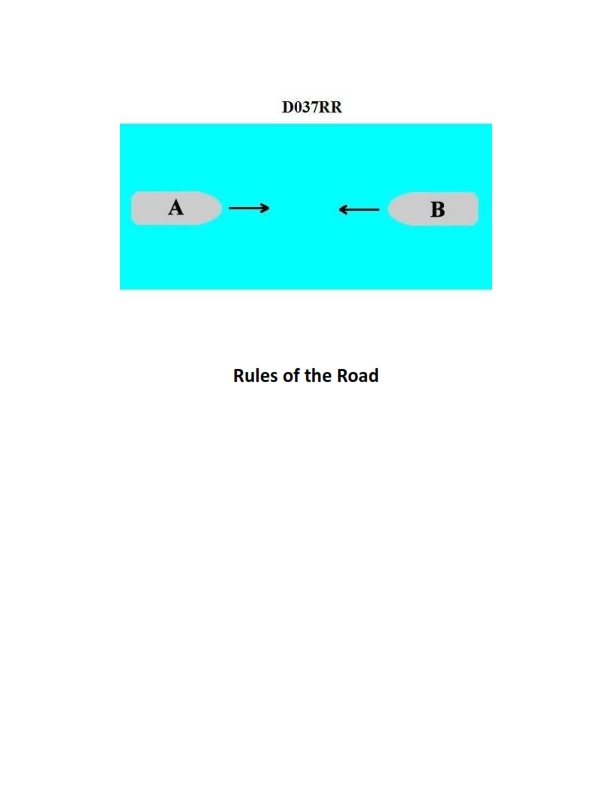
Question 20
Question: BOTH INTERNATIONAL & INLAND You are on Vessel "A" engaged in fishing in a narrow channel as shown in illustration D037RR below. Vessel "B" is a tanker proceeding in the channel. Vessel "B" sounds five short and rapid blasts. What action should you take?
A. maintain course and speed
B. not answer the whistle signals from vessel "B"
C. sound one prolonged followed by two short blasts
D. not impede the passage of vessel "B"
The Correct Answer is D. **Why option D ("not impede the passage of vessel "B"") is correct:** Vessel "A" is engaged in fishing, which makes it a Vessel Engaged in Fishing (V.E.F.) and therefore a vessel restricted in its ability to maneuver (Rule 3(g)). However, Rule 9 (Narrow Channels) mandates specific responsibilities. Rule 9(b) states that a V.E.F. shall not impede the passage of any other vessel navigating within a narrow channel. Vessel "B" is a tanker, likely deep-draft, proceeding in the channel. The signal of five short and rapid blasts sounded by Vessel "B" is the danger or doubt signal (Rule 34(d)), indicating that Vessel "B" doubts whether sufficient action is being taken by Vessel "A" to ensure safe passage, or that Vessel "A" is creating a dangerous situation. Regardless of the signal, Vessel "A" (the fishing vessel) has a mandatory obligation under Rule 9(b) not to impede the passage of vessels that can only navigate safely within the channel. Therefore, Vessel "A" must take immediate action to ensure Vessel "B" can proceed unimpeded. **Why the other options are incorrect:** * **A) maintain course and speed:** This is incorrect. Maintaining course and speed directly violates Rule 9(b) if it results in impeding Vessel "B". Furthermore, receiving a danger signal (five blasts) requires immediate action to resolve the dangerous situation or doubt, not inaction. * **B) not answer the whistle signals from vessel "B":** This is incorrect. While five blasts generally do not require a specific answer, taking no action is unacceptable given the mandatory obligation not to impede (Rule 9(b)) and the fact that the five blasts indicate a potential danger or misunderstanding that must be resolved. Vessel "A" must maneuver or take steps to ensure B's passage is not impeded. * **C) sound one prolonged followed by two short blasts:** This is incorrect. This signal (Rule 35(c)) is the prescribed signal for a vessel engaged in fishing or towing *when underway* in restricted visibility (fog), not a maneuvering signal in clear visibility responding to a doubt signal. Responding with the proper maneuver to ensure B's passage is unimpeded is required, not sounding an unrelated signal.
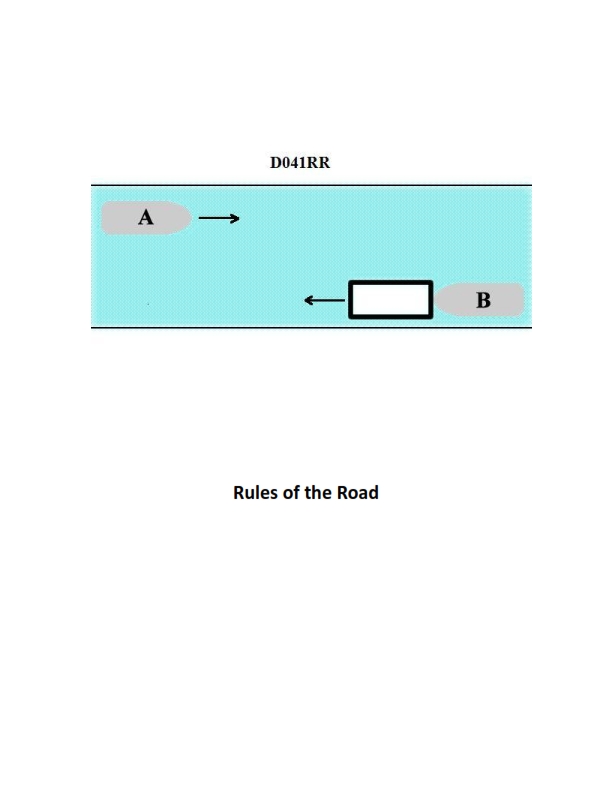
Question 28
Question: INLAND ONLY Vessels "A" and "B" are meeting on a river as shown in illustration D041RR below and will pass 1/4 mile apart. Which is one of the lights on vessel "B" that you will see if you are on vessel "A"?
A. yellow towing light
B. red sidelight
C. special flashing light
D. All of the above
The Correct Answer is C ### Explanation for Option C (Special Flashing Light) The **Special Flashing Light (SFL)** is a light specifically mandated under the Inland Navigation Rules, particularly for vessels operating on the Western Rivers and certain designated waters (like the Great Lakes connecting waters). 1. **Identification of Vessel B:** If Vessel B is displaying the Special Flashing Light, it identifies Vessel B as a power-driven vessel pushing ahead or alongside. 2. **Positioning:** The Special Flashing Light (an amber light flashing at 50-70 flashes per minute) is displayed **forward** on the vessel. Because Vessels A and B are meeting (and passing 1/4 mile apart, meaning Vessel A has a clear view of Vessel B's forward profile and side), the SFL is positioned where it would be easily visible to Vessel A. This unique, mandatory inland light is therefore one of the lights Vessel A would certainly see. ### Explanation for Incorrect Options **A) yellow towing light:** The yellow towing light is located at the stern (above the white stern light) and shines primarily aft. In a meeting situation where Vessel A is viewing Vessel B's forward profile, the towing light would not be visible. **B) red sidelight:** The red sidelight covers the arc from the vessel’s port beam to 22.5 degrees abaft the beam. In a standard meeting situation on a river, vessels often pass port-to-port. If they are passing port-to-port, Vessel A would see Vessel B’s **green** (starboard) sidelight, not the red (port) sidelight. While the red sidelight might be visible if the angle is skewed toward a starboard-to-starboard passing, the visibility of the red sidelight is not guaranteed, whereas the forward-facing special flashing light is mandatory and easily seen in a meeting scenario. **D) All of the above:** Since the yellow towing light (A) is incorrectly positioned (aft) for visibility in a meeting scenario, this option is incorrect.
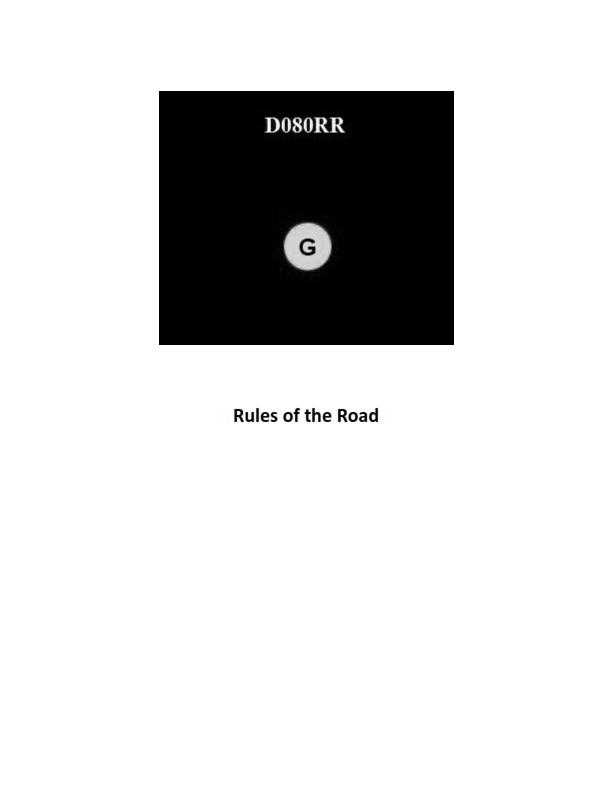
Question 30
Question: BOTH INTERNATIONAL & INLAND You see ONLY the light shown in illustration D080RR below. Which type of vessel are you observing?
A. vessel on pilotage duty
B. law enforcement vessel
C. sailing vessel
D. vessel engaged in fishing
The Correct Answer is C **Why option C ("sailing vessel") is correct:** Illustration D080RR shows a vessel displaying two all-round lights in a vertical line: **Red over Green** (RG). According to the International Regulations for Preventing Collisions at Sea (COLREGs), Annex I to 33 CFR Subchapter C, Rule 25, a sailing vessel, when underway and also under power, may in addition to the lights prescribed for a sailing vessel, exhibit forward where it can best be seen **an all-round light red over an all-round light green** (RG). This combination (Red over Green) specifically identifies a sailing vessel that is operating using both sail and machinery (under power). Since the prompt states you see *only* this light, this unique signal is the definitive indication of a sailing vessel operating under power. **Why the other options are incorrect:** * **A) vessel on pilotage duty:** A vessel engaged in pilotage duty displays two all-round lights in a vertical line: **White over Red** (WR), with the white light above the red light. This is different from the Red over Green (RG) shown. * **B) law enforcement vessel:** While law enforcement vessels often use flashing blue lights (when authorized), they do not use the specific Red over Green (RG) all-round lights as their primary identification signal mandated by COLREGs. * **D) vessel engaged in fishing:** A vessel engaged in fishing (not trawling) displays two all-round lights in a vertical line: **Red over White** (RW), with the red light above the white light (indicating "nets in the water"). Trawlers display Green over White (GW). Neither matches the Red over Green (RG) signal.
Question 31
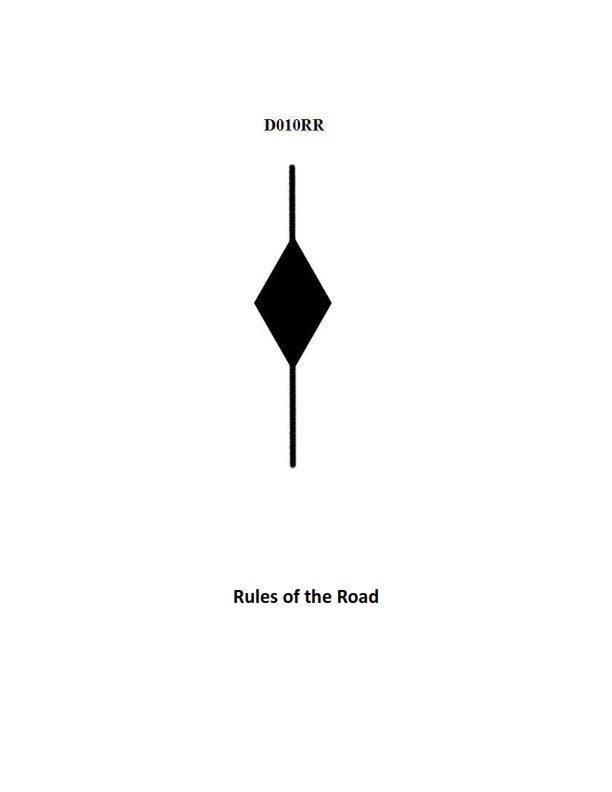
Question: BOTH INTERNATIONAL & INLAND A vessel displaying the shape shown in illustration D010RR below is which of the following?
A. Is at anchor
B. Is not under command
C. Has a tow that exceeds 200 meters in length
D. Has a tow that is carrying hazardous cargo
The Correct Answer is C **Explanation for Option C (Correct Answer):** The illustration D010RR depicts a vessel displaying a specific arrangement of shapes: a **diamond shape** positioned vertically above a **diamond shape**. (Note: While the typical arrangement for this rule is a diamond shape suspended where lights are required, sometimes illustrations simplify the display to just the two vertical diamonds). According to the International Regulations for Preventing Collisions at Sea (COLREGS), Rule 24 (Towing and Pushing), a vessel engaged in towing, when the length of the tow exceeds 200 meters, must display: * **Day signal:** A **diamond shape** where it can best be seen. Furthermore, Rule 24 also requires the towing vessel to display a **diamond shape** (the same signal) at the position where the tow is located (typically on the tow itself). However, the question asks what the **vessel displaying the shape shown** (the towing vessel) is doing. The display of a **single diamond shape** is the mandatory day signal for a vessel whose tow exceeds 200 meters in length. Therefore, the vessel displaying this shape has a tow that exceeds 200 meters in length. **Explanation of Incorrect Options:** **A) Is at anchor:** A vessel at anchor displays a **black ball** (for vessels less than 100 meters) or two black balls (for vessels 100 meters or more) during the day. A diamond shape is not the proper signal for anchoring. **B) Is not under command:** A vessel not under command (NUC) displays **two black balls** in a vertical line during the day. A diamond shape is not the proper signal for NUC. **D) Has a tow that is carrying hazardous cargo:** There is no specific international COLREGS day signal (shape) designated solely for a vessel towing hazardous cargo. Hazardous cargo marking is usually managed through flags (like Flag B for dangerous goods) or vessel documentation, not through a standardized COLREGS day shape signal like the diamond. The diamond shape specifically relates to the *length* of the tow, regardless of the cargo.
Question 32
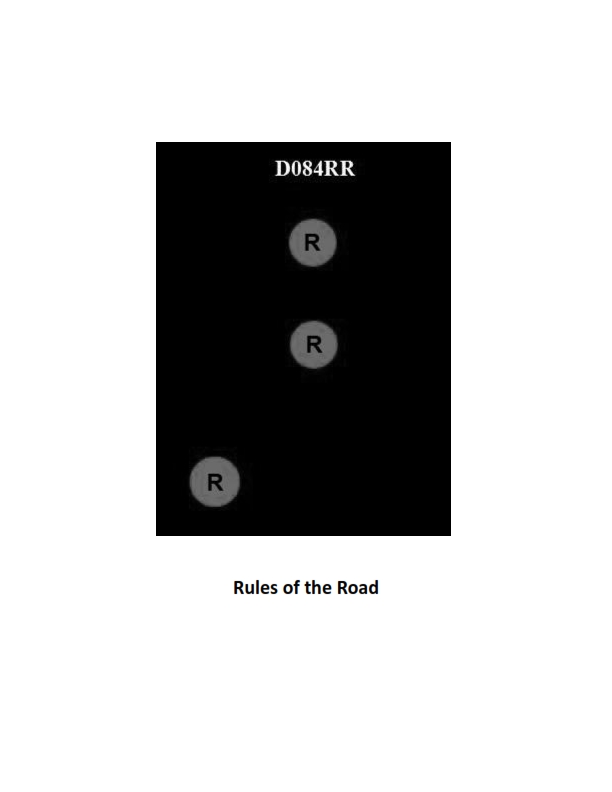
Question: BOTH INTERNATIONAL & INLAND Which of the following describes a vessel exhibiting the lights shown in illustration D084RR below?
A. not under command
B. showing improper lights
C. dredging
D. towing
The Correct Answer is A. ### Explanation for Option A (Correct Answer: not under command) **Option A (not under command)** is correct because the illustration D084RR depicts a vessel showing **two all-round red lights displayed vertically.** According to the International Regulations for Preventing Collisions at Sea (COLREGs) Rule 27(b) and the Inland Rules equivalent: * A vessel **not under command (NUC)**, which through some exceptional circumstance is unable to maneuver as required by the Rules, is required to exhibit **two all-round red lights in a vertical line** where they can best be seen. Therefore, the lights shown clearly identify the vessel as being Not Under Command. *** ### Explanation of Incorrect Options **Option B (showing improper lights):** This is incorrect. The vessel is displaying the internationally recognized and regulated lights for a vessel Not Under Command (two vertical all-round red lights). These are proper and required lights for this specific situation. **Option C (dredging):** This is incorrect. A vessel engaged in dredging (or underwater operations) is typically classified as a vessel **restricted in her ability to maneuver (RAM)**. While a RAM vessel shows two vertical all-round lights (Red, White, Red), a vessel actually engaged in dredging operations (when obstructing a channel) must also show two vertical all-round red lights (obstruction side) and two vertical all-round green lights (passing side), in addition to the masthead/sidelights/sternlight if underway. The illustration only shows two vertical all-round red lights, which specifically denotes NUC, not the complex arrangement required for dredging/RAM. **Option D (towing):** This is incorrect. A power-driven vessel engaged in towing exhibits different lights. It shows two (or sometimes three) **masthead lights in a vertical line** (depending on the length of the tow), in addition to sidelights and a sternlight. It also shows a towing light (a yellow light above the sternlight). It does **not** show two vertical all-round red lights.
Question 34
Question: BOTH INTERNATIONAL & INLAND Which is TRUE of a tugboat displaying the shape shown in illustration D010RR below?
A. Has a tow that exceeds 200 meters in length
B. Has a tow that is carrying hazardous cargo
C. Is at anchor
D. Is not under command
The Correct Answer is A. **Explanation for A (Correct Option):** The shape shown in illustration D010RR is a diamond shape, or a black diamond (one vertical diamond shape). According to the Convention on the International Regulations for Preventing Collisions at Sea (COLREGs), Rule 24 (Towing and Pushing), a vessel engaged in towing and the vessel being towed, when the length of the tow (measured from the stern of the towing vessel to the after end of the towed vessel) exceeds 200 meters, must display a diamond shape where it can best be seen. This signal is required under both International and Inland Rules. **Explanation for B (Incorrect Option):** The shape displayed (a diamond) signifies the length of the tow. Carrying hazardous cargo does not require the display of this specific day shape under COLREGs. Vessels carrying dangerous goods have specific marking requirements (like placards or signals indicating explosives, etc.), but not the diamond shape. **Explanation for C (Incorrect Option):** A vessel that is at anchor must display a black ball shape (or two black balls if exceeding 50 meters in length) during the day. The diamond shape is exclusively reserved for towing operations where the tow exceeds 200 meters. **Explanation for D (Incorrect Option):** A vessel that is Not Under Command (NUC) must display two black balls, one above the other, during the day. The diamond shape is not used to signify a vessel that is not under command.
Question 44
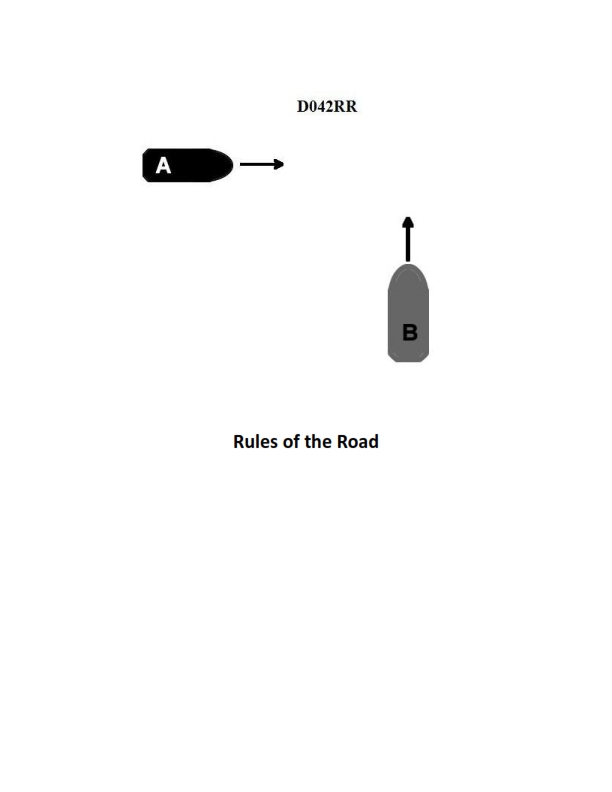
Question: BOTH INTERNATIONAL & INLAND Two power-driven vessels are crossing as shown in illustration D042RR below. Vessel "A" sounds three short blasts on the whistle. What is the meaning of this signal?
A. Vessel "A" intends to hold course and speed
B. Vessel "A" is sounding a signal of doubt
C. Vessel "A" proposes to cross ahead of the other vessel
D. Vessel "A" is backing engines
The Correct Answer is D. **Why Option D ("Vessel "A" is backing engines") is correct:** The signals described in the International Regulations for Preventing Collisions at Sea (COLREGs) and Inland Rules are standardized. Rule 34(a) governs maneuvering and warning signals. Specifically, **three short blasts** (one prolonged followed by two short is the international 'power-driven vessel leaving the berth' signal, but here we focus on the maneuvering meaning) delivered in quick succession signifies that the power-driven vessel is operating astern propulsion. In other words, the vessel is backing up or using its engines to significantly reduce forward speed or move astern. Therefore, Vessel "A" is backing engines. **Why the other options are incorrect:** * **A) Vessel "A" intends to hold course and speed:** There is no whistle signal defined in the rules solely to indicate the intention to hold course and speed. Maintaining course and speed is the responsibility of the stand-on vessel, but it is not communicated via three short blasts. * **B) Vessel "A" is sounding a signal of doubt:** A signal of doubt or disagreement (the danger signal) consists of **at least five short and rapid blasts**. Three short blasts do not convey doubt. * **C) Vessel "A" proposes to cross ahead of the other vessel:** Signals indicating intent to maneuver relative to another vessel (passing or altering course) are typically one short blast (I intend to leave you on my port side/alter course to starboard) or two short blasts (I intend to leave you on my starboard side/alter course to port). Three short blasts specifically indicates using astern propulsion, not an intent to cross ahead.