Pass Your Coast Guard Licensing Exams!
Study offline, track your progress, and simulate real exams with the Coast Guard Exams app
GLI08 - Limited OUPV
12 images
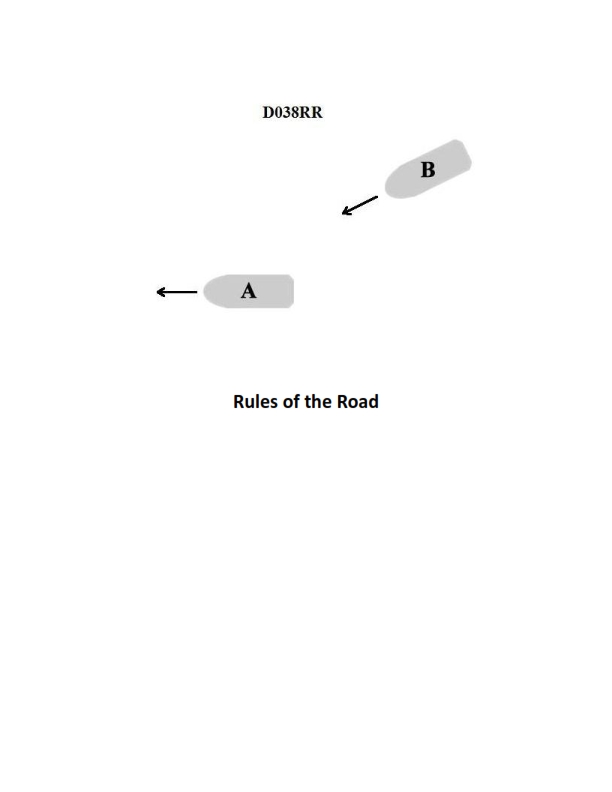
Question 3
Question: INLAND ONLY You are on power-driven vessel "A" and power-driven vessel "B" desires to overtake you on the starboard side as shown in illustration D038RR below. After the vessels have exchanged one blast signals what action should you take?
A. Slow your vessel until vessel "B" has passed
B. Hold course and speed
C. Alter course to the left or right to give vessel "B" more sea room
D. Alter course to the left
The Correct Answer is B **Explanation of Option B (Hold course and speed):** In an overtaking situation under the Inland Rules, the vessel being overtaken (Vessel A) is considered the stand-on vessel relative to the overtaking vessel (Vessel B) once agreement has been signaled. According to Inland Rule 17(a)(ii), the stand-on vessel (in this case, Vessel A) must **maintain her course and speed**. This predictability is crucial for the safety of the maneuver, allowing the overtaking vessel (Vessel B) to calculate the time and distance needed to safely pass. Since the vessels have already exchanged signals, confirming the maneuver, Vessel A's primary duty is to hold steady. *** **Explanation of Incorrect Options:** **A) Slow your vessel until vessel "B" has passed:** The vessel being overtaken must maintain speed. Slowing down (reducing speed) or stopping is generally prohibited because it creates confusion and alters the dynamics of the overtake, potentially putting Vessel B into a dangerous situation that they did not anticipate when signaling their maneuver. **C) Alter course to the left or right to give vessel "B" more sea room:** The rules specifically require the stand-on vessel (Vessel A) to maintain course. Altering course, whether to the left or right, introduces the risk of collision by moving Vessel A unpredictably or steering it directly into the path of the overtaking vessel (Vessel B). **D) Alter course to the left:** This is a specific violation of the rule requiring the maintenance of course. Additionally, if Vessel B is overtaking on the starboard side (right side), Vessel A altering course to the left (port) could swing its stern toward Vessel B or restrict the navigable space, greatly increasing the risk of contact.
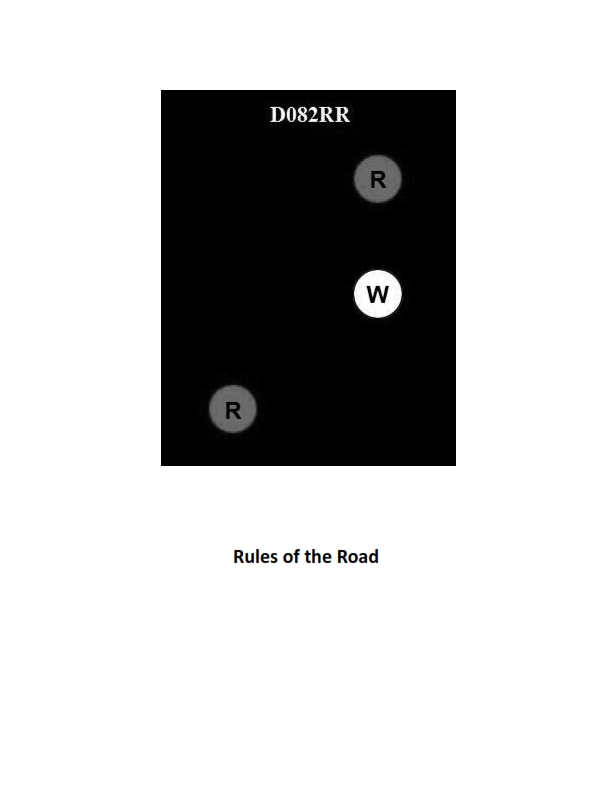
Question 7
Question: BOTH INTERNATIONAL & INLAND A vessel is exhibiting the lights shown in illustration D082RR below. Which can you conclude about the vessel?
A. it is a pilot boat on duty
B. it is a fishing vessel
C. it is a sailing vessel
D. it is a trawling vessel
The Correct Answer is B *** ### Explanation for Option B (it is a fishing vessel) Option B is correct because the light configuration described (implied by the illustration linked to this question, which depicts an all-round green light vertically above an all-round white light) is the specific signal required for a vessel engaged in fishing under the International Regulations for Preventing Collisions at Sea (COLREGs), Rule 26. * **Rule 26 (Fishing Vessels):** A vessel engaged in fishing shall exhibit two all-round lights in a vertical line, the upper being green and the lower white. This combination (Green over White) positively identifies the vessel as one currently engaged in fishing operations. *** ### Explanations for Incorrect Options **A) it is a pilot boat on duty** A vessel engaged in pilotage duty (Rule 29) must display an all-round **white** light vertically above an all-round **red** light ("White over Red, Pilot Ahead"). This differs from the green over white signal shown. **C) it is a sailing vessel** A sailing vessel (Rule 25) shows only sidelights and a stern light. Optionally, it may display two all-round lights in a vertical line, the upper being **red** and the lower being **green** ("Red over Green, Sailing Machine"). This is not the green over white signal. **D) it is a trawling vessel** Trawling is a specific *method* of fishing. While a trawler *is* a fishing vessel, the light signal (Green over White) is the standard signal required for **any** vessel engaged in fishing, regardless of the gear used (trawl, nets, lines, etc.). Therefore, the broadest and most accurate conclusion drawn directly from the lights is that the vessel is a "fishing vessel" (Option B).
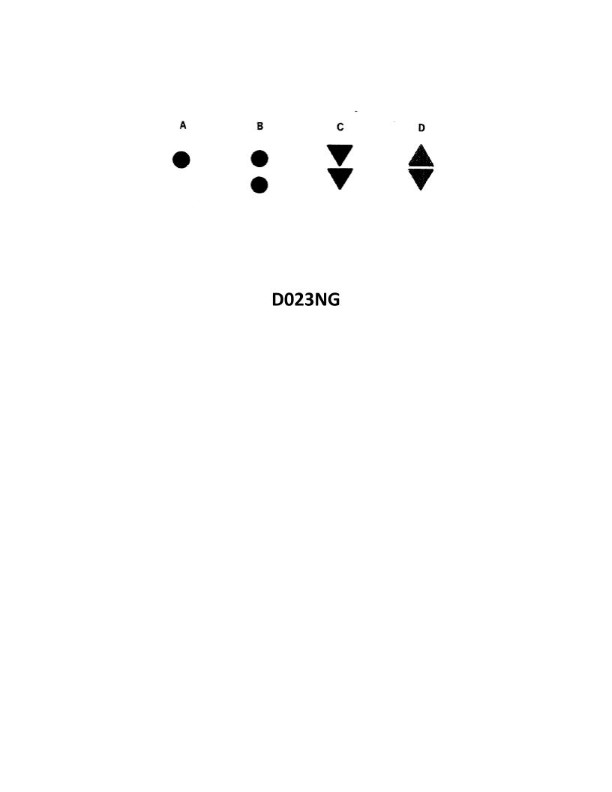
Question 18
Question: Which topmark shown in illustration D023NG below identifies an isolated danger?
A. A
B. B
C. C
D. D
The Correct Answer is B **Explanation for Option B (Correct):** Option B identifies the topmark for an **Isolated Danger Mark**. The defining characteristic of the topmark for an Isolated Danger Mark is **two black spheres, one above the other**. These marks are used to indicate an isolated hazard (like a small wreck or a rock) that has navigable water all around it. **Explanation for Other Options (Incorrect):** * **Option A (Incorrect):** Option A shows a single black sphere. This topmark identifies a **Safe Water Mark** (or Mid-Channel Mark), which indicates that navigable water exists all around the mark (often positioned in the center of a wide channel or fairway). * **Option C (Incorrect):** Option C shows two black cones, points meeting at the center (hourglass shape). This configuration identifies a **Cardinal Mark** indicating the **West Quadrant** (West Cardinal Mark). Cardinal Marks indicate the direction of the safest water relative to the mark. * **Option D (Incorrect):** Option D shows a single red cylinder. This topmark, usually paired with a can-shaped buoy, identifies a **Lateral Mark** indicating the **port (left) side** of a channel when entering from seaward in Region B (the Americas, Japan, Philippines, etc.).
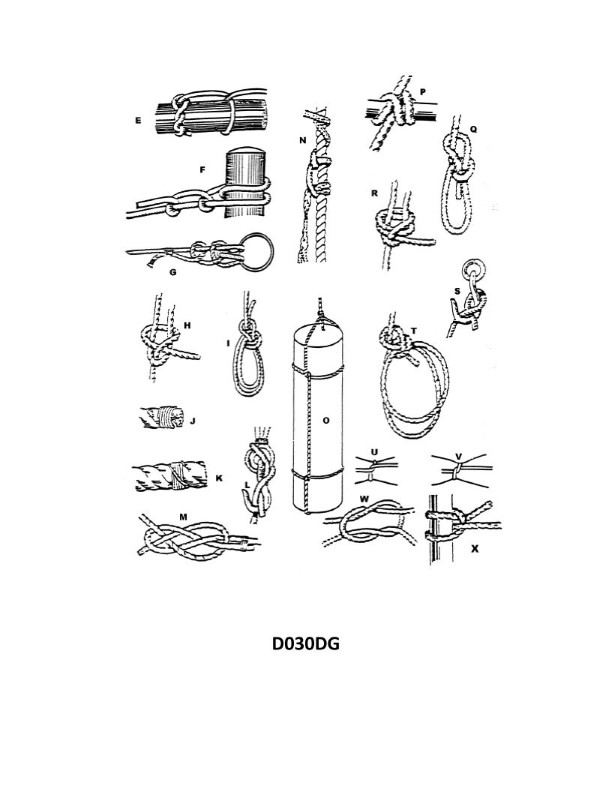
Question 22
Question: What type of knot in illustration D030DG below is indicated by the Letter "Q"?
A. Square knot
B. Bowline
C. Clove hitch
D. Round knot
The Correct Answer is B **Explanation for Option B (Bowline):** The knot indicated by the letter "Q" in the illustration D030DG is a Bowline. The Bowline is a classic, essential loop knot famous for forming a non-slip loop at the end of a line. The illustration clearly shows the characteristic structure of a properly tied Bowline: a loop (the "rabbit hole") through which the working end (the "rabbit") passes, wraps around the standing line (the "tree"), and tucks back down through the original loop. This structure—a fixed loop secured by the tucked working end—unmistakably identifies it as a Bowline. **Explanation of Why Other Options are Incorrect:** * **A) Square knot:** A Square knot (Reef knot) is used to join two lines of equal diameter. It is a symmetrical binding knot, not a loop knot. The structure shown in "Q" is an end-of-line loop, which is not characteristic of a Square knot. * **C) Clove hitch:** A Clove hitch is a temporary hitch used primarily to secure a line around an object (like a pole or stake). It is defined by two half hitches applied around the object. The structure shown at "Q" is a single, permanent loop in the line, not a hitch tied around a spar or object. * **D) Round knot:** "Round knot" is not a standard, recognized name for an established, distinct type of fundamental knot in most common knotting nomenclature (unlike the Square knot, Bowline, or Clove hitch). Therefore, it is incorrect as a specific identifier.
Question 24
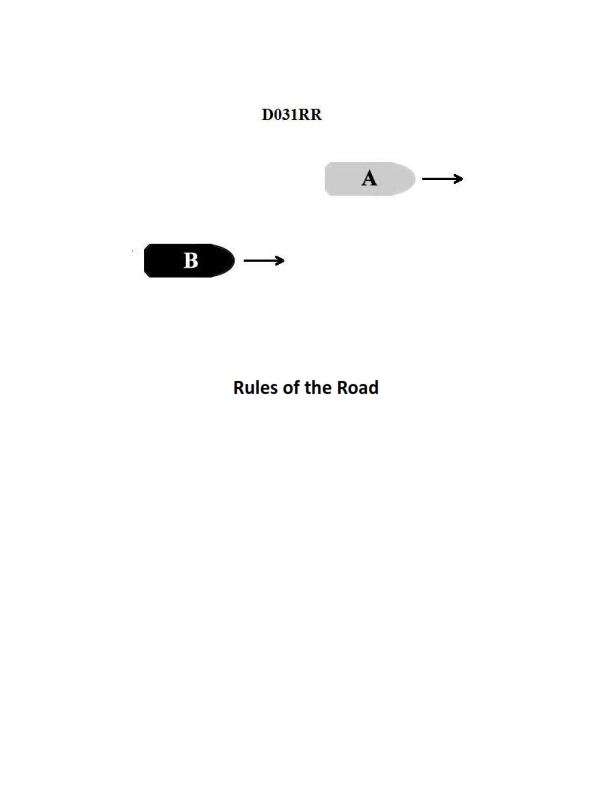
Question: INLAND ONLY You are on vessel "A", and vessel "B" desires to overtake you on your starboard side as shown in illustration D031RR below. After the vessels have exchanged one blast signals what action should you take?
A. Hold course and speed
B. Alter course to the left to give vessel "B" more sea room
C. Slow your vessel until vessel "B" has passed
D. Alter course to the right to give vessel "B" more sea room
The Correct Answer is A **Explanation for Option A (Hold course and speed):** Vessel "A" is the vessel being overtaken (the burdened vessel) and vessel "B" is the vessel intending to overtake (the give-way vessel). Under the Inland Navigation Rules, specifically Rule 13 (Overtaking) and Rule 17 (Action by Stand-on Vessel), the vessel being overtaken must **maintain her course and speed** until the other vessel is finally past and clear. When vessel "B" signals one short blast, it means "I intend to overtake you on your starboard side." Vessel "A" must answer with one short blast, confirming the maneuver is safe and indicating assent, and then hold course and speed to allow the overtaking to proceed safely. **Why the other options are incorrect:** * **B) Alter course to the left to give vessel "B" more sea room:** This is incorrect. The vessel being overtaken must maintain course and speed. Altering course (especially towards the passing vessel's intended path, which would be an alteration to the left if B is passing to starboard) creates unpredictability and danger, potentially hindering the safe completion of the maneuver. * **C) Slow your vessel until vessel "B" has passed:** This is incorrect. The vessel being overtaken must maintain her speed. Slowing down could complicate the overtaking calculation for vessel "B" and violates the requirement to hold course and speed. * **D) Alter course to the right to give vessel "B" more sea room:** This is incorrect. While this action seems helpful, the primary responsibility of the vessel being overtaken is to be predictable. Altering course violates the requirement to maintain course and speed, which is crucial for the safe execution of the overtaking maneuver by vessel "B".
Question 35
Question: Which knot in illustration D030DG below represents a bowline?
A. G
B. H
C. L
D. Q
The Correct Answer is D **Explanation for Option D ("Q"):** The knot labeled **Q** in the illustration represents a **bowline**. A bowline is fundamentally a single-loop knot that forms a stable, non-slipping loop at the end of a line. The illustration clearly shows the distinctive characteristics of a finished bowline: 1. It forms a secure loop (the 'eye'). 2. The working end (the tail) passes around the standing part and is tucked under itself, completing the structure often remembered by the mnemonic "the rabbit comes out of the hole, goes around the tree, and back down the hole." **Explanation for Incorrect Options:** * **A) G:** Knot **G** is a **sheet bend** (or becket bend). It is used primarily for joining two ropes, especially ropes of unequal diameter. It is not a loop knot like the bowline. * **B) H:** Knot **H** is a **clove hitch**. This knot is used to fasten a line to an object (like a pole or spar) and relies on tension to stay secure. It is not an end-of-line loop knot. * **C) L:** Knot **L** is a **figure-eight knot** (or figure-eight stopper knot). Its main purpose is to create a large, secure stopper at the end of a rope to prevent it from passing through a hole or block. While it is tied at the end of a line, it does not form a loop like a bowline; it functions as a bulky stopper.
Question 36
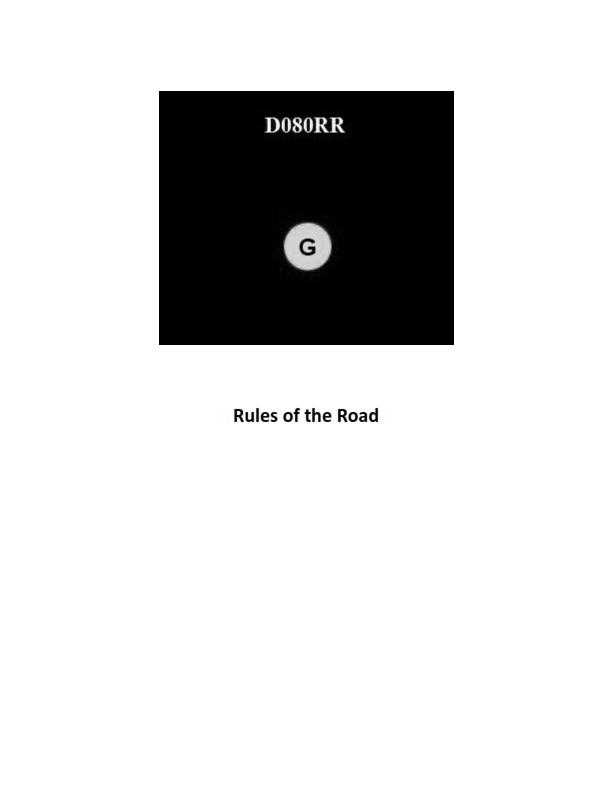
Question: BOTH INTERNATIONAL & INLAND You see ONLY the light shown in illustration D080RR below. This could be what type of vessel?
A. towing
B. not under command
C. engaged in fishing
D. under oars
The Correct Answer is D **Why option D ("under oars") is correct:** Illustration D080RR shows a single white light. According to the COLREGs (International Regulations for Preventing Collisions at Sea), a vessel under oars may exhibit the lights prescribed for a sailing vessel, but if she does not, she must have ready at hand an electric torch or lighted lantern showing a white light which shall be exhibited in sufficient time to prevent collision (Rule 25(d)). The single white light shown is consistent with the required/alternative lighting for a small vessel under oars (or under 7 meters in length). **Why the other options are incorrect:** * **A) towing:** A power-driven vessel towing would display specific masthead lights (two or three, depending on the tow length) in a vertical line, sidelights, and a stern light. It would also display a towing light (yellow light) above the stern light. The single white light shown is insufficient for a towing vessel. * **B) not under command (NUC):** A vessel not under command exhibits two all-round red lights in a vertical line where they can best be seen, and when making way through the water, also sidelights and a stern light. The single white light shown is not the correct signal for an NUC vessel. * **C) engaged in fishing:** A vessel engaged in fishing displays two all-round lights in a vertical line (the upper one green, the lower one white). When making way, it also displays sidelights and a stern light. The single white light shown is not the correct signal for a fishing vessel.
Question 41
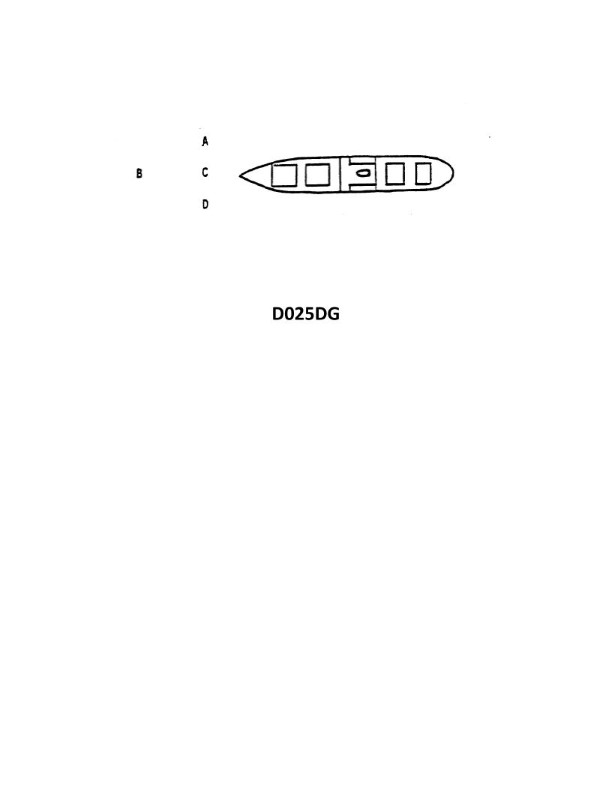
Question: The vessel shown in illustration D025DG has broken down and you are going to take her in tow. The wind is coming from her starboard beam. You are making more leeway than she. Where should you position your vessel when you start running lines?
A. A
B. B
C. C
D. D
The Correct Answer is A. **Explanation for A (Correct Option):** When taking a disabled vessel in tow, especially when both vessels are experiencing significant leeway due to wind (known as "sailing"), it is crucial to position the towing vessel in a location that minimizes the relative movement and risk of collision, while making the line handling safe and efficient. 1. **Leeway Consideration:** The question states that the wind is on the disabled vessel's starboard beam (pushing her to port) and that **you are making more leeway than she is.** This means your vessel (the tug/towing vessel) is drifting faster to port than the disabled vessel. 2. **Relative Position for Approach:** To compensate for your greater leeway, you must start upwind/upside of the disabled vessel (relative to the direction of drift). If you position yourself at position A (slightly upwind and ahead of the disabled vessel), your greater leeway will cause you to drift down slowly onto the disabled vessel. This controlled drift (setting down) allows you to maintain control and reduces the need for excessive maneuvering when the vessels are close, making it easier to heave the lines across safely. Position A is the standard starting point in beam wind/sea conditions where the towing vessel anticipates a faster rate of drift. **Explanation for Incorrect Options:** * **B) B:** Position B is directly downwind (or down-drift) of the disabled vessel. Since you are drifting faster than she is, positioning yourself here would mean you would need to use power continuously to push upwind/up-drift, fighting the forces. If your engine failed or you lost control momentarily, you would immediately be pushed into the disabled vessel, increasing the risk of collision significantly. * **C) C:** Position C is slightly downwind/astern of the disabled vessel. While safer than position B in terms of immediate collision risk, positioning yourself downwind means you would need to push forward and upwind to close the distance. Since the wind is pushing both vessels away from this position, you would have to overcome the disabled vessel's momentum and the effects of the wind. This makes line handling harder and less controlled than a controlled drift downwind from position A. * **D) D:** Position D is directly astern (behind) the disabled vessel. This position is generally used for pushing maneuvers or when preparing to pull directly ahead in calm conditions. In a beam wind condition, the wind and leeway would be pushing both vessels sideways. Position D does not allow for a safe and controlled approach for running lines, as you would still need to maneuver sideways or wait for the wind to push the disabled vessel away from your approach path.
Question 42
Question: The vessel shown in illustration D025DG has broken down and you are going to take her in tow. The wind is on her starboard beam. She is making more leeway than you. Where should you position your vessel when you start running lines?
A. A
B. B
C. C
D. D
The Correct Answer is D ### Why Option D is Correct In this scenario, the wind is on the starboard beam (coming from the starboard side, pushing both vessels to port). The critical factor is that the disabled vessel (casualty) is making **more leeway** (drifting sideways) than the towing vessel (tug). 1. **Leeway Direction:** Both vessels are drifting to port (the leeward side). 2. **Relative Movement:** Because the casualty is drifting faster than the tug, if the tug positions directly alongside the casualty on the leeward side (C), the casualty will quickly drift away from the tug, making line handling impossible. 3. **Positioning Strategy:** The safest and most effective position to initiate running lines when the casualty has excessive leeway is to position the tug slightly **ahead** of the casualty and on the **leeward side** (downwind side). Position D allows the tug to maintain station while the casualty’s greater rate of drift brings its forward section (the ideal location for receiving the line) towards the tug. This controls the closing distance and avoids the risk of the casualty drifting onto the tug. ### Why the Other Options are Incorrect * **A) A (Upwind/Starboard Abeam):** This is the most dangerous position. Since the wind is pushing the casualty to port, if the tug is positioned on the starboard (upwind) side, the casualty will drift directly onto the tug, resulting in a severe collision. * **B) B (Upwind/Starboard Bow):** Similar to A, this position is upwind. The wind and the casualty’s drift will force the disabled vessel onto the tug, increasing the risk of collision and entanglement. * **C) C (Downwind/Port Abeam):** This position is safe from collision, as it is on the leeward side. However, because the casualty is making *more* leeway, it will drift away from the tug faster than the tug can move sideways to compensate, making line passing extremely difficult or impossible.
Question 45
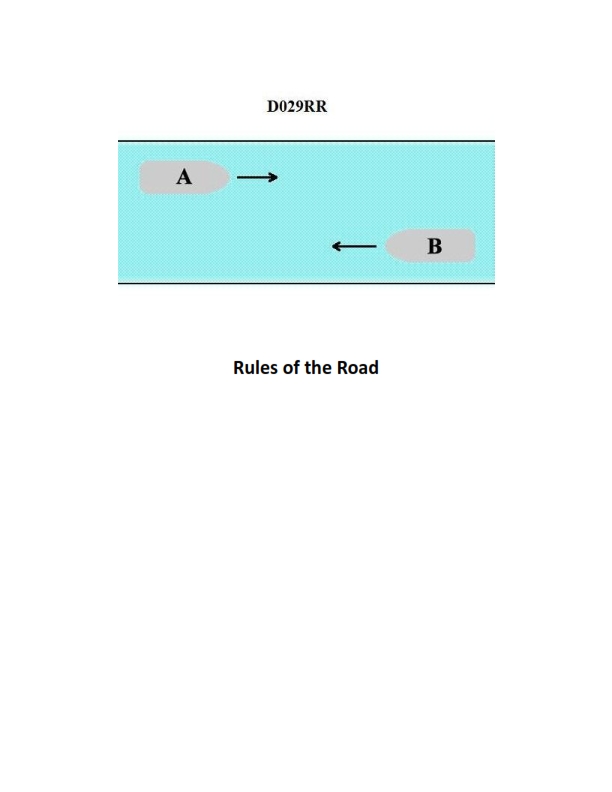
Question: INLAND ONLY Vessels "A" and "B" are meeting on a river as shown in illustration D029RR below and will pass about 1/4 mile apart. Which statement is TRUE?
A. Both vessels should continue on course and pass without sounding any whistle signals.
B. The vessels should exchange two blast whistle signals and pass port-to-port.
C. The vessels should exchange two blast whistle signals and pass starboard to starboard.
D. The vessels should pass port-to-port and must sound whistle signals only if either vessel changes course.
The Correct Answer is C ### Explanation for Option C (Correct) Option C states: "The vessels should exchange two blast whistle signals and pass starboard to starboard." This is correct under the Inland Navigation Rules, which govern vessel movements on U.S. rivers. 1. **Whistle Signals of Intent (Inland Rule 34):** Inland Rules require meeting vessels to signal their intent to pass. Unlike International Rules (COLREGs), which use signals to indicate action taken, Inland Rules use signals to indicate the **intended side of passing**. 2. **Two Blasts Mean Starboard-to-Starboard:** A signal of two short blasts indicates, "I intend to leave you on my starboard side." This is the signal for a starboard-to-starboard passing arrangement. 3. **Agreement is Required:** Since the vessels are meeting and require a defined method of passing (even though they are 1/4 mile apart), they must agree upon the maneuver by exchanging the appropriate signals (two blasts each, in this case), confirming the starboard-to-starboard pass. The scenario described by illustration D029RR must depict a situation where a starboard-to-starboard passing is the safest or most practical option (e.g., due to channel position, current, or a bend in the river). ### Explanation of Incorrect Options **A) Both vessels should continue on course and pass without sounding any whistle signals.** This is incorrect under Inland Rules. In a meeting situation where risk of collision exists (or where agreement is required for defining the passing arrangement), vessels must signal their intent to pass (Rule 34(a)(i)). Even with 1/4 mile separation, they must confirm the manner of passing. **B) The vessels should exchange two blast whistle signals and pass port-to-port.** This is incorrect because the signal does not match the maneuver. Two short blasts signal the intent to pass starboard-to-starboard (I intend to leave you on my starboard side). A port-to-port pass requires an exchange of **one** short blast. **D) The vessels should pass port-to-port and must sound whistle signals only if either vessel changes course.** This is incorrect. While port-to-port is the default preferred arrangement (Rule 14), Inland Rules require the signal of intent *before* the maneuver is fully established or agreed upon. If they were to pass port-to-port, they would be required to exchange one blast. Furthermore, the correct answer (C) confirms that in this specific scenario, the agreement reached is for a starboard-to-starboard pass, not the default port-to-port.
Question 46
Question: Which knot in illustration D030DG below represents a single becket bend?
A. E
B. F
C. G
D. H
The Correct Answer is D. ### Explanation for D (H) The knot labeled **H** in illustration D030DG represents a **single becket bend** (also widely known as a **sheet bend**). * **Structure:** A becket bend is used to join two ropes, typically of different diameters. The thicker or stiffer rope forms a bight (a U-shaped loop). The thinner rope (the working end) passes through this bight, wraps around the standing parts of the bight, and is tucked under its own standing part. * **Identification:** Knot H perfectly exhibits the characteristic structure of the sheet bend/single becket bend, making it the correct representation. *** ### Explanation of Why Other Options Are Incorrect **A) E (Incorrect)** Knot **E** represents a **reef knot** (or square knot). This knot is used to tie two ends of rope together, but it is notorious for slipping, especially when joining ropes of unequal size or when load is applied cyclically. It is not a becket bend. **B) F (Incorrect)** Knot **F** represents a **figure-eight bend**. This knot is used to join two ropes by tying a figure-eight knot in one rope and then following the path of the first rope with the second rope's end (a double fisherman's structure using the figure-eight path). It is not a becket bend. **C) G (Incorrect)** Knot **G** represents a **double becket bend** (or double sheet bend). This is a more secure version of the single becket bend (H), where the thinner rope wraps twice around the bight of the thicker rope instead of just once. Because it shows two full wraps, it is a *double* becket bend, not the requested *single* becket bend.
Question 47
Question: INLAND ONLY Vessels "A" and "B" are meeting on a river as shown in illustration D029RR below and will pass 1/4 mile apart. Which statement is TRUE?
A. If a passing agreement is reached by radiotelephone whistle signals are optional.
B. The vessels should exchange two blast whistle signals and pass port-to-port.
C. The vessels should pass port-to-port and must sound whistle signals only if either vessel changes course.
D. Whistle signals must be exchanged in all situations when passing within one half mile.
The Correct Answer is A **Explanation for Option A (Correct):** Option A states: "If a passing agreement is reached by radiotelephone whistle signals are optional." This statement is true under the Inland Rules of Navigation (33 CFR Subchapter E). Rule 34(h) of the Inland Rules (Maneuvering and Warning Signals) explicitly addresses the use of radiotelephone for passing agreements: > "When vessels are in sight of one another and a passing agreement has been effected between them by radiotelephone, **whistle signals are optional** but may be sounded to indicate the intention of the vessels as agreed to." Since the vessels are meeting on an inland river and are passing within sight and are only 1/4 mile apart, a radiotelephone agreement makes the traditional maneuvering whistle signals optional. **Explanation of Incorrect Options:** **B) The vessels should exchange two blast whistle signals and pass port-to-port.** This is incorrect. A two-blast signal indicates a starboard-to-starboard (passing on the other's starboard side) maneuver under the Inland Rules (Rule 34(a)(i)). If they were passing port-to-port, they would exchange one-blast signals. Furthermore, if they pass 1/4 mile apart, they are already safely clear, and whistle signals (while traditionally required if no radio agreement exists) would depend on the specific agreed-upon maneuver, not necessarily a two-blast signal for a port-to-port pass. **C) The vessels should pass port-to-port and must sound whistle signals only if either vessel changes course.** This is incorrect. Under Inland Rule 34(a)(i), when vessels are meeting or crossing within half a mile of each other, they **must** indicate their intention by whistle signals. The whistle signals are mandatory to propose the maneuver (one blast for port-to-port, two blasts for starboard-to-starboard), not just to signal a course change after the maneuver is agreed upon. (This requirement is waived only if a radio agreement is made, as stated in Option A). **D) Whistle signals must be exchanged in all situations when passing within one half mile.** This is incorrect. While Inland Rule 34(a)(i) requires whistle signals when vessels are within half a mile and are meeting or crossing, this requirement is explicitly negated if a passing agreement is reached by radiotelephone (Rule 34(h)), making the signals optional.