Pass Your Coast Guard Licensing Exams!
Study offline, track your progress, and simulate real exams with the Coast Guard Exams app
AB01 - Able Seafarer
11 images
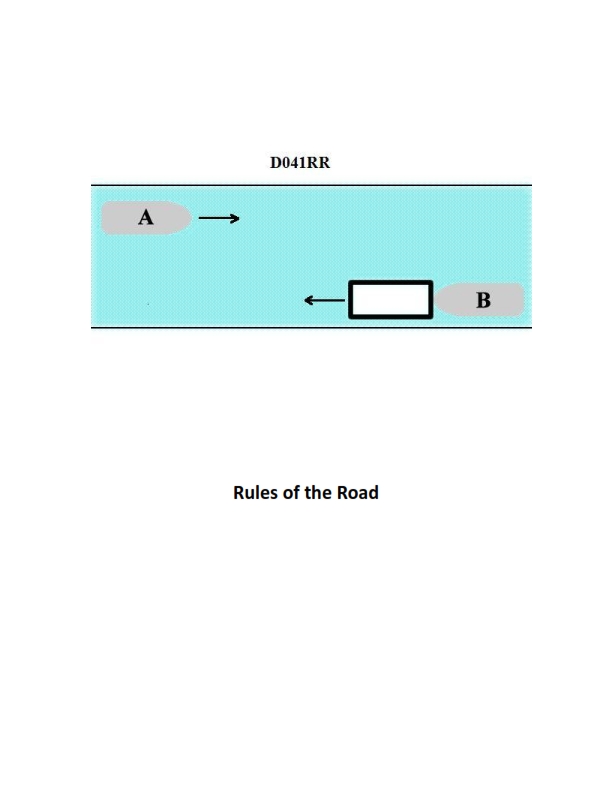
Question 2
Question: INLAND ONLY Vessels "A" and "B" are meeting on a river as shown in illustration D041RR below and will pass 1/4 mile apart. Which is one of the lights on vessel "B" that you will see if you are on vessel "A"?
A. red sidelight
B. yellow towing light
C. special flashing light
D. All of the above
The Correct Answer is C ### Explanation for C (special flashing light) Option C is correct because this question describes a scenario common under the U.S. Inland Navigation Rules (33 CFR 84.23(d)). The "special flashing light" is a yellow light flashing at 50 to 70 times per minute, visible over an arc of 225 degrees forward. This light is **required to be shown at the head (bow) of a vessel or vessels being pushed ahead** when operating on U.S. Inland Waters. If Vessel B is an inland towing vessel (tug) pushing a barge ahead, the front end of that barge must exhibit the special flashing light. Since Vessel A is meeting Vessel B head-on (or nearly head-on, passing 1/4 mile apart), the special flashing light on the head of the tow is one of the primary lights Vessel A will see, identifying the presence and forward extent of the tow. ### Explanation for Why Other Options Are Incorrect **A) red sidelight** While Vessel B will display a red sidelight (port side) and a green sidelight (starboard side), the question asks for *one* of the lights you will see. If Vessel A is approaching Vessel B, the vessel may initially see both sidelights and the masthead lights. However, the special flashing light is the unique and specific identifying light for this type of Inland pushing operation, making it the most distinctive required answer in this context. Furthermore, depending on the passing agreement (e.g., port-to-port), only the green sidelight might be clearly visible. **B) yellow towing light** The yellow towing light (also known as the stern light when shown above the white stern light) is visible only from the stern (135 degrees). Since Vessel A and Vessel B are **meeting** (approaching each other), Vessel A is viewing Vessel B's forward aspect. Therefore, Vessel A cannot see the yellow towing light. **D) All of the above** Since option B (yellow towing light) is incorrect, this option cannot be correct.
Question 12
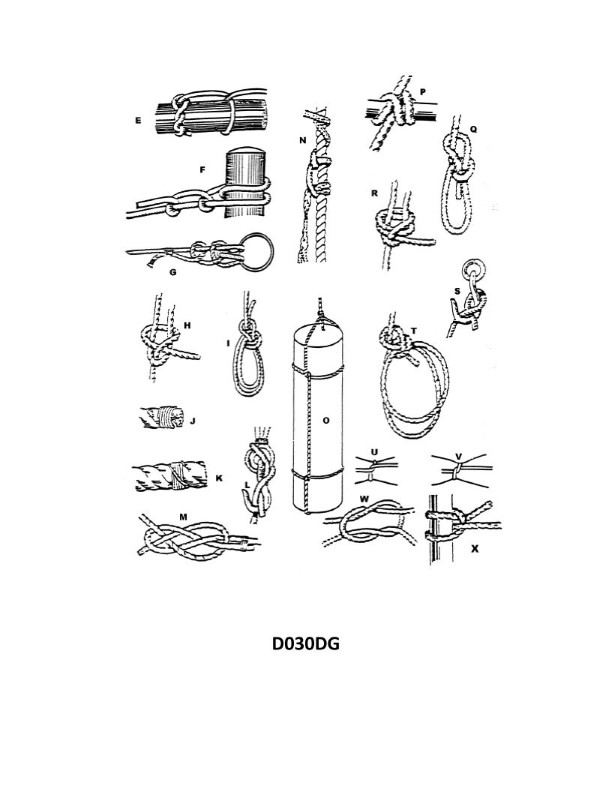
Question: What type of knot in illustration D030DG below is indicated by the Letter "E"?
A. Bowline on a bight
B. Timber and half hitch
C. Stopper hitch
D. Blackwall hitch
The Correct Answer is B. **Explanation for Option B (Timber and half hitch):** The knot indicated by the letter "E" (which, based on the provided answer, must illustrate a specific knot often used for hoisting or securing logs/poles) is the **Timber and half hitch**. This compound knot consists of two parts: 1. A **Timber Hitch** (a specific form of slipping knot created by wrapping the working end around the standing part and then weaving it back three times or more around its own standing part). The Timber Hitch provides the secure hold and prevents the load from slipping. 2. A **Half Hitch** (a simple turn and tuck) located further up the standing part. The Half Hitch acts as a check or stabilizing point, controlling the direction and preventing the timber from swinging uncontrollably or rotating during lifting. This combination is standard practice for moving cylindrical objects like logs or pipes, and the structure described by the name matches the configuration typically associated with "E" in instructional diagrams of basic utility knots. **Why the other options are incorrect:** * **A) Bowline on a bight:** This knot creates two fixed loops (bights) without a running end. It is used primarily for rescue or safety harnessing and does not feature the specific wrapping and stabilizing components characteristic of a timber hitch used for hoisting a single object. * **C) Stopper hitch:** A stopper hitch (or stopper knot) is used to prevent a rope from running through a block or opening (like a figure-eight knot or a simple overhand knot at the end of a line). While it is a type of hitch, it is a single-purpose terminal knot, not the compound hauling knot shown. * **D) Blackwall hitch:** The Blackwall hitch is a temporary hitch used to secure a line to a hook, relying solely on friction and the tension of the load. It consists of only one or two turns around the shank of the hook and lacks the complex wraps of the timber hitch or the stabilizing half hitch component.
Question 18
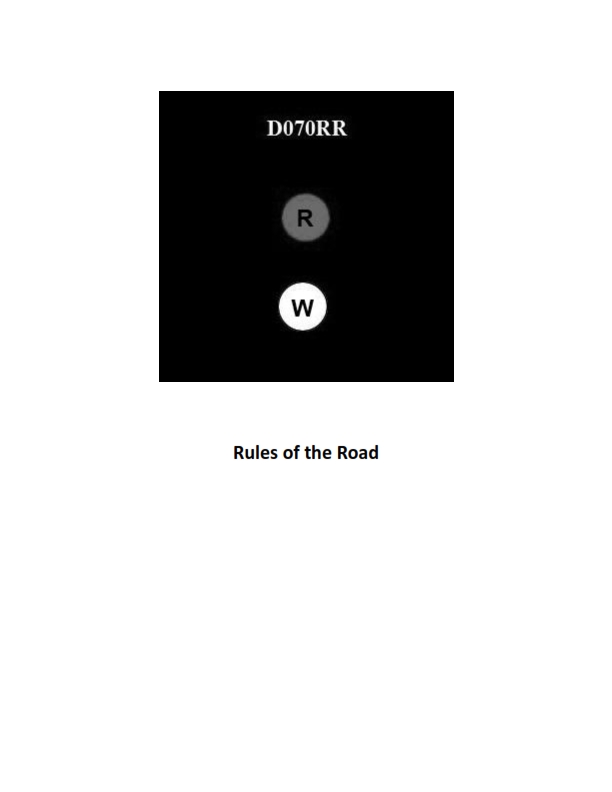
Question: BOTH INTERNATIONAL & INLAND Which type of vessel is required to display the lights shown in illustration D070RR below?
A. sailboat
B. fishing vessel
C. pilot boat
D. motorboat
The Correct Answer is B. **Why option B ("fishing vessel") is correct:** The illustration D070RR depicts a vessel displaying a masthead light (white), sidelights (red and green), and a specific combination of vertical lights: an upper light that is green over a lower light that is white. This combination—green over white—is the internationally and inland recognized signal for a vessel engaged in **trawling**. A trawling vessel is a specific type of **fishing vessel**. When a vessel is engaged in fishing, it must display the lights appropriate for that operation, regardless of whether it is an under-12m motorboat or a large trawler. Therefore, the lights shown specifically identify a vessel that is fishing (specifically trawling). **Why each of the other options is incorrect:** * **A) sailboat:** A sailboat (when under sail and not using propulsion) typically displays only sidelights and a stern light, or combined lantern. It does not display the green-over-white fishing lights. * **C) pilot boat:** A pilot boat displays two vertical lights (white over red) when engaged in pilot duties, which signifies "Pilot required on board." It does not display the green-over-white fishing lights. * **D) motorboat:** A standard motorboat (power-driven vessel) displays a masthead light, sidelights, and a stern light. While a motorboat could be a fishing vessel, the term "motorboat" alone is too general. A motorboat that is *not* engaged in fishing would not display the green-over-white operational lights. The lights shown specifically indicate the operational status of "fishing/trawling," not just "power-driven."
Question 27
Question: What type of knot in illustration D030DG below is indicated by the Letter "Q"?
A. Clove hitch
B. Round knot
C. Bowline
D. Square knot
**The Correct Answer is C** ### Why Option C ("Bowline") is correct: The Bowline (often pronounced "Boh-lin") is one of the most fundamental and useful knots. It is specifically designed to form a reliable, secure, non-slipping loop at the end of a line (the working end). The visual indicated by "Q" (assuming it depicts the classic loop formed by the working end going up through the small loop, around the standing part, and back down) unmistakably identifies this essential loop-forming knot. ### Why the other options are incorrect: **A) Clove hitch:** A Clove hitch is used to attach a line to a cylindrical object (a post or spar) quickly. It consists of two half hitches and is designed to grip a pole, not form a secure, fixed loop in the middle of a line. **B) Round knot:** "Round knot" is not a standard or recognized term for a functional knot in seamanship or climbing. Standard knots have specific names (like Sheet Bend, Figure Eight, or Bowline) that describe their structure and function. **D) Square knot:** Also known as a Reef knot, the Square knot is used to tie two ends of the same or similar diameter rope together. It forms a flat binding that connects two lines and does not create a secure loop at the end of a single line.
Question 38
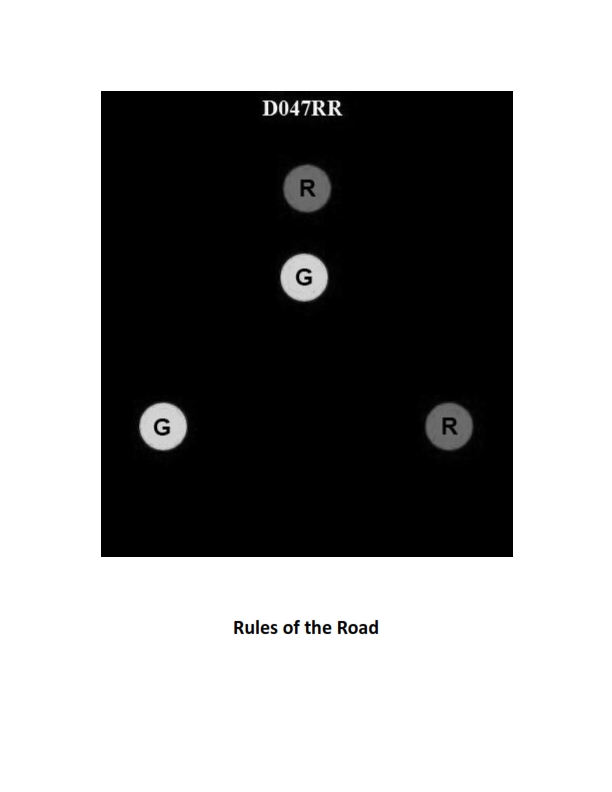
Question: BOTH INTERNATIONAL & INLAND You are underway at night and you sight the lights shown in illustration D047RR below. You know these lights indicate which of the following?
A. dredge at work
B. trawler dragging nets
C. fishing vessel engaged in fishing
D. sailing vessel
The Correct Answer is D **Explanation for D (sailing vessel):** The illustration D047RR (which typically shows a masthead light, a green sidelight, and a red sidelight) depicts the lights of a vessel seen head-on or nearly head-on at night. According to the International Regulations for Preventing Collisions at Sea (COLREGs) Rule 23 (Power-driven vessels underway) and Rule 25 (Sailing vessels underway): * A vessel showing only a **red sidelight** (port) and a **green sidelight** (starboard) is a vessel whose primary means of propulsion is sail (a sailing vessel). * If the vessel is under sail and is also under power, it must exhibit the lights of a power-driven vessel, plus the black cone (day signal) or the inverted cone (night signal). However, the lights shown (just red and green sidelights) distinctly represent a vessel propelled by sail alone. * **If a sailing vessel is over 20 meters in length**, it is also required to show separate red and green sidelights and a sternlight. * **If a sailing vessel is under 20 meters in length**, it may combine these lights in one lantern at or near the top of the mast (a tri-color lantern), but when viewed from dead ahead, the sidelights are still the predominant visual cue for identification. Therefore, seeing only the sidelights from a vessel underway indicates a sailing vessel. **Explanation of Incorrect Options:** * **A) dredge at work:** A vessel restricted in its ability to maneuver (like a dredge) would display vertical lights (red-white-red) to indicate its restricted status, and if dredging, it would show specific lights (two vertical green lights indicating the passable side, and two vertical red lights indicating the obstructed side). The lights shown do not match this pattern. * **B) trawler dragging nets:** A vessel engaged in trawling displays two vertical lights: a green light above a white light. It must also show sidelights and a sternlight. The illustration shows only the sidelights, not the required vertical green over white lights. * **C) fishing vessel engaged in fishing:** A vessel engaged in fishing (other than trawling) displays two vertical lights: a red light over a white light. It must also show sidelights and a sternlight. The illustration shows only the sidelights, not the required vertical red over white lights.
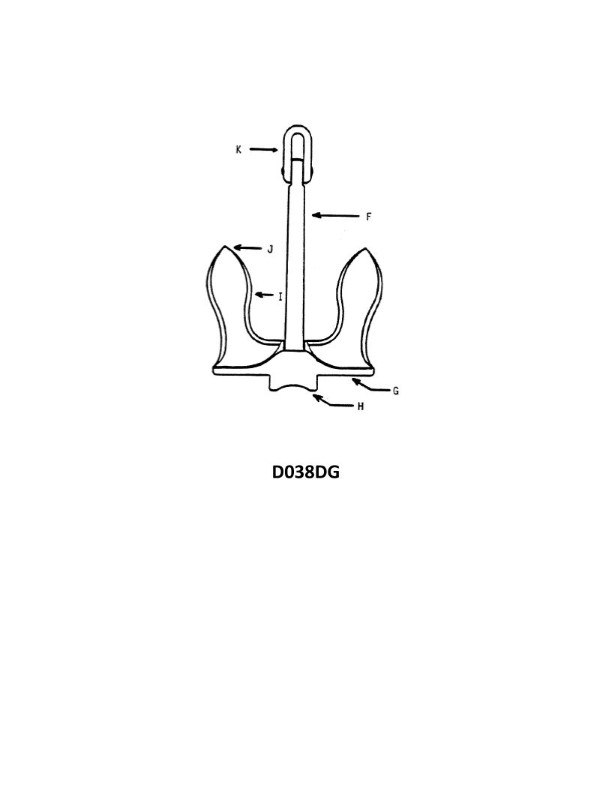
Question 38
Question: In illustration D038DG below, which letter indicates the tripping palm?
A. F
B. G
C. H
D. J
The Correct Answer is B **Explanation for Option B (G) being correct:** The tripping palm is the component (often a hinged or pivoting arm) designed to directly engage with and move the trip mechanism when a force or signal is applied (e.g., when an electromagnet is energized due to an overcurrent). In the provided illustration, the component labeled 'G' is clearly positioned and structured to act as this intermediary arm, which would rotate or move to strike the trip lever (H) when activated by the armature/plunger (F) of the electromagnet. Therefore, 'G' indicates the tripping palm. **Explanation for the other options being incorrect:** * **A) F:** F indicates the armature or plunger of the solenoid/electromagnet. This component moves when the coil is energized but does not directly constitute the "tripping palm." It acts upon the tripping palm (G). * **C) H:** H indicates the main trip lever or latch mechanism. This is the component that holds the breaker contacts closed and is struck by the tripping palm (G) to release the mechanism, but H itself is the trip lever, not the tripping palm. * **D) J:** J indicates the adjustment screw or setting for the instantaneous trip mechanism. This component is used to calibrate the force or distance required to activate the trip mechanism but is not the tripping palm itself.
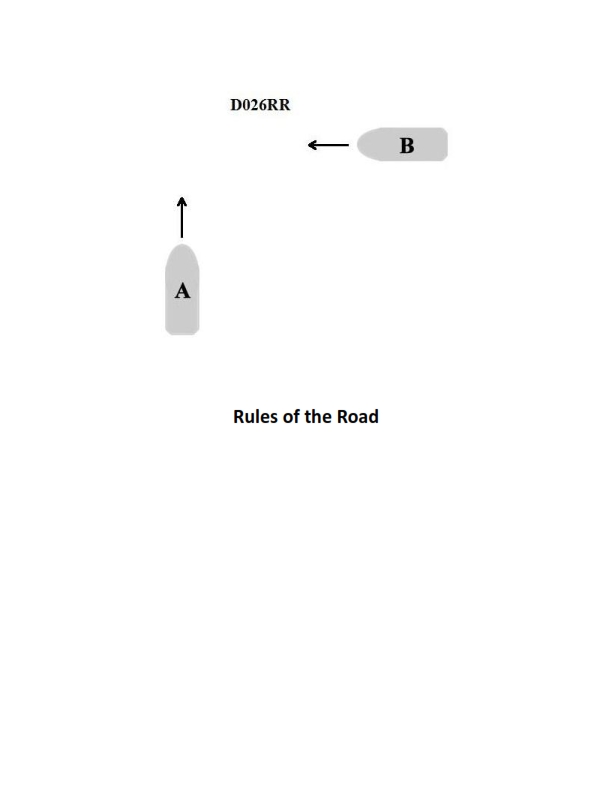
Question 39
Question: BOTH INTERNATIONAL & INLAND Vessels "A" and "B" are power-driven vessels and crossing as shown in illustration D026RR below. Which statement is TRUE?
A. Vessel "B" should alter course to the right.
B. Vessel "A" must keep clear of vessel "B".
C. Vessel "B" should pass under the stern of vessel "A".
D. The vessels should pass starboard to starboard.
The Correct Answer is B **Explanation of Correct Option (B):** The scenario described is a crossing situation between two power-driven vessels (Vessel A and Vessel B). According to the International Regulations for Preventing Collisions at Sea (COLREGS), Rule 15 (Crossing Situation), when two power-driven vessels are crossing so as to involve risk of collision, the vessel which has the other vessel on her own starboard side shall keep out of the way. In illustration D026RR (which depicts a standard crossing situation where A is approaching B's port bow and B is approaching A's starboard bow), **Vessel A has Vessel B on its own starboard side.** Therefore, Vessel A is the give-way vessel and **must keep clear** of Vessel B, the stand-on vessel. **Explanation of Incorrect Options:** * **A) Vessel "B" should alter course to the right.** Vessel B is the stand-on vessel (the vessel on Vessel A's port side). According to Rule 17 (Action by Stand-on Vessel), the stand-on vessel must maintain its course and speed. While Vessel B may take action if collision cannot be avoided by Vessel A's actions alone, its primary requirement is to hold course and speed, not to initiate an alteration to the right (which is the required action for the give-way vessel, Vessel A). * **C) Vessel "B" should pass under the stern of vessel "A".** Since Vessel A is the give-way vessel, Vessel A is required to take substantial action early and clearly to keep clear of Vessel B. Vessel A may choose to pass under the stern of B, but Vessel B (the stand-on vessel) does not have the obligation to initiate a maneuver to pass under the stern of A. Furthermore, passing under the stern of the give-way vessel is often considered poor seamanship for a stand-on vessel unless an emergency requires it. * **D) The vessels should pass starboard to starboard.** Rule 15 requires Vessel A to keep clear. The action generally required of the give-way vessel (A) in a crossing situation is to turn to starboard (right) to pass astern of the stand-on vessel (B), resulting in a **port-to-port** passage. Only when circumstances make the required starboard turn ineffective or dangerous might an alternative maneuver be considered, but starboard-to-starboard is not the standard or preferred action in a crossing situation.
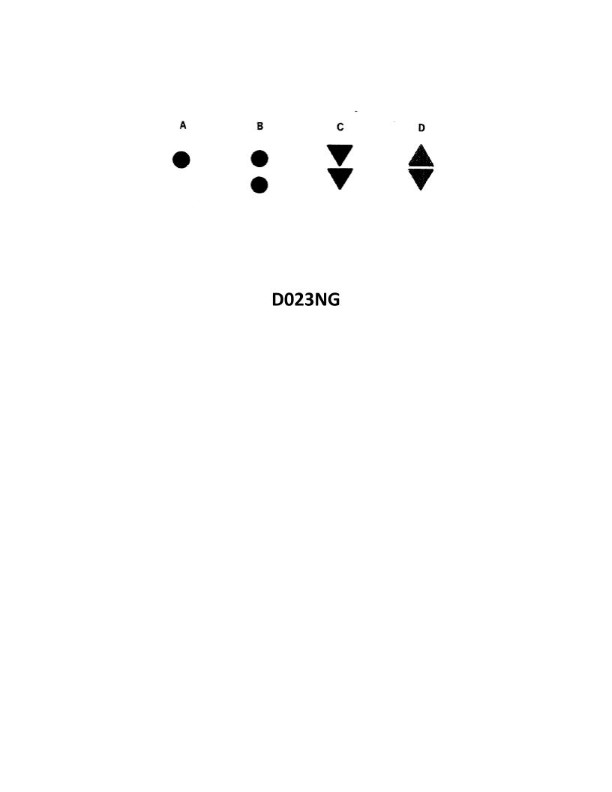
Question 40
Question: Which topmark shown in illustration D023NG below identifies an isolated danger?
A. A
B. B
C. C
D. D
The Correct Answer is B. **Explanation for B (Correct Answer):** Option B depicts a topmark of two black spheres, one above the other. According to the International Association of Marine Aids to Navigation and Lighthouse Authorities (IALA) maritime buoyage system (specifically System A and B, which share the same isolated danger mark), this topmark identifies an **Isolated Danger Mark**. An isolated danger is a small area, such as a wreck or a rock, which has navigable water all around it but is too deep or far from the main channel to be marked by a lateral buoy. The mark is typically black with one or more red horizontal bands. **Explanation for Incorrect Options:** * **A:** Option A shows a topmark of two black cones, points meeting at the center (a 'diamond' shape). This identifies an **East Cardinal Mark**, indicating that the navigable water is to the east of the mark. * **C:** Option C shows a topmark of two black cones, points downward. This identifies a **South Cardinal Mark**, indicating that the navigable water is to the south of the mark. * **D:** Option D shows a topmark of a single red sphere. This identifies a **Safe Water Mark** (or Mid-channel Mark), indicating that the surrounding water is navigable and the mark should generally be passed close aboard (it does not denote a specific danger).
Question 41
Question: What type of knot in illustration D030DG below is indicated by the Letter "G"?
A. Barrel hitch
B. Round turn and two half hitches
C. Timber hitch
D. Fisherman's bend
The Correct Answer is D **Explanation for Option D (Fisherman's bend):** The illustration D030DG (specifically the knot marked "G") shows a method of joining two lines or attaching a line to a ring or spar using a series of turns and securing it with two half hitches. A Fisherman's bend (also commonly called an Anchor bend) is specifically used for attaching a rope or cable to an anchor ring or shackle. It is constructed by taking two turns around the object (the ring), followed by a half hitch around the standing part and through the two turns, and then securing the tail with a second half hitch around the standing part. The knot shown at "G" accurately depicts this structure, characterized by the two initial turns around the ring providing friction, making it extremely secure and resistant to chafing, which is critical for anchor lines. **Explanation for Why Other Options are Incorrect:** * **A) Barrel hitch:** A Barrel hitch is a sling-type knot used for hoisting cylindrical or oddly shaped objects (like a barrel). It involves encircling the object with the rope and often crossing the lines over the top, which is structurally completely different from the attachment knot shown at "G". * **B) Round turn and two half hitches:** While the Fisherman's bend *includes* two half hitches and utilizes turns, a standard "round turn and two half hitches" typically uses only one turn around the object before the half hitches are applied. The Fisherman's bend is distinguished by the two initial turns and the fact that the first half hitch passes under the first turn, making it a more secure variant. * **C) Timber hitch:** A Timber hitch is a temporary knot used for dragging or lifting logs or cylindrical objects. It is characterized by several wraps (or twists) of the working end around its own standing part, forming a secure loop at the end of the log. It does not involve attachment to a ring or shackle in the manner shown in the illustration.
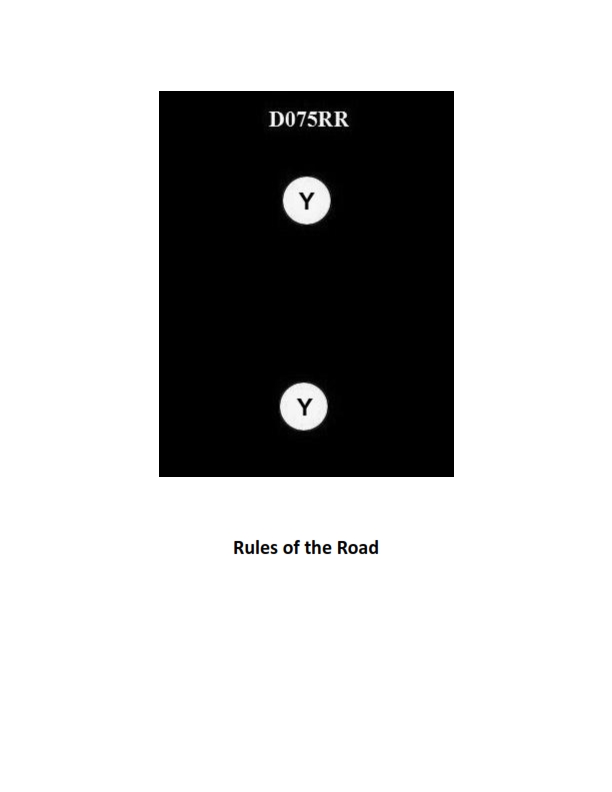
Question 43
Question: INLAND ONLY At night, you see the lights shown in illustration D075RR below. These lights are shown by what type of vessel?
A. barge being towed astern
B. barge being pushed ahead
C. tug pushing a barge ahead
D. tug towing a barge astern
The Correct Answer is C 1. **Why option C ("tug pushing a barge ahead") is correct:** The illustration D075RR shows three specific white lights arranged in a vertical line on the vessel on the right (the pushing vessel, or tug), and two vertical red lights on the vessel on the left (the pushed vessel, or barge). * **Tug pushing ahead:** According to Inland Rules (Rule 24(c)), a power-driven vessel pushing ahead or towing alongside displays masthead lights appropriate to its length and, in addition, **two white lights in a vertical line** at the stern. However, Rule 24(e) specifies that when a pushing vessel and a vessel being pushed ahead are rigidly connected (forming a composite unit), they are regarded as a single power-driven vessel and must display lights appropriate for that length. The illustrated scenario, showing the three vertical white lights, is the key indicator for a pushing operation. * **Identifying the three white lights:** On the Western Rivers or waterways outside the demarcation line specified in Annex V, a power-driven vessel pushing ahead or towing alongside must display **three white lights in a vertical line** at the forward part of the vessel (Rule 24(g)). These three white lights identify the vessel as a towboat involved in pushing ahead (or towing alongside). * **Identifying the two vertical red lights:** The vessel being pushed ahead (the barge) must show sidelights and **two red lights in a vertical line** at its forward end (Rule 24(f)). * Since the illustration shows the combination of three vertical white lights (on the pushing vessel) and two vertical red lights (on the pushed vessel), this combination specifically identifies a **tug pushing a barge ahead** in Inland Waters. 2. **Why the other options are incorrect:** * **A) barge being towed astern:** A vessel being towed astern (barge) would only display sidelights and a sternlight, and potentially special white or yellow lights if obscured by the towing vessel. It would not display two vertical red lights. The towing vessel (tug) would display two or three vertical white masthead lights (depending on the length of the tow) and a towing light (yellow) above the sternlight (white), but it would not show three vertical white lights forward and the two red lights on the towed vessel. * **B) barge being pushed ahead:** This option describes the vessel on the left (the barge), but the question asks what **type of vessel** is showing *these lights* (implying the entire configuration shown, which includes the tug). The lights shown are characteristic of the entire **operation** (tug and barge), not just the barge alone. More importantly, the most distinct identifying feature in the illustration is the presence of the tug's three vertical white lights, defining the operation as a push tow. * **D) tug towing a barge astern:** Similar to Option A, a tug towing astern displays two or three vertical white masthead lights and a towing light (yellow) above the sternlight (white). It does not display the three vertical white lights shown in the forward part of the tug, nor would the towed barge display two vertical red lights.
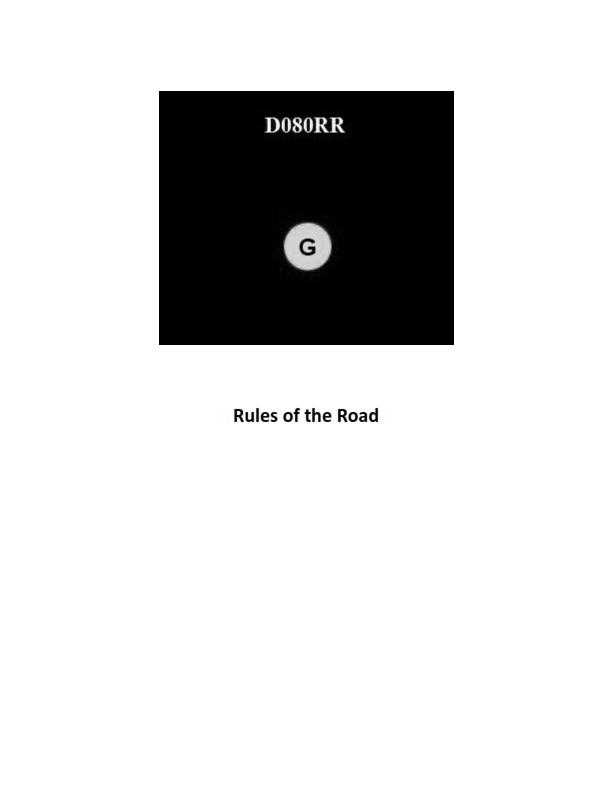
Question 44
Question: BOTH INTERNATIONAL & INLAND You see ONLY the light shown in illustration D080RR below. Which type of vessel are you observing?
A. vessel engaged in fishing
B. vessel on pilotage duty
C. law enforcement vessel
D. sailing vessel
The Correct Answer is D **Explanation for D (sailing vessel) being correct:** The illustration D080RR (which is implied to show only the lights visible from a specific angle) depicts a single masthead light visible. If the question states that *only* the light shown is visible, and we assume this light is a white light displayed high on the vessel, this corresponds to the sternlight configuration of a sailing vessel when viewed from directly astern. According to COLREGs Rule 25 (Sailing Vessels Underway and Vessels Under Oars): * A sailing vessel must show sidelights and a sternlight. * However, if the sailing vessel is less than 20 meters in length, these lights may be combined in a single lantern carried at or near the top of the mast where it can best be seen. If a vessel is showing *only* a single white light visible at a high level, and no sidelights are visible (which would be the case when viewed from directly ahead or astern, depending on the combination arrangement), the single white light visible high up is characteristic of the optional combined lantern used by small sailing vessels, or potentially the stern light of a larger sailing vessel viewed from directly astern. Since sailing vessels are often characterized by a single white light (sternlight or all-around light from the combined lantern) when viewed from certain angles where sidelights are obscured, and none of the other options fits this minimal lighting scheme, a sailing vessel is the most appropriate identification. *(Note: While a strict stern view would show only a single white sternlight, if the vessel is less than 7 meters, it might only show an all-around white light. However, among the choices provided, the single visible light is best associated with the sternlight/combined light configuration of a sailing vessel.)* **Why the other options are incorrect:** * **A) vessel engaged in fishing:** A vessel engaged in fishing (trawling or non-trawling) is required to show specific vertical lights (green over white or red over white) and possibly a masthead light, sidelights, and a sternlight, depending on the type of fishing and the vessel's length. A single white light is insufficient and incorrect for a fishing vessel. * **B) vessel on pilotage duty:** A vessel on pilotage duty is required to show specific vertical lights (white over red) at the masthead, along with sidelights and a sternlight. A single white light is incorrect for a pilot vessel. * **C) law enforcement vessel:** While there is no specific mandated COLREG lighting configuration for general "law enforcement" status, a vessel generally must adhere to standard navigational lights (masthead, sidelights, sternlight). If it is a vessel of special nature, it might show specific emergency or operational lights, but a single white light high up does not define a standard law enforcement vessel.